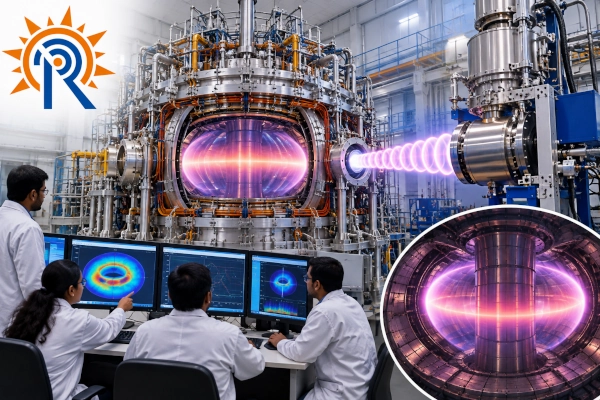
India has strengthened one of the critical technologies required for controlled nuclear fusion research with the integration of an 82.6 GHz high-power gyrotron heating system with the SST-1 superconducting tokamak at the Institute for Plasma Research in Gandhinagar, Gujarat.
The Institute for Plasma Research, an aided institute of the Department of Atomic Energy, confirms that the 82.6 GHz Electron Cyclotron Resonance Heating system can deliver up to 400 kilowatts of radio-frequency power for pulses lasting up to 0.5 seconds. The system has been integrated with SST-1 for experiments involving plasma formation and heating.
The development may sound highly specialised, but it addresses one of the fundamental problems facing fusion research: scientists must first create an extremely hot plasma, keep it confined and then supply sufficient energy to heat and control it. The gyrotron provides part of that heating capability by generating powerful microwave radiation that transfers energy directly to electrons inside the plasma.
Understanding why this matters requires first understanding what fusion, plasma and a tokamak actually are.
What Is Nuclear Fusion?
Nuclear fusion is the physical process that powers the Sun and other stars.
Atoms contain a central nucleus surrounded by electrons. In a fusion reaction, the nuclei of two light elements are brought sufficiently close together that they combine, or fuse, to form a heavier nucleus. A small amount of mass is converted into energy during the process.
For laboratory fusion research, the reaction considered most practical involves two isotopes of hydrogen called deuterium and tritium. When their nuclei fuse, they produce a helium nucleus, a neutron and a large amount of energy.
ITER-India explains that the positively charged nuclei naturally repel each other. They therefore have to possess enormous kinetic energy before they can approach closely enough for fusion to occur. This means heating the fuel to temperatures considerably hotter than the centre of the Sun.
In future fusion power plants, the objective would be to capture the energy released during these reactions as heat and eventually use it to produce electricity.
Researchers have not yet reached the stage where commercial tokamak fusion power stations can routinely generate electricity. Machines such as SST-1 are experimental facilities intended to solve the scientific and engineering problems that must first be overcome.
What Is Plasma?
Ordinary matter is familiar to us mainly in three forms: solid, liquid and gas. Plasma is commonly described as the fourth state of matter.
If a gas is heated sufficiently, atoms begin losing their electrons. Instead of remaining a collection of electrically neutral atoms, the material becomes a mixture of free electrons and positively charged ions. This ionised state is called plasma.
The Institute for Plasma Research explains that because the particles in a plasma carry electrical charges, they can be influenced and confined using magnetic fields. This property is fundamental to magnetic-confinement fusion.
Plasma is not unusual in nature. The Sun and other stars are composed predominantly of plasma, and natural phenomena such as lightning and auroras also involve plasma.
For fusion research, however, scientists need a very different kind of plasma: one heated to extraordinarily high temperatures and held under controlled conditions long enough for fusion reactions to become possible.
Why Can’t Such Hot Plasma Be Put Inside an Ordinary Container?
Fusion temperatures create an obvious engineering problem.
No ordinary material can simply hold plasma at temperatures of tens or hundreds of millions of degrees while remaining in direct contact with it. A conventional metal vessel would be unable to survive those conditions.
Scientists therefore try to prevent the hottest part of the plasma from touching the walls.
Because plasma consists of electrically charged particles, powerful magnetic fields can guide and confine those particles. This makes it possible to suspend the hot plasma inside a vacuum vessel while keeping most of it away from the surrounding structure.
One of the most successful machines developed for doing this is the tokamak.
What Is a Tokamak?
A tokamak is a magnetic-confinement machine designed to create, heat and control high-temperature plasma.
Its most recognisable feature is a doughnut-shaped, or toroidal, vacuum chamber. Powerful magnetic coils positioned around the chamber create magnetic fields that confine the charged plasma particles and help prevent them from striking the vessel walls.
The word tokamak originated from a Russian acronym referring to a toroidal chamber with magnetic coils.
Inside the machine, hydrogen gas is introduced into the vacuum vessel and converted into plasma. Magnetic fields then confine that plasma while several different heating systems increase its temperature.
IPR describes SST-1 as India’s first superconducting tokamak, developed specifically to advance magnetic-confinement fusion research and investigate long-duration plasma operation.
SST-1 uses superconducting toroidal and poloidal magnetic-field coils and incorporates several plasma-heating and current-drive technologies, including Electron Cyclotron Resonance Heating and Lower Hybrid Current Drive.
Why Is SST-1 Superconducting?
Producing the strong magnetic fields required by a tokamak consumes considerable electrical power.
Superconducting magnets provide an important solution because electrical resistance becomes extremely small when suitable materials are cooled to cryogenic temperatures. This allows very large electrical currents to circulate through magnetic coils much more efficiently.
SST-1 uses superconducting magnets cooled to extremely low temperatures. IPR developed the machine specifically to investigate technologies and plasma behaviour relevant to sustained or steady-state tokamak operation.
This is important for future fusion power because a practical power station cannot operate only through extremely short plasma pulses. Fusion researchers ultimately need machines capable of sustaining controlled plasma for much longer periods.
IPR began the SST-1 programme after India’s first indigenous tokamak, ADITYA. SST-1 achieved its first plasma on June 20, 2013, establishing India among the countries operating superconducting tokamak systems.
Heating the Plasma Is a Major Challenge
Magnetic confinement by itself is not enough to achieve fusion conditions.
The plasma must also be heated.
A tokamak initially creates plasma using electrical fields, but this form of heating becomes progressively less effective as plasma temperature increases. Additional heating systems are therefore needed.
Fusion machines employ several approaches. These include neutral-beam heating, radio-frequency heating and microwave heating.
SST-1 has been equipped with multiple external systems so that Indian researchers can investigate how different forms of heating and current drive interact with confined plasma.
One of these is Electron Cyclotron Resonance Heating, or ECRH.
What Is Electron Cyclotron Resonance Heating?
Electrons inside a tokamak do not simply travel randomly through the plasma. Because they are electrically charged and surrounded by a magnetic field, they spiral around the magnetic-field lines.
The frequency of this motion is known as the electron cyclotron frequency.
If electromagnetic radiation of the correct frequency is injected into the plasma, the microwave energy can resonate with this electron motion. The electrons absorb energy from the electromagnetic wave and become hotter.
IPR describes ECRH as a well-established auxiliary-heating method in which high-frequency microwave power generated by a gyrotron is injected into magnetised plasma. When the microwave frequency matches the electron cyclotron frequency or one of its harmonics, energy is efficiently transferred to the electrons.
In simple terms, the microwave beam is tuned so that it can efficiently transfer its energy to electrons already spiralling inside the magnetic field.
That makes it possible to heat selected regions of the plasma without placing a physical heating element inside the extraordinarily hot environment.
What Is a Gyrotron?
The machine generating these powerful microwaves is called a gyrotron.
A gyrotron is a specialised high-power microwave source designed to produce electromagnetic radiation at very high frequencies and power levels that ordinary microwave generators cannot easily achieve.
A typical household microwave oven operates at about 2.45 GHz and uses roughly one kilowatt or less of microwave power.
The SST-1 system operates at 82.6 GHz and is capable of producing up to 400 kW.
It is therefore operating at a frequency more than thirty times that of an ordinary microwave oven while generating microwave power hundreds of times greater.
The comparison is only useful for understanding scale. The technology, beam control, power supply and intended application of a fusion gyrotron are fundamentally different from those of a household microwave oven.
Why 82.6 GHz?
The frequency is not arbitrary.
The resonance frequency of electrons depends upon the strength of the tokamak’s magnetic field. A gyrotron therefore has to generate radiation at frequencies appropriate to the magnetic-field configuration in which experiments are being conducted.
IPR says the 82.6 GHz system is used on SST-1 for second-harmonic heating at a toroidal magnetic field of 1.5 tesla and fundamental-harmonic heating at 3 tesla.
A harmonic in this context refers to a multiple of the basic electron cyclotron frequency.
Having this capability allows researchers to perform heating experiments across different magnetic-field configurations without depending upon a single operating regime.
The New System Can Deliver 400 Kilowatts
IPR currently lists two advanced ECRH systems in its fusion programme.
The first operates at 42 GHz and can provide up to 500 kW for pulses lasting 0.5 seconds. It has been used with both SST-1 and the ADITYA-U tokamak.
The second operates at 82.6 GHz and delivers up to 400 kW for 0.5-second pulses. This system has now been integrated with SST-1.
The 42 GHz system has already played an important role in plasma breakdown, heating and current-drive experiments. The addition of the higher-frequency 82.6 GHz system expands the experimental conditions available to researchers.
What Does ‘Plasma Breakdown’ Mean?
Before a tokamak can heat plasma, it first has to create it.
Hydrogen gas introduced into the vacuum vessel initially consists mainly of electrically neutral atoms. Energy must be supplied to strip electrons away from those atoms and turn the gas into an ionised plasma.
This initial conversion is called plasma breakdown or ionisation.
Electron Cyclotron Resonance Heating can help initiate this process by energising electrons in the gas, which then collide with other atoms and cause further ionisation.
IPR says ECRH-assisted start-up is particularly important for SST-1 because the machine’s available loop voltage is only about 3.5 volts, which by itself is insufficient for reliable plasma breakdown and start-up under important operating conditions.
Microwave-assisted pre-ionisation therefore helps create the initial plasma before subsequent heating and current-drive systems take over.
From the Gyrotron to the Plasma
Producing a powerful microwave beam is only one part of the system.
The radiation must be transported from the gyrotron to the tokamak with minimal loss and then directed accurately into the plasma.
IPR’s ECRH systems use corrugated waveguides to carry microwave power. These are specially designed tubes capable of transporting high-frequency electromagnetic radiation while maintaining the required beam characteristics.
The system also includes mirrors and a launcher that direct the radiation into the vacuum vessel.
IPR has developed an advanced launcher with a high-precision steerable mirror capable of rapidly adjusting the microwave beam in both the poloidal and toroidal directions.
This ability to steer the beam is valuable because fusion researchers often want to deposit energy at particular locations inside the plasma rather than simply heating everything uniformly.
Superconducting Magnets Are Used Inside the Gyrotron System Too
The 82.6 GHz gyrotron system itself contains another layer of advanced engineering.
IPR says both of its major gyrotron sources use liquid-helium-cooled superconducting cryomagnets. These magnets create the intense and highly controlled magnetic fields required for gyrotron operation.
The high-voltage systems used to operate the gyrotrons have also become an area of indigenous development.
IPR says the ECRH systems are powered and controlled using domestically developed high-voltage power supplies. A 55 kV, 110 A Main High Voltage Power Supply is currently used for operation of the gyrotrons.
This means the achievement extends beyond operating a microwave tube. India has developed important supporting capabilities in high-voltage engineering, cryogenics, superconducting magnets, microwave transmission, beam steering and control systems.
The 82.6 GHz Programme Has a Longer History
It is important not to describe India’s work on 82.6 GHz heating as something that began only in 2026.
IPR has worked on an 82.6 GHz ECRH system for many years. An official IPR publication from 2014 described an earlier 82.6 GHz, 200 kW system intended for SST-1 experiments at magnetic fields of 1.5 and 3 tesla.
The current IPR configuration is listed at 400 kW, double the power of that earlier system.
The present significance therefore lies in the higher-power configuration, its successful commissioning and its integration with SST-1 rather than in the first appearance of the 82.6 GHz frequency in India’s fusion programme.
Does SST-1 Produce Fusion Electricity?
No.
SST-1 is an experimental fusion-research machine. It does not operate as a commercial fusion reactor and does not supply electricity to the grid.
Its purpose is to help researchers understand the behaviour of magnetically confined plasma and master technologies required for more advanced fusion systems.
IPR states that SST-1 was built to study plasma processes under steady-state conditions and has a design target for plasma operation far longer than the sub-second discharges achieved during its earlier experimental campaigns.
The distinction is important because the phrase “fusion reactor” can create the impression that India is already generating electricity through controlled fusion. That is not the case.
What India is building is the scientific and engineering foundation required before such reactors can eventually become practical.
How Is Fusion Different From Nuclear Fission?
Existing nuclear power plants use nuclear fission, not fusion.
In fission, a heavy atomic nucleus such as uranium is split into smaller nuclei, releasing energy.
Fusion works in the opposite direction. Two light nuclei are combined to form a heavier nucleus.
Both processes release nuclear energy, but they involve fundamentally different physical mechanisms and reactor technologies.
Fusion researchers are particularly interested in the deuterium-tritium reaction because deuterium can be obtained from water while tritium could eventually be bred from lithium inside a fusion power system.
The challenge is that bringing two positively charged nuclei close enough to fuse requires extreme temperatures and sufficiently effective confinement.
Why Fusion Research Is So Difficult
Producing plasma is relatively straightforward. Producing plasma hot enough, dense enough and stable enough for sustained fusion is extraordinarily difficult.
A successful fusion system must simultaneously satisfy several conditions. The plasma must reach extreme temperature. Enough fuel particles must be present for fusion collisions to occur. The plasma must remain confined for sufficient time. Instabilities must be controlled. Heat escaping from the plasma must be managed, and the surrounding reactor structures must withstand intense neutron bombardment.
This explains why fusion development depends on numerous specialised technologies rather than one single breakthrough.
Magnets, cryogenic plants, microwave sources, neutral beams, vacuum systems, plasma diagnostics, high-voltage equipment, advanced materials and sophisticated control systems all have to work together.
The gyrotron integrated with SST-1 addresses one part of this larger problem: reliably creating and heating the plasma.
SST-1 Is Part of India’s Wider Fusion Programme
India’s fusion research programme began decades ago and is centred primarily at the Institute for Plasma Research.
India’s first indigenous tokamak, ADITYA, entered operation in 1989. It was later upgraded to ADITYA-U.
SST-1 represented a much larger technological step because it introduced superconducting magnet systems and was specifically designed for research connected with longer-duration plasma operation.
The Department of Atomic Energy says India’s fusion programme has developed capabilities including superconducting electromagnets, cryogenic systems, high-power neutral beams, plasma-facing technologies and other systems relevant to future fusion machines.
India is also one of the members of the international ITER programme, the world’s largest magnetic-confinement fusion experiment currently being constructed in France.
Why ITER Matters to India
ITER is designed to demonstrate whether a large tokamak can create conditions in which fusion reactions produce substantially more power than the external heating supplied directly to the plasma.
India participates in ITER alongside China, the European Union, Japan, South Korea, Russia and the United States.
The technologies required for machines such as SST-1 are therefore closely connected with India’s long-term ability to participate meaningfully in larger international fusion programmes and eventually develop future domestic fusion systems.
Operating its own tokamaks gives Indian researchers direct experience with superconducting magnets, cryogenics, plasma heating, current drive, diagnostics and plasma-control problems rather than limiting the country to supplying individual components to overseas experiments.
Why the 82.6 GHz Gyrotron Matters
The importance of the new system is therefore not that India has suddenly achieved commercial fusion.
It has not.
Its importance lies in mastering another difficult technology needed to create and control high-temperature plasma.
The 82.6 GHz, 400 kW ECRH system gives SST-1 an additional high-frequency heating capability at magnetic-field configurations of 1.5 and 3 tesla. It also gives Indian scientists a platform for studying plasma breakdown, resonance heating, microwave propagation and energy deposition inside a superconducting tokamak.
The associated engineering is equally important. High-power gyrotrons require superconducting magnets, cryogenic cooling, precision microwave transmission, extremely high-voltage power systems, rapid protection circuits and accurate beam-control technology.
Building expertise across all of these areas strengthens India’s broader fusion-technology base.
Fusion Progress Comes One Technology at a Time
Fusion research does not normally advance through a single dramatic invention that suddenly produces unlimited electricity.
Progress comes through solving a succession of difficult scientific and engineering problems.
Researchers must learn how to create plasma reliably, confine it with superconducting magnets, heat it efficiently, sustain electrical current within it, control instabilities, measure its behaviour and protect the surrounding machine from extreme conditions.
The commissioning and integration of the 82.6 GHz gyrotron with SST-1 represents progress in one of those essential areas.
It gives India’s fusion researchers a more capable tool for creating and heating plasma while simultaneously expanding domestic expertise in high-power microwave engineering.
SST-1 is still an experimental tokamak, and commercially useful fusion energy remains a much larger challenge. But every future fusion power plant will depend on sophisticated technologies capable of creating and controlling plasma under conditions that do not naturally exist on Earth.
The 82.6 GHz gyrotron is one of those technologies, and its integration with SST-1 adds another important capability to India’s long-term fusion research programme.
You may also like
-
A Decade of Cosmic Flickering Reveals New Clues About A Rare Giant Binary Black Hole System
-
Indian Researchers Screen 94 Pea Lines to Identify High-Protein, Mineral-Rich Breeding Material
-
Indian Researchers Combine AI and Infrared Spectroscopy to Detect Parkinson’s-Linked Biochemical Changes in Fruit Flies
-
IIT Hyderabad Develops Lung-Derived Bioink for 3D Bioprinting and Regenerative Medicine
-
Indian Scientists Discover Molecular Switch That Can Regulate Cellular Autophagy
