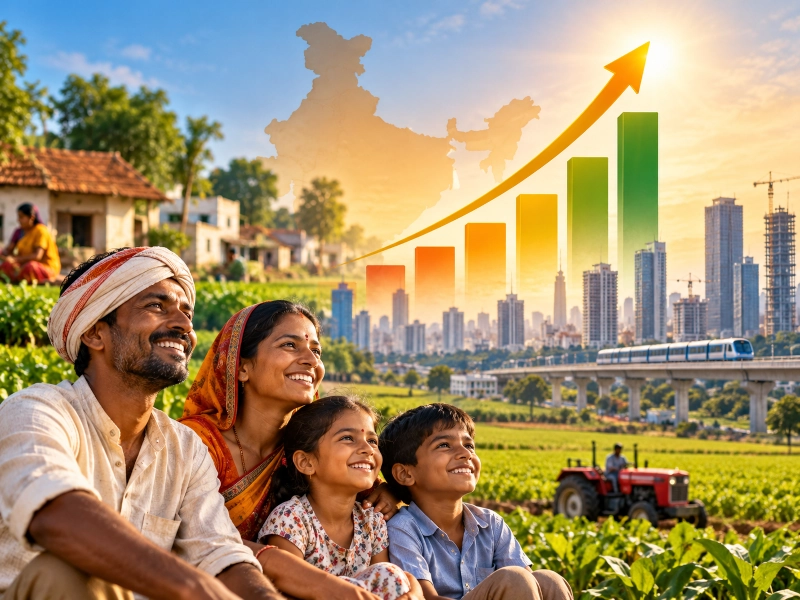
India has recorded a substantial reduction in extreme poverty over the past twelve years, with the proportion of people living below the international extreme poverty threshold declining from 27.1 percent in 2011 to 2.6 percent in 2023, according to the World Bank’s October 2026 Poverty and Equity Brief.
The report highlights India’s progress in reducing poverty through rising household consumption, employment growth and expanded social protection programmes. It estimates that approximately 496 million people, equivalent to 49.6 crore individuals, moved above the lower-middle-income poverty threshold during the period.
The findings were highlighted by Union Finance Minister Nirmala Sitharaman on 30 October 2026, who described the improvements as evidence of progress in economic inclusion and household welfare.
The World Bank’s analysis also identifies continuing challenges involving employment quality, income disparities and geographical concentrations of poverty, indicating that further economic and social development will be necessary to sustain the progress.
Extreme Poverty Declines Sharply Over Twelve Years
According to the World Bank, India’s extreme poverty rate declined from 27.1 percent in 2011 to 2.6 percent in 2023, representing a reduction of 24.5 percentage points.
The international extreme poverty threshold is defined as living on less than $3 per person per day, measured using 2021 purchasing power parity.
Purchasing power parity adjusts for differences in the cost of goods and services across countries, allowing poverty measurements to be compared internationally. The $3 threshold therefore does not represent a direct conversion of three US dollars into Indian rupees at prevailing market exchange rates.
The World Bank estimates that approximately 35 million people remained in extreme poverty in India in 2023–24 under this measure.
The sharp decline reflects changes in household consumption and economic conditions over the period, although poverty continues to affect vulnerable communities across different regions.
Nearly 50 Crore Indians Move Above Lower-Middle-Income Poverty Threshold
The World Bank report also examined poverty using the international threshold applicable to lower-middle-income economies, set at $4.20 per person per day in 2021 purchasing power parity.
Under this measure, India’s poverty rate declined from 57.7 percent in 2011 to 16.1 percent in 2023.
The reduction represents an estimated 496 million individuals moving above the lower-middle-income poverty threshold over twelve years.
This broader measure is particularly important because it captures households that may have moved beyond extreme deprivation but remain economically vulnerable.
Although the extreme poverty rate has fallen substantially, the lower-middle-income poverty figures indicate that a larger proportion of India’s population continues to live with limited financial resources.
The distinction between the two poverty thresholds is essential for understanding the scale of India’s economic development and the challenges associated with improving household living standards.
Rising Employment and Women’s Workforce Participation Support Poverty Reduction
The World Bank identified employment growth as one of the principal factors contributing to poverty reduction.
Between 2017 and 2023, employment in India increased by approximately 13.4 crore people, nearly twice the increase in the working-age population during the same period.
An important component of this expansion was increased workforce participation among rural women.
The report highlighted the contribution of women entering paid employment, alongside broader improvements in household consumption and access to economic opportunities.
Employment growth can improve household financial security by increasing access to wages, self-employment income and other sources of livelihood.
However, the World Bank also identified challenges involving the quality and productivity of employment.
Real earnings remained broadly unchanged in some segments of the labour market, while a significant share of employment growth occurred in relatively low-productivity activities.
These findings indicate that increasing employment opportunities must be accompanied by improvements in productivity, earnings and job quality to sustain long-term poverty reduction.
Rural and Urban Poverty Decline, but Regional Differences Remain
The World Bank’s analysis indicates that poverty declined across both rural and urban India.
Under the lower-middle-income poverty threshold of $4.20 per day, rural poverty declined from 64.9 percent in 2011–12 to 19.3 percent in 2023–24.
Urban poverty declined from 39.7 percent to 8.6 percent over the corresponding period.
The reduction in both categories reflects improvements in household consumption and economic conditions across geographical areas.
Under the extreme poverty threshold of $3 per day, rural poverty was estimated at 3.1 percent in 2023–24, compared with 1.4 percent in urban areas.
Despite these improvements, rural poverty remains higher than urban poverty, highlighting differences in economic opportunities, income sources and access to productive employment.
The report also identified the continuing geographical concentration of poverty.
Approximately 57 percent of India’s poor are estimated to live in a geographical belt extending from Uttar Pradesh to West Bengal.
This concentration indicates that regional development and targeted poverty reduction measures remain important for ensuring that economic progress reaches disadvantaged populations.
Food Subsidies and Social Transfers Contribute to Household Welfare
The World Bank identified expanded social transfers, including subsidised food, as another important contributor to poverty reduction.
Social protection programmes can help vulnerable households meet essential consumption requirements while reducing the financial pressures associated with food, healthcare and other basic necessities.
Food subsidies are particularly relevant to lower-income households because expenditure on essential commodities accounts for a substantial proportion of their budgets.
The report associated the expansion of social transfers with broader improvements in household consumption and welfare.
However, poverty reduction is influenced by multiple factors, including employment, economic growth, changes in consumption, access to public services and government support.
Consequently, the overall decline cannot be attributed exclusively to any individual programme or policy measure.
Access to Electricity and Essential Services Expands
The World Bank’s assessment also examined improvements in non-monetary dimensions of welfare.
These include access to infrastructure and essential services that influence household living conditions.
Finance Minister Nirmala Sitharaman highlighted the expansion of electricity access, which had reached approximately 99 percent of India’s population.
Greater access to electricity can support household welfare by improving lighting, communication, education and opportunities for economic activity.
Infrastructure and public services also influence poverty reduction indirectly by improving access to markets, reducing barriers to employment and supporting productivity.
The World Bank’s findings therefore extend beyond income and consumption indicators to consider broader improvements in living conditions.
Finance Minister Highlights India’s Poverty Reduction Progress
Reacting to the World Bank’s October 2026 findings, Finance Minister Nirmala Sitharaman highlighted the reduction in poverty and the expansion of employment opportunities.
She observed that India’s extreme poverty rate had fallen from 27.1 percent to 2.6 percent between 2011 and 2023, while more than 49 crore people had moved above the lower-middle-income poverty threshold.
The Finance Minister also drew attention to the increase in employment, particularly among rural women, and the contribution of social protection programmes to household welfare.
She attributed the improvements to sustained government policy efforts and reiterated the importance of productive employment, stronger household incomes and effective delivery of public services.
The World Bank’s findings provide an independent statistical assessment of poverty trends, while the Finance Minister’s remarks reflect the government’s interpretation of those developments.
Employment Quality and Income Disparities Remain Important Challenges
Despite the substantial reduction in poverty, the World Bank cautioned that important economic challenges remain.
The report identified continuing disparities in earnings and the concentration of employment in relatively low-productivity activities.
Differences in employment opportunities across regions and population groups can influence the ability of households to achieve lasting economic security.
The report also noted that poverty remains concentrated in certain geographical areas, underlining the need for regionally focused development initiatives.
Another consideration involves the measurement of consumption inequality.
Household expenditure surveys may not fully capture the consumption patterns of the wealthiest households, potentially leading to an understatement of inequality.
These statistical limitations are relevant when interpreting changes in poverty and inequality over time.
Continued progress will therefore depend not only on reducing the number of people below international poverty thresholds but also on creating productive employment, improving earnings and strengthening access to quality public services.
Understanding the World Bank’s Poverty Estimates
The World Bank’s poverty estimates are based on household consumption surveys and internationally comparable poverty thresholds.
For India, the analysis draws on household consumption expenditure surveys conducted in 2011–12, 2022–23 and 2023–24.
The estimates incorporate adjustments intended to improve comparability between surveys conducted using different methodologies.
The international poverty thresholds were revised in June 2025 to reflect updated purchasing power parity calculations and country-level poverty standards.
These revisions are important because changes in poverty measurement can influence historical estimates as well as assessments of recent progress.
The October 2026 findings should therefore be understood as updated statistical estimates of poverty conditions during earlier years rather than direct measurements of poverty in October 2026.
The latest figures nevertheless provide evidence of substantial improvement in consumption-based poverty indicators over the period examined.
Sustaining Poverty Reduction Through Productive Economic Growth
India’s reduction in extreme poverty represents a significant development in the country’s economic trajectory.
The decline from 27.1 percent to 2.6 percent over twelve years indicates that a considerably smaller proportion of the population now falls below the World Bank’s international extreme poverty threshold.
The movement of approximately 49.6 crore people above the lower-middle-income poverty line also reflects a broader improvement in household consumption.
However, the World Bank’s findings demonstrate that continued economic progress will require attention to employment quality, productivity, regional disparities and household vulnerability.
Improving access to education, healthcare, infrastructure and productive economic opportunities will remain important for sustaining poverty reduction.
The October 2026 Poverty and Equity Brief provides an updated statistical foundation for assessing these challenges and understanding the changing economic conditions of Indian households.
References
1. World Bank — Poverty and Equity Brief, India, October 2026
Official World Bank publication examining India’s poverty reduction, household consumption, employment and inequality.
https://www.worldbank.org/en/topic/poverty/publication/poverty-and-equity-briefs
2. World Bank — India Development Update, April 2026
Official World Bank analysis containing poverty estimates for 2011–12 and 2023–24, including rural and urban comparisons.
https://thedocs.worldbank.org/en/doc/4262e1e15b463ecb360cec4ad78cf062-0310012026/original/April-2026-India-Development-Update.pdf
3. World Bank — India Country Data
Official statistical database confirming India’s extreme poverty rate of 2.6 percent in 2023 at the $3-per-day international poverty threshold.
https://data.worldbank.org/country/india
4. Akashvani News (News On AIR), 30 October 2026
India’s Extreme Poverty Declines from 27.1% to 2.6% Between 2011–2023, Says FM Sitharaman.
https://newsonair.gov.in/indias-extreme-poverty-declines-from-27-1-to-2-6-between-2011-2023-says-fm-sitharaman
5. DD India, 30 October 2026
India’s Extreme Poverty Rate Falls from 27.1% to 2.6% Between 2011 and 2023: World Bank.
https://ddindia.co.in/2026/10/indias-extreme-poverty-rate-falls-from-27-1-to-2-6-between-2011-and-2023-world-bank
You may also like
-
Indian SpaceTech Company Pixxel Establishes US Subsidiary to Expand Defence and Satellite Intelligence Business
-
PI Industries Unveils India’s First Indigenously Discovered Insecticide Molecule Pioxaniliprole
-
Sun Pharma Secures US FDA Approval for ILUMYA to Treat Active Psoriatic Arthritis
-
India Expands UPI Payments for Online Tourist Bookings at Burj Khalifa and Singapore’s Resorts World Sentosa
-
Gujarat’s First Bullet Train Traction Substation Nears Completion at Bilimora as India Develops 508-Km High-Speed Rail Power Network
