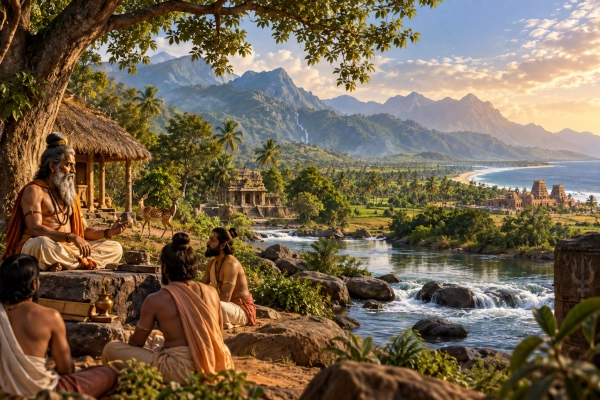
Among the geographical names preserved in the Mahabharata, Tamraparni is particularly interesting because the name acquired more than one geographical association in later Indian and Sri Lankan traditions. It has been used for the river now known as the Thamirabarani in southern Tamil Nadu, for the surrounding region of ancient Pandya country, and in other historical contexts for parts of Sri Lanka under related forms such as Tambapanni.
Within the Mahabharata itself, however, the clearest reference points towards the Tamraparni river-region of southern Tamil Nadu, rather than directly to the island of Sri Lanka. The name appears in the Vana Parva during a description of sacred places in the southern country, immediately after references to the Pandyas and Kumari.
Tamraparni in the Vana Parva
The principal Mahabharata reference occurs in the Tirtha-yatra section of the Vana Parva, where the sage describes sacred places that Yudhishthira may visit during pilgrimage.
The Sanskrit verse places Tamraparni directly after a reference to sacred sites among the Pandyas:
“The sacred Kumaris have been described among the Pandyas… now hear of Tamraparni.”
The passage then describes Tamraparni as a sacred place where the gods had performed austerities in pursuit of spiritual attainment.
This context is important. The sequence moves through southern sacred geography and specifically identifies the Pandya country before introducing Tamraparni. That strongly supports its identification with the river and landscape of the far south of the Indian peninsula.
The River Behind the Ancient Name
The modern Thamirabarani River, historically known in Sanskrit as Tamraparni and in Tamil tradition as Porunai, rises in the southern Western Ghats and flows eastward through present-day Tirunelveli and Thoothukudi districts before entering the Gulf of Mannar.
The river remains one of the defining geographical features of southern Tamil Nadu. Its course links the hill country around the Pothigai range with the fertile plains of Tirunelveli and the coastal zone facing the Gulf of Mannar.
Older geographical scholarship has also identified the Tamraparni of the Mahabharata with the river of the former Tinnevelly region. The sequence of places in the Vana Parva—Pandya country, Kumari and Tamraparni—fits this southern Tamil setting particularly well.
Tamraparni and the Pandya Country
The Mahabharata does not present Tamraparni as an isolated geographical name. It appears within a landscape associated with the Pandyas, one of the major political and cultural powers of southern India.
In the same passage, the epic refers to the sacred sites of Agastya and Varuna in Pandya territory and then to Kumari before moving to Tamraparni. Internet Sacred Text Archive
This sequence places the river within an interconnected southern sacred geography. The region around the southern Western Ghats, Kumari and the Pandya plains later became strongly associated with traditions surrounding the sage Agastya, and the Tamraparni river system formed one of the principal waterways of this landscape.
The Mahabharata therefore preserves more than the name of a river. It places Tamraparni within one of the great southern cultural regions known to the epic tradition.
A Sacred Tirtha Rather Than a Kingdom
Unlike many geographical entries in the Mahabharata, Tamraparni is not introduced here as a kingdom conquered by one of the Pandavas or as a people participating in the Kurukshetra War.
The text classifies it as a tirtha, a sacred destination. The emphasis is therefore religious rather than military or political. The gods themselves are said to have undertaken austerities there, giving the place a sanctity that made it part of the pilgrimage geography described to Yudhishthira.
This distinction matters when reconstructing Mahabharata geography. Tamraparni should not automatically be treated as another political state alongside Pandya, Kerala or Lanka. In the passage where it is actually named, it functions primarily as a sacred geographical region associated with water, pilgrimage and penance.
The Wider Southern Landscape
The importance of Tamraparni becomes clearer when viewed alongside the surrounding places mentioned in the Vana Parva.
The narrative directs attention towards Pandya country, sacred sites connected with Agastya, the region of Kumari, and then Tamraparni. Together they form a chain of places extending towards the southernmost part of the Indian peninsula.
This geographical arrangement suggests that the compilers of the epic possessed at least a broad conception of the far south as a distinct sacred landscape. Rivers, mountains, coastal shrines and political regions were woven together into the pilgrimage routes described to the Pandavas.
The Tamraparni thus stands at the intersection of physical geography and sacred geography: a river whose waters belonged to the landscape of the Pandya realm but whose importance extended beyond political boundaries.
Tamraparni and Agastya Traditions
The southern landscape surrounding Tamraparni became deeply connected with the figure of Agastya, one of the most important sages associated with the transmission of Vedic and Sanskritic traditions into southern India.
The Mahabharata passage itself places Agastya-related sacred sites within the wider geographical sequence surrounding the Pandya country. It also refers nearby to an asylum associated with a disciple of Agastya and to another hermitage of the sage.
Later traditions developed these associations much further, particularly around the Pothigai or Agastyamalai ranges from which the modern Thamirabarani river system emerges.
For geographical reconstruction, however, the Mahabharata need not be made to say more than it does. What is clear is that Tamraparni belonged to a southern sacred landscape in which Agastya traditions were already prominent.
Why the Name Is Sometimes Associated With Sri Lanka
The identification becomes more complicated because forms of the same name later appear in connection with Sri Lanka.
The Pali form Tambapanni became an important early name associated with the island, and the Sanskrit form Tamraparni was consequently also used in literary and geographical traditions for Sri Lanka. Historical sources therefore allow the term to carry both an Indian and an insular association depending on period and context.
This dual usage has sometimes led to the Mahabharata’s Tamraparni being identified directly with Sri Lanka. Yet the immediate context of the Vana Parva does not require such an interpretation.
The verse places Tamraparni alongside the Pandyas and Kumari, making the southern Tamil river-region the stronger identification for this particular passage. The use of related names for Sri Lanka belongs to a wider historical development and should not automatically be projected back onto every occurrence of the term.
Tamraparni Is Not the Same as Lanka
The distinction becomes especially important because the Mahabharata separately knows Lanka.
During Sahadeva’s southern campaign in the Sabha Parva, the narrative reaches the southern mainland and subsequently sends an embassy to Vibhishana across the sea. Lanka therefore exists independently in the epic’s geographical vocabulary.
This makes it unnecessary to interpret every occurrence of Tamraparni as another name for Lanka or Sri Lanka. Where the Vana Parva places Tamraparni within Pandya sacred geography, the river-region interpretation is more consistent with the text itself.
The later use of Tamraparni or Tambapanni for Sri Lanka remains historically important, but it represents a separate layer of geographical terminology.
Tamraparni and Tamradvipa
Another name that requires care is Tamradvipa, literally the “Copper Island,” which appears separately in the Sabha Parva during Sahadeva’s southern Digvijaya.
The text lists a place called Tamradvipa among territories encountered during the southern expedition. Its precise identification remains uncertain, and some later writers have attempted to connect it with Sri Lanka.
Tamradvipa and Tamraparni, however, should not simply be treated as interchangeable names. They occur in different passages and perform different geographical functions. Tamraparni is explicitly a sacred tirtha in the Vana Parva, while Tamradvipa appears in the political geography of Sahadeva’s campaign.
Keeping the two names separate prevents later identifications from obscuring what the Mahabharata actually says.
A River Connecting Mountains, Plains and Sea
The modern Thamirabarani provides a useful geographical framework for understanding why this region could occupy such an important place in southern tradition.
The river rises in the southern Western Ghats, crosses the Tirunelveli plain and ultimately reaches the Gulf of Mannar. Its basin therefore connects upland forests, agricultural plains and the maritime coast within a comparatively compact region.
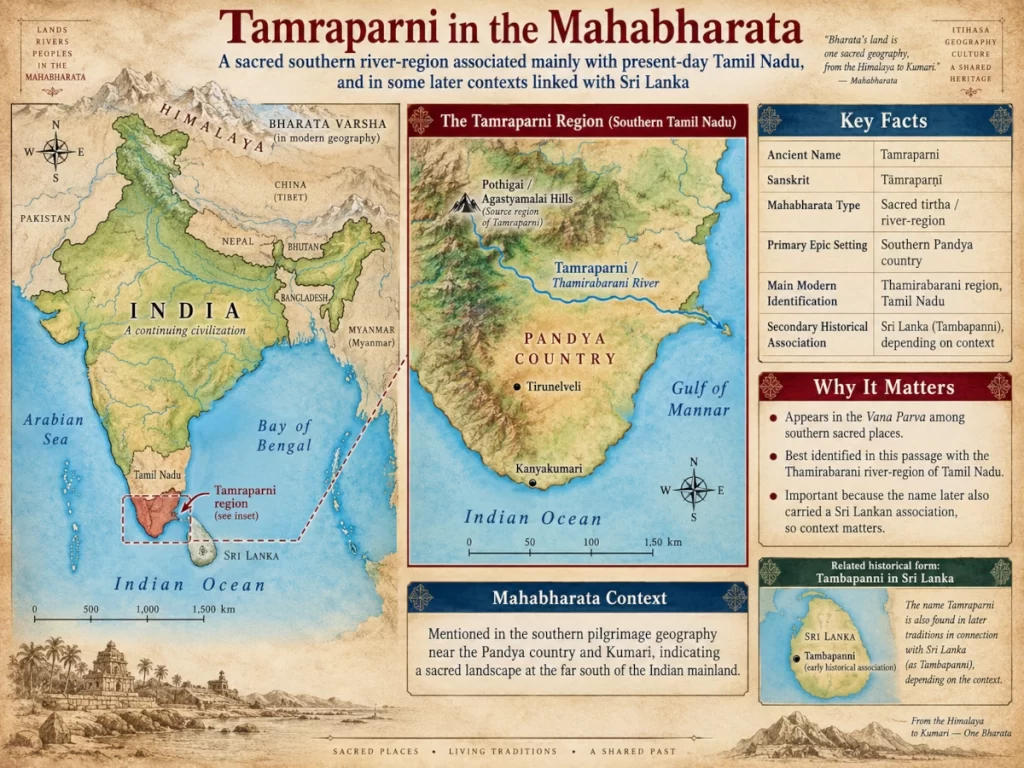
Such river valleys naturally became centres of settlement, agriculture, pilgrimage and exchange. The Mahabharata’s reference to Tamraparni as a sacred destination fits comfortably within this broader geographical character.
The name survives today in the form Thamirabarani, preserving a striking continuity between the epic geographical tradition and the modern landscape of southern Tamil Nadu.
Tamraparni on the Modern Map
For the specific Mahabharata passage in which the name occurs, the most defensible modern identification is the Thamirabarani river-region of southern Tamil Nadu.
The geographical correspondence may be summarised as follows:
Ancient name: Tamraparni
Sanskrit: ताम्रपर्णी — Tāmraparṇī
Mahabharata classification: Sacred tirtha
Primary epic reference: Vana Parva, 3.86.11 in the Sanskrit numbering
Associated ancient region: Pandya country
Modern geographical counterpart: Thamirabarani River and its surrounding region
Modern state: Tamil Nadu
Principal modern districts: Tirunelveli and Thoothukudi
River mouth: Gulf of Mannar
Secondary historical association of the name: Sri Lanka, particularly through forms such as Tambapanni
Preferred identification in the Mahabharata passage: Southern Tamil Nadu
Tamraparni therefore represents an important example of why Mahabharata geography must be reconstructed passage by passage. The name later acquired associations extending across the Gulf of Mannar to Sri Lanka, but the epic’s own Vana Parva reference places it firmly within the sacred world of the southern Pandya country. In that setting, Tamraparni is best understood as the ancient river and pilgrimage region that survives today in the Thamirabarani of Tamil Nadu.
You may also like
-
Simhala or Simhaladvipa in the Mahabharata: The Island Kingdom of Sri Lanka
-
Lanka in the Mahabharata: The Island Kingdom Beyond India’s Southern Shore
-
Cina in the Mahabharata: The Trans-Himalayan World at the Edge of the Epic’s Geography
-
India and France Sign Agreement to Preserve and Digitise Ancient Indian Manuscripts
-
Huna in the Mahabharata: Nakula’s Western Campaign, the Harahunas and Central Asia’s Changing Frontiers
