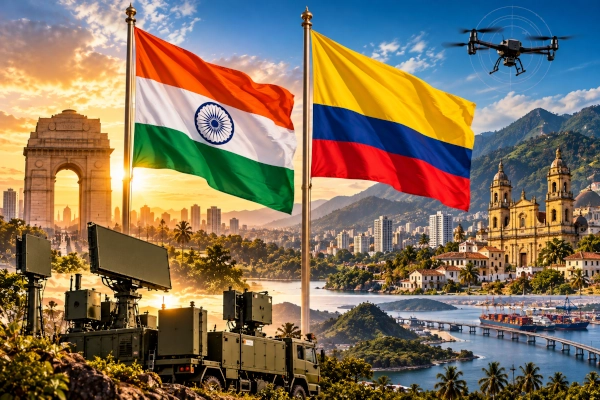
Colombia is seeking deeper security and law-enforcement cooperation with India to strengthen its campaign against drug cartels, organised crime and narco-terrorism. The South American country has expressed interest in acquiring counter-drone technology from Bharat Electronics Limited (BEL), India’s leading defence electronics public sector enterprise, while exploring closer intelligence-sharing arrangements between the two countries.
Colombia’s Ambassador to India, Victor Hugo Echeverri Jaramillo, outlined these priorities in an interview published by Mint on 8 October 2026. The proposed cooperation reflects Colombia’s growing interest in India’s defence technology, artificial intelligence capabilities and experience in combating cross-border security threats.
The initiative could also create new opportunities for Indian defence manufacturers in Latin America, where governments increasingly require advanced surveillance and counter-drone systems to confront criminal organisations operating across difficult terrain.
Colombia Explores BEL’s Indigenous Counter-Drone Systems
Colombia has held discussions with Bharat Electronics Limited regarding the possible procurement of counter-drone systems to support operations against drug cartels and armed criminal groups.
A Colombian delegation visited BEL’s Ghaziabad Unit and Central Research Laboratory in March 2026 to examine the company’s technological capabilities. The visit formed part of Colombia’s efforts to identify suitable technologies for detecting and countering unmanned aerial threats.
Ambassador Jaramillo highlighted the competitive pricing of Indian counter-drone solutions compared with European alternatives. He indicated that Colombia had been evaluating Indian systems as part of its broader efforts to strengthen security capabilities.
BEL has developed integrated counter-drone technologies designed to detect, track and neutralise hostile unmanned aerial vehicles. Depending on the configuration, such systems can combine radar surveillance, electro-optical sensors, radio-frequency detection and electronic countermeasures.
These capabilities are particularly relevant to countries facing threats from criminal organisations that increasingly employ commercially available drones for reconnaissance, surveillance and illicit activities.
Although discussions are underway, neither BEL nor the Colombian government has announced a completed procurement contract for the proposed equipment.
Colombia’s National Anti-Drone Programme Opens Opportunities for India
Colombia launched its National Anti-Drone Shield Project in January 2026 to strengthen protection against the growing use of unmanned aerial systems by illegal armed groups.
As part of this initiative, officials from Colombia’s Ministry of National Defence, including the Vice Minister of Strategy and Planning, visited India between 16 and 20 March 2026. The delegation examined BEL’s capabilities in unmanned aerial systems and counter-drone technology while exploring potential industrial cooperation.
Colombia’s interest reflects a changing security environment in which relatively inexpensive drones can create significant operational challenges for police and military personnel. Criminal organisations may use these platforms to observe security operations, transport small consignments or threaten personnel and infrastructure.
Counter-drone systems provide an additional layer of protection by helping security agencies identify unauthorised aerial activity and respond according to operational requirements.
For BEL, Colombia represents a potential export market for technologies developed to meet India’s own defence and internal security requirements. The discussions also illustrate the expanding international relevance of Indian electronic warfare and surveillance capabilities.
Colombia Considers Police Attaché in New Delhi
Beyond defence equipment, Colombia is considering establishing a police attaché position at its embassy in New Delhi to facilitate closer cooperation between the two countries’ law-enforcement agencies.
Ambassador Jaramillo explained that international drug trafficking networks operate across national boundaries and require coordinated responses involving intelligence, technology and investigative expertise.
A dedicated police attaché could support communication between Colombian and Indian authorities, facilitate information exchanges and improve coordination on investigations involving transnational criminal networks.
Such cooperation would build upon existing diplomatic and security relationships while creating a more specialised channel for law-enforcement engagement.
The proposed position remains under consideration, and no formal appointment has been announced.
Artificial Intelligence and Intelligence Sharing Become Priorities
Colombia is particularly interested in India’s capabilities in artificial intelligence, information technology and intelligence analysis.
According to Ambassador Jaramillo, conventional security operations are often insufficient against criminal organisations operating from remote jungle regions. These groups can exploit difficult terrain, dispersed infrastructure and limited accessibility to conceal their activities.
Technology-assisted intelligence gathering can help authorities analyse information, identify suspicious patterns and improve situational awareness across large operational areas.
Artificial intelligence may also support the processing of surveillance imagery, identification of unusual movements and analysis of information collected from multiple sources.
India’s experience in developing digital technologies and applying advanced surveillance systems to security operations provides a basis for technical exchanges with Colombian institutions.
The ambassador also raised concerns about international narcotics trafficking routes, including possible connections through India. However, an Indian government official quoted by Mint stated that while Indian agencies had seized cocaine originating from Colombia, they had not established evidence of consignments being routed through India to Australia or New Zealand.
This distinction highlights the importance of verified intelligence and coordinated investigations when examining international trafficking networks.
Colombian Police Officers Receive Specialised Training in India
India and Colombia have already undertaken practical cooperation in security-related training.
Twenty-five officers from Colombia’s National Police attended a specialised programme on artificial intelligence for human security at Rashtriya Raksha University in Gujarat between 26 March and 8 April 2025.
The programme formed part of India’s Indian Technical and Economic Cooperation (ITEC) initiative, which provides professional training and capacity-building opportunities to personnel from partner countries.
The course introduced Colombian officers to technological applications relevant to modern security challenges, strengthening professional interaction between the two countries’ institutions.
Rashtriya Raksha University confirmed that no additional training programme or visit involving Colombian National Police personnel had been scheduled at the time of the October 2026 report.
The completed programme nevertheless provides an institutional foundation for expanding future cooperation in specialised policing, digital investigation and security technology.
India and Colombia Have an Established Defence Partnership
The latest discussions build upon a defence relationship that has developed over nearly two decades.
India and Colombia signed a Defence Cooperation Agreement in February 2009, establishing a framework for bilateral military engagement and institutional dialogue. The first meeting of the Joint Defence Committee took place in Bogotá in September that year.
Subsequent exchanges included military delegations, technical visits and discussions involving defence manufacturing and operational cooperation.
Colombia has previously examined Indian artillery technologies, including equipment associated with the Gun Carriage Factory in Jabalpur. Colombian military representatives have also participated in defence-related engagements with Indian institutions.
In September 2022, the two defence ministries held virtual discussions covering peacekeeping operations, counterterrorism and humanitarian assistance. A bilateral defence industry webinar followed in October 2023.
These interactions demonstrate that Colombia’s present interest in BEL technology is part of a longer process of defence engagement rather than an entirely new relationship.
Indian Defence Technology Gains Attention in Latin America
Colombia’s interest in Indian counter-drone equipment reflects the growing international presence of India’s defence manufacturing industry.
Indian companies have expanded their capabilities in radar systems, electronic warfare, communications equipment, unmanned platforms and integrated air-defence technologies.
BEL occupies an important position within this ecosystem through its work on surveillance radars, battlefield electronics, command-and-control systems and counter-unmanned aircraft technologies.
For international buyers, Indian defence equipment offers an opportunity to diversify procurement sources while exploring solutions tailored to specific operational requirements.
Latin American countries face security challenges ranging from border surveillance and organised crime to the protection of critical infrastructure. These requirements create potential markets for electronic sensors, surveillance equipment and specialised security technologies.
Former Indian Ambassador to Colombia Deepak Bhojwani has noted that Colombia previously expressed interest in Indian defence equipment, including artillery systems and armoured platforms.
The renewed emphasis on counter-drone technology indicates that bilateral defence discussions are increasingly addressing emerging threats alongside conventional military requirements.
India and Colombia Can Build a Broader Security Partnership
The proposed cooperation offers complementary opportunities for both countries.
Colombia has extensive operational experience confronting drug cartels, organised criminal networks and illegal armed groups. Its security agencies have developed specialised knowledge of intelligence gathering and law-enforcement operations across challenging geographical environments.
India brings capabilities in defence electronics, digital technologies, technical training and the development of indigenous security systems.
Closer engagement could facilitate the exchange of operational knowledge while encouraging collaboration between research institutions, security agencies and defence manufacturers.
Such cooperation would also strengthen India’s diplomatic and technological engagement with Latin America, a region with growing importance for international trade, industrial partnerships and security dialogue.
The present discussions remain focused on exploring equipment procurement and institutional cooperation. A new bilateral security agreement or finalised BEL counter-drone sale has not been announced.
A New Opportunity for India’s Defence Exports and Security Diplomacy
Colombia’s interest in Indian counter-drone technology represents another opportunity for India’s defence industry to demonstrate its capabilities in international markets.
The engagement also shows how bilateral security relationships are evolving beyond conventional military equipment towards artificial intelligence, electronic surveillance, specialised training and cooperation against transnational crime.
For India, the discussions support the broader objective of building a globally competitive defence manufacturing ecosystem while strengthening partnerships with countries facing complex security challenges.
Colombia’s interest in BEL systems, combined with existing institutional exchanges, provides a foundation for developing a more comprehensive relationship between the two nations.
India’s growing capabilities in indigenous defence electronics and advanced security technologies are opening new avenues for international cooperation, strengthening the country’s position as a reliable partner in addressing emerging security challenges.
References
- Mint — 8 October 2026. Colombia Seeks Deeper Security Ties with India to Fight Drug Cartels. Interview with Colombian Ambassador Victor Hugo Echeverri Jaramillo.
https://www.livemint.com/news/colombia-seeks-deeper-security-ties-with-india-to-fight-drug-cartels-11791366028228.html - Embassy of India, Bogotá — India–Colombia Development Partnership and Cooperation. Background on the bilateral defence relationship, the 2009 Defence Cooperation Agreement and the March 2026 Colombian defence delegation’s visit to India.
https://www.eoibogota.gov.in/ - Embassy of India, Bogotá — 17 September 2026. ITEC Day 2026. Details of India’s capacity-building and technical cooperation programmes with Colombia.
https://www.eoibogota.gov.in/section/press-releases/itec-day-2026/ - Bharat Electronics Limited — Official Website. Information on BEL’s indigenous defence electronics, surveillance systems and counter-drone technologies.
https://bel-india.in/ - Rashtriya Raksha University — Official Website. Institutional information on specialised security education, artificial intelligence and international training programmes.
https://rru.ac.in/
You may also like
-
Larsen & Toubro Selects Australian Orbital’s 350HFE Heavy-Fuel Engines for Indian Tactical UAV Programme
-
Indian Navy Receives Two Indigenous TROUT Military-Grade Underwater Robots from Kochi Startup EyeROV
-
Himachal Startup Tecnod8.AI Develops Industrial AI Copilot for Advanced Manufacturing
-
Skyroot Aerospace Partners with Brazil’s Concert Technologies to Develop New Orbital Launch Vehicle
-
NIS Management Secures ₹6.24 Crore Surveillance Technology Contract for West Bengal Police
