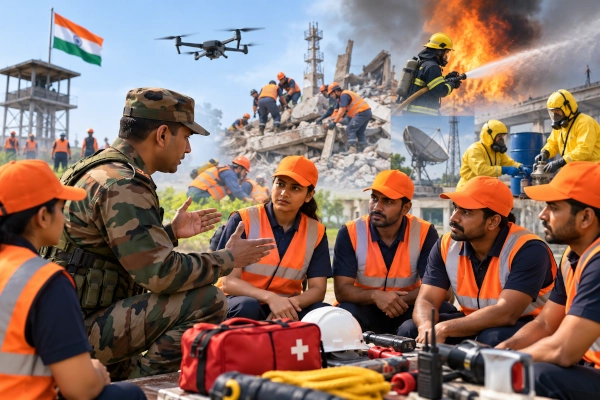
The Ministry of Home Affairs (MHA), in collaboration with the Indian Army, has announced a major initiative to strengthen India’s civil defence preparedness through a structured training programme capable of reaching 60,000 Civil Defence Volunteers across 12 states and Union Territories. The initiative will combine the Indian Army’s operational expertise with the country’s civilian volunteer network to improve emergency response, critical infrastructure protection and preparedness against emerging security threats.
Announced on 23 October 2026, the first-of-its-kind joint training initiative will begin with specialised instruction for 600 Civil Defence Master Trainers. These trainers will subsequently provide training to volunteers in their respective states and Union Territories, creating a wider network of personnel equipped to support civilian authorities during emergencies.
The programme forms part of the Union Government’s efforts to develop a modern civil defence system capable of responding to changing security challenges, including drone threats, hybrid warfare, cyber incidents and emergencies involving critical infrastructure.
Indian Army to Train 600 Civil Defence Master Trainers
The Directorate General of Fire Services, Civil Defence and Home Guards (DGFSCDHG), functioning under the Ministry of Home Affairs, will coordinate the initiative with the Indian Army. The first phase will involve a three-day specialised training programme at designated Army training establishments.
Under the approved framework, 600 Civil Defence Master Trainers, comprising 50 participants from each of the 12 participating states and Union Territories, are proposed to complete their training by the second week of November 2026.
The initial programme will focus on developing instructors who can transfer specialised skills to a much larger volunteer network. By concentrating Army-led training on selected master trainers, the government intends to establish a system through which trained personnel can subsequently conduct programmes at the state and local levels.
This approach will help integrate military expertise into civilian emergency preparedness while maintaining the role of civil defence personnel in supporting civil administration during crises.
Twelve States and Union Territories Selected for the First Phase
The initial phase will cover Jammu and Kashmir, Punjab, Rajasthan, Gujarat, Delhi, Meghalaya, Sikkim, Assam, Uttar Pradesh, Kerala, Karnataka and Tamil Nadu.
The participating regions represent different geographical environments and security requirements. They include northern and northeastern border regions, major urban centres, coastal states and areas containing important industrial and strategic infrastructure.
The programme will provide a common training framework while enabling participating states and Union Territories to strengthen their existing civil defence capabilities. Personnel trained under the initiative will be better prepared to assist local authorities in managing emergencies, coordinating protective measures and supporting organised response operations.
The Ministry of Home Affairs has indicated that the programme could expand to the remaining states and Union Territories in subsequent phases, based on the outcomes of the initial pilot.
Training to Address Modern Warfare and Drone Threats
A central component of the programme will be threat awareness, particularly in relation to the changing nature of modern warfare and its potential impact on civilian populations.
Participants will receive instruction on modern and hybrid warfare, drone awareness and air-raid threats. These subjects reflect the increasing importance of preparing civilian emergency-response networks for situations in which security threats may extend beyond conventional military engagements.
Unmanned aerial systems have introduced new challenges for the protection of civilian infrastructure and populated areas. Awareness of such threats can help trained volunteers recognise potential dangers, communicate relevant information to authorities and support established protective procedures.
The training will also emphasise the importance of understanding emerging security risks and responding through coordinated civilian and military channels.
Focus on Critical Infrastructure Protection and Emergency Response
The second major training component will address protection and emergency response. Participants will receive instruction covering critical infrastructure protection, fire safety, casualty management, search and rescue, and awareness of chemical, biological, radiological and nuclear threats.
Critical infrastructure such as transportation networks, communication systems, energy installations and essential public services plays an important role in maintaining normal civilian life. Emergencies affecting these facilities can create wider disruptions, making timely coordination and effective protective measures essential.
Training in fire safety, casualty management and search-and-rescue procedures will strengthen the ability of civil defence volunteers to support authorised emergency-response agencies. The programme will also introduce participants to the challenges associated with hazardous incidents requiring specialised protective measures.
Chemical, Biological, Radiological and Nuclear (CBRN) awareness will form part of the curriculum. This component will help participants understand the nature of such hazards and the importance of following established emergency procedures under the direction of competent authorities.
The combination of protective awareness and emergency-response instruction is intended to improve the readiness of civil defence personnel when assisting during complex situations.
Emergency Communication and Cybersecurity Included in Training
The third training component will focus on communication and coordination, recognising that effective emergency management depends on the timely exchange of information between different agencies.
The programme will cover emergency communication, cyber hygiene, digital resilience, civil-military coordination and incident command. These subjects are increasingly relevant as emergency-response systems depend on digital communication networks and coordinated institutional decision-making.
Cyber hygiene and digital resilience training will familiarise participants with practices designed to reduce vulnerabilities and maintain dependable communication during disruptions. Volunteers will also receive instruction on coordination procedures that support organised responses involving multiple agencies.
Incident command training will introduce the principles of structured emergency management, including the allocation of responsibilities and coordination between participating organisations.
By incorporating these subjects, the programme seeks to strengthen both the operational readiness of individual volunteers and the effectiveness of the wider emergency-response network.
Master Trainer Model to Reach 60,000 Volunteers
The initiative’s principal feature is its structured Master Trainer model, which is designed to multiply the impact of the initial training programme.
Following their specialised instruction by the Indian Army, each of the 600 Master Trainers will be responsible for training 100 additional Civil Defence Volunteers in their respective states and Union Territories.
Through this approach, the initial group of trainers has the potential to extend specialised civil defence preparedness skills to 60,000 volunteers across the 12 participating regions.
The cascading training model will allow skills introduced during the Army-led programme to reach a larger number of personnel without requiring every volunteer to attend the initial training at military establishments.
It will also create a foundation for continued capacity building within existing civil defence organisations. Master Trainers can serve as important links between specialised training institutions and volunteers operating at the local level.
The figure of 60,000 represents the intended reach of the proposed training framework rather than a completed training achievement.
Initiative Follows Prime Minister’s Independence Day Announcement
The programme follows Prime Minister Narendra Modi’s Independence Day address on 15 August 2026, when he outlined a vision for developing a modern and responsive civil defence network.
The Prime Minister emphasised the need to equip civil defence organisations with contemporary technologies, modern systems and improved preparedness capabilities to address emerging security challenges.
The new initiative translates that objective into a structured training programme involving cooperation between the Ministry of Home Affairs and the Indian Army.
Civil defence organisations traditionally support civilian authorities during emergencies, including incidents requiring evacuation, rescue operations, public safety measures and assistance to affected communities.
The latest programme seeks to strengthen these functions while incorporating awareness of modern security threats and technological vulnerabilities.
Strengthening Civil-Military Coordination Across India
The involvement of the Indian Army will provide Civil Defence Master Trainers with access to specialised instruction informed by military operational experience.
Effective civil defence requires coordination between civilian authorities, emergency services and other organisations responsible for public safety. During large-scale emergencies, established communication channels and clearly defined responsibilities can help participating agencies organise their response more effectively.
The Army-led training programme will introduce participants to procedures associated with contemporary threats, emergency management and coordination. These skills can support civil defence organisations in carrying out their responsibilities alongside police, fire services, medical responders and other authorised agencies.
The initiative also recognises the importance of strengthening preparedness before emergencies occur. Regular training and familiarisation with established response systems can improve institutional readiness and reduce confusion during complex incidents.
By creating a larger pool of trained civil defence personnel, the programme aims to improve the capacity of participating states and Union Territories to organise coordinated responses when required.
Pilot Programme Could Expand Nationwide
The Ministry of Home Affairs plans to assess the outcomes of the initial phase before extending the initiative to the remaining states and Union Territories.
The pilot programme will establish an initial training framework through which the Army’s specialised expertise can reach civilian volunteers. Its implementation will also provide practical experience in coordinating training activities between central authorities, military establishments and state-level civil defence organisations.
The proposed expansion offers an opportunity to develop a more consistent national approach to volunteer preparedness while accommodating the operational requirements of different regions.
With 600 Master Trainers forming the foundation of a potential 60,000-strong trained volunteer network, the initiative represents a substantial step towards strengthening India’s civil defence capabilities. The collaboration between the Ministry of Home Affairs and the Indian Army will contribute to the development of a more organised, responsive and technologically aware civilian preparedness system.
References
- Press Information Bureau, Ministry of Home Affairs, 23 October 2026. In line with the vision of Prime Minister Shri Narendra Modi, the work to establish a vibrant Civil Defence Network in the country is set to begin. Release ID: 2327332.
https://www.pib.gov.in/PressReleseDetailm.aspx?PRID=2327332 - Akashvani News (News on AIR), 24 October 2026. Indian Army to Train Civil Defence Master Trainers Across 12 States, UTs.
https://newsonair.gov.in/indian-army-to-train-civil-defence-master-trainers-across-12-states-uts/ - Akashvani News (News on AIR), 23 October 2026. Home Ministry to launch pilot initiative to establish vibrant Civil Defence Network.
https://newsonair.gov.in/home-ministry-to-launch-pilot-initiative-to-establish-vibrant-civil-defence-network/
You may also like
-
Zen Technologies Introduces Indigenous Hyper-Strike Falcon AI-Guided Counter-Drone Interceptor
-
L&T and Germany’s SCHOTTEL Expand Partnership for Controllable Pitch Propeller Systems in Indian Shipbuilding
-
Indian Army’s Northern Command Opens 75-Day Defence Technology Internship Programme for Young Innovators
-
India Emerges as Major Arms Supplier to Europe, Defence Secretary Highlights Surge in Ammunition Exports
-
India’s Indigenous AIP System for Kalvari-Class Submarines Enters Critical Testing Phase Ahead of 2027 Integration
