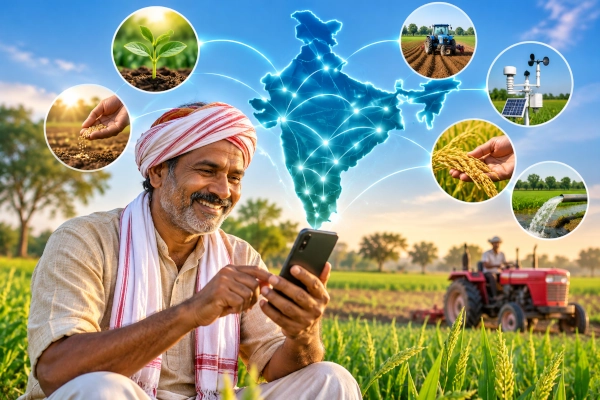
India has achieved a major milestone in its agricultural digital transformation by creating 11 crore Farmer IDs across the country, completing the national target five months ahead of schedule. Union Minister for Agriculture and Farmers’ Welfare Shivraj Singh Chouhan announced the achievement on 24 October 2026, describing it as an important step towards making agricultural services more accessible, transparent and efficient.
The target was achieved on the night of 23 October, well before the government’s deadline of 31 March 2027. The initiative forms part of the Digital Agriculture Mission, which aims to establish a comprehensive digital public infrastructure for India’s agricultural sector. By providing farmers with unique digital identities, the government intends to simplify access to welfare schemes, institutional credit, crop insurance, agricultural procurement and disaster relief.
The Ministry of Agriculture and Farmers’ Welfare has also confirmed that more than six crore farmers have already received benefits through Farmer ID-based service delivery. The achievement highlights the growing role of digital infrastructure in connecting India’s farming communities with government services and agricultural support systems.
Farmer ID: A Unique Digital Identity for India’s Farmers
A Farmer ID is a unique digital identity created for an individual farmer under the AgriStack framework. The system aims to establish a verified digital record that can be used across participating agricultural services, reducing the need for repeated identification and verification.
The Farmer Registry forms one of the core components of AgriStack, an agricultural digital public infrastructure being developed under the Digital Agriculture Mission. It works alongside other digital databases covering agricultural land, geographical information and crops cultivated by farmers.
The government intends to use these interconnected systems to improve the identification of eligible beneficiaries and make agricultural service delivery more efficient. Instead of requiring farmers to repeatedly submit similar documents to different departments, a verified digital identity can support faster processing and more consistent records.
Farmer IDs are particularly relevant in a country where agricultural services involve multiple government departments, financial institutions, insurance providers and procurement agencies. A common digital identification framework can help these organisations deliver services more efficiently while improving accountability.
The Farmer ID is not a replacement for Aadhaar. It serves as an agriculture-specific digital identity within the wider framework of agricultural data and service delivery.
Government Completes Target Five Months Ahead of Schedule
Union Agriculture Minister Shivraj Singh Chouhan confirmed that the government successfully completed the creation of 11 crore Farmer IDs by the night of 23 October 2026.
The milestone was achieved through coordinated efforts involving the Ministry of Agriculture and Farmers’ Welfare, state governments, Union Territory administrations, district authorities and officials working at the village level.
Prime Minister Narendra Modi had set 31 March 2027 as the deadline for achieving the target. Completing the exercise ahead of schedule marks substantial progress in expanding digital agricultural infrastructure across India.
Chouhan congratulated farmers and government personnel involved in implementing the programme. He described the initiative as an important component of the government’s efforts to build a more transparent and technologically advanced agricultural system.
The achievement also demonstrates the scale at which digital public infrastructure can be developed through cooperation between central and state administrations.
Digital Agriculture Mission Provides the Foundation
The Union Cabinet approved the Digital Agriculture Mission on 2 September 2024 with an allocation of ₹2,817 crore. The mission seeks to develop digital infrastructure capable of supporting agricultural planning, service delivery and technology-driven solutions for farmers.
Its principal components include AgriStack, the Krishi Decision Support System and a comprehensive Soil Fertility and Profile Map. Together, these systems are intended to create a more integrated information framework for India’s agricultural sector.
AgriStack contains three foundational registries: the Farmer Registry, the Crop Sown Registry and Geo-Referenced Village Maps. State governments and Union Territory administrations are responsible for creating and maintaining these registries within the national framework.
The Farmer Registry establishes verified identities, while the Crop Sown Registry supports digital recording of crops cultivated on agricultural plots. Geo-referenced village maps provide geographical information that can assist in linking agricultural activities with specific land parcels.
These systems are intended to provide a reliable foundation for agricultural services, including financial assistance, crop insurance, farm advisories and government procurement.
The development of Farmer IDs represents one of the mission’s most extensive implementation achievements.
More Than Six Crore Farmers Already Receive Benefits
According to the Ministry of Agriculture and Farmers’ Welfare, more than six crore farmers have already received direct benefits under various schemes through Farmer ID-based service delivery.
This indicates that the digital identity framework is moving beyond registration and becoming part of the operational infrastructure used for agricultural services.
A verified Farmer Registry can help government departments identify beneficiaries, check eligibility and reduce repeated verification. It can also support coordination between different agencies responsible for delivering agricultural benefits.
The Ministry has highlighted the potential of the system to reduce duplicate records and prevent irregularities in beneficiary identification. Better-integrated records can also assist administrators in monitoring scheme implementation and evaluating the effectiveness of agricultural support programmes.
The creation of 11 crore Farmer IDs establishes a broad foundation for expanding these services, although the practical benefits will depend on continued integration with relevant government and financial systems.
Easier Access to Agricultural Loans and Kisan Credit Cards
One of the major objectives of the Farmer ID initiative is to simplify access to institutional agricultural credit.
Farmers seeking loans often need to provide identity documents, land-related information and other records during the application process. Repeated verification can create additional administrative requirements, particularly for farmers accessing different financial services.
The government expects Farmer IDs to reduce duplication in these procedures by enabling authorised institutions to use verified information through participating digital systems.
The initiative is particularly relevant to the Kisan Credit Card scheme, which provides eligible farmers with access to institutional credit for agricultural activities and related financial requirements.
Digital identification can support faster verification and improve coordination between banks and agricultural departments. It can also assist in maintaining consistent records across participating institutions.
However, the creation of a Farmer ID does not automatically establish eligibility for a loan. Credit approval will continue to depend on the applicable requirements of financial institutions and government schemes.
Strengthening Crop Insurance and Disaster Relief
The Farmer ID system is also expected to improve the administration of the Pradhan Mantri Fasal Bima Yojana and other agricultural risk-management programmes.
Crop insurance plays an important role in protecting eligible farmers against financial losses caused by adverse weather conditions, natural calamities and other covered risks. Effective implementation requires accurate information about beneficiaries, cultivated land and insured crops.
The integration of Farmer IDs with agricultural databases can support more reliable verification of these records and improve coordination between participating agencies.
According to the Agriculture Ministry, the system is intended to make crop-loss compensation and insurance-related payments more transparent. Where applicable, verified information can assist in processing benefits and transferring approved payments directly into farmers’ bank accounts.
The digital framework can also support disaster relief administration by improving the identification of affected and eligible farmers.
Together with digital crop surveys and agricultural data systems, Farmer IDs could help authorities organise assistance more efficiently during droughts, floods and other agricultural emergencies.
Improving Minimum Support Price Procurement
Farmer IDs are also expected to strengthen agricultural procurement systems, including procurement conducted under Minimum Support Price arrangements.
Accurate beneficiary identification is important when government agencies purchase agricultural produce from eligible farmers. Digital records can help participating procurement agencies verify farmer details and maintain more consistent transaction information.
The Agriculture Ministry has indicated that Farmer IDs will support greater transparency in procurement and help reduce the role of unauthorised intermediaries.
Digital registration can also improve the traceability of procurement transactions and facilitate coordination between farmers, procurement agencies and payment systems.
These improvements are intended to ensure that eligible farmers receive payments through established procedures with fewer administrative difficulties.
The effectiveness of the system will depend on its integration with state procurement platforms and the implementation of applicable procurement rules.
AgriStack Links Farmer Records with Digital Crop Surveys
The creation of Farmer IDs is closely connected with the wider development of AgriStack, which seeks to build an integrated digital information system for agriculture.
While the Farmer Registry provides verified identities, digital crop surveys collect information about crops cultivated on specific agricultural plots.
The Crop Sown Registry is designed to improve the availability of crop-related information, including cultivated area and cropping patterns. State administrations can use this information to support agricultural planning, monitoring and service delivery.
The Digital Agriculture Mission also includes the Krishi Decision Support System, which integrates information from satellite imagery, weather observations, soil resources, water availability and agricultural databases.
This framework is intended to support agricultural advisories, crop monitoring, land-use analysis and decision-making by government agencies.
By connecting verified farmer records with geographical and crop-related information, the government aims to develop a more comprehensive understanding of India’s agricultural activities.
The successful expansion of Farmer IDs provides an important foundation for the continued development of these interconnected services.
Bringing Tenant Farmers and Actual Cultivators into the Digital System
The Agriculture Ministry has also emphasised the importance of ensuring that eligible cultivators are not excluded from the digital registration process.
States and Union Territories are taking steps, in accordance with applicable regulations, to include tenant farmers and actual cultivators within the digital framework.
This is an important aspect of agricultural administration because land ownership and actual cultivation do not always involve the same individual. Tenant farmers and other cultivators may face difficulties when accessing services that depend heavily on land ownership records.
The government aims to strengthen mechanisms for identifying eligible farmers while accounting for different agricultural arrangements across states.
State-level rules, verification procedures and the availability of relevant records will remain important in determining how different categories of farmers are incorporated into the system.
Expanding coverage to eligible cultivators will help improve the inclusiveness of agricultural digital infrastructure and support wider access to government programmes.
Centre-State Cooperation Drives Nationwide Implementation
The creation of 11 crore Farmer IDs required extensive cooperation between the Central Government, state administrations, Union Territories and field-level officials.
Agriculture is a sector in which effective administration depends heavily on state-level institutions. Land records, agricultural databases, local verification procedures and implementation arrangements vary across the country.
The Digital Agriculture Mission therefore relies on coordination between the Ministry of Agriculture and Farmers’ Welfare and participating state governments.
Union Minister Shivraj Singh Chouhan described the achievement as an example of cooperative federalism, acknowledging the contributions of government personnel working across different administrative levels.
District authorities and village-level teams have played an important role in expanding registration and supporting verification activities.
The experience gained through this nationwide exercise can also support future improvements in agricultural service delivery and digital governance.
Building a Farmer-Centric Digital Agricultural Ecosystem
The achievement of 11 crore Farmer IDs marks an important stage in India’s transition towards a more integrated agricultural digital infrastructure.
The government now has a wider verified digital identity framework through which participating agencies can improve the delivery of services, reduce repeated documentation and strengthen beneficiary identification.
The next phase of development will involve deepening the integration of Farmer IDs with agricultural credit, insurance, procurement, disaster assistance and other government services.
Continued attention to data accuracy, secure information handling, accessibility and the inclusion of eligible cultivators will be essential for making the infrastructure useful across India’s diverse agricultural regions.
With more than six crore farmers already receiving benefits through Farmer ID-based systems, the Digital Agriculture Mission has begun demonstrating its practical applications.
The completion of the 11 crore registration target ahead of schedule provides a substantial foundation for expanding these capabilities. As India’s agricultural digital infrastructure continues to develop, Farmer IDs are positioned to become an important instrument for delivering timely services and strengthening the connection between farmers and agricultural institutions.
References
- Press Information Bureau, Ministry of Agriculture and Farmers’ Welfare, 24 October 2026. 11 Crore Farmer IDs Created Five Months Ahead of Schedule, Marking Major Milestone in Digital Agriculture: Shri Shivraj Singh Chouhan.
https://www.pib.gov.in/PressReleseDetailm.aspx?PRID=2327905 - Akashvani News (News on AIR), 24 October 2026. Centre Achieves Target of Creating 11 Crore Farmer IDs Across the Country.
https://newsonair.gov.in/centre-achieves-target-of-creating-11-crore-farmer-ids-across-the-country/ - Press Information Bureau, Ministry of Agriculture and Farmers’ Welfare, 1 April 2025. Digital Identities to Farmers.
https://www.pib.gov.in/PressReleasePage.aspx?PRID=2117390 - Press Information Bureau, Ministry of Agriculture and Farmers’ Welfare, 2024. Digital Agriculture Mission and Development of Agricultural Digital Public Infrastructure.
https://www.pib.gov.in/PressReleasePage.aspx?PRID=2051719
You may also like
-
PM Modi to Inaugurate RBI’s Tier IV Data Centre and Cybersecurity Training Institute in Bhubaneswar
-
Chak-Hao Black Rice of Manipur and Nagaland: The Aromatic Purple Heritage Grain with GI Recognition
-
Oil India Discovers Natural Gas in Krishna-Godavari Basin, Records Peak Flow of 2 Lakh Cubic Metres Per Day
-
India’s Business Confidence Index Rebounds to 107.8 as Industry Sentiment Improves in Q2 FY 2026–27
-
India Targets Indigenous Mobile Phone Brands by 2028 with Focus on Indian Design, Technology and Manufacturing
