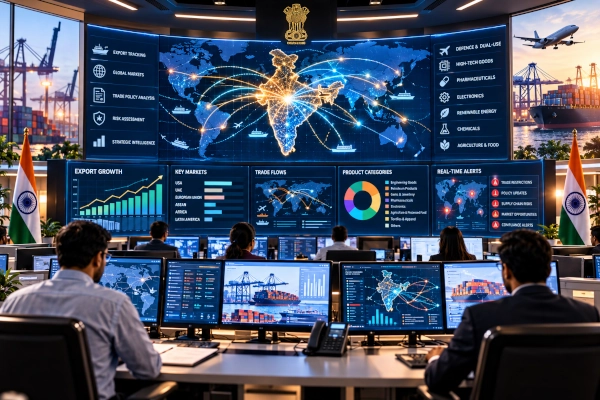
India has taken a major step towards modernising its international trade administration with the launch of the National Strategic Trade Command Centre (NSTCC) at Vanijya Bhawan in New Delhi. The new facility will strengthen trade intelligence, export monitoring and evidence-based policymaking by bringing together critical trade-related information through an integrated digital analytics platform.
Union Minister of Commerce and Industry Piyush Goyal inaugurated the National Strategic Trade Command Centre on October 15, 2026, in the presence of Commerce Secretary Rajesh Agrawal and Director General of Foreign Trade (DGFT) Lav Agarwal.
Developed by the Department of Commerce under the Ministry of Commerce and Industry, NSTCC aims to transform how India monitors international trade, evaluates export promotion schemes, processes regulatory applications and identifies emerging opportunities in overseas markets.
The Command Centre integrates information from multiple trade-related systems, allowing policymakers to examine trade performance, application processing, export obligations and regulatory requirements through interactive dashboards.
The initiative represents an important development in India’s digital trade governance, moving beyond conventional periodic reporting towards continuous monitoring, faster administrative intervention and informed policy decisions.
National Strategic Trade Command Centre Brings Trade Data onto a Unified Platform
The National Strategic Trade Command Centre has been established to provide senior policymakers and government officials with a consolidated view of India’s international trade ecosystem.
India’s foreign trade administration involves numerous processes, including exporter registration, import and export authorisations, certificates of origin, export promotion schemes and regulatory approvals.
These activities generate substantial quantities of information across different government systems and regional offices. The new Command Centre brings relevant information together through an integrated analytics and visualisation platform.
The system enables officials to examine trade-related indicators across multiple administrative and commercial dimensions. These include national trade performance, regional office activities, export promotion schemes, individual products, destination markets and regulatory applications.
By integrating these datasets, NSTCC will help government departments identify emerging trends, assess administrative performance and respond to operational challenges.
The platform has also been designed to support different levels of authorised access, ensuring that officials can examine information relevant to their responsibilities.
This integrated approach will strengthen coordination within India’s trade administration while improving the availability of information required for policy formulation.
Advanced Trade Intelligence to Identify New Export Opportunities
One of the principal objectives of NSTCC is to strengthen India’s ability to analyse international trade patterns and identify opportunities for exporters.The Command Centre enables product-wise and market-wise analysis, allowing officials to examine how different categories of Indian goods perform across overseas markets.
Such analysis can help identify products with growing export potential, regions showing changes in demand and markets where Indian businesses may find opportunities to expand their commercial presence.India exports a diverse range of products, including engineering goods, electronics, chemicals, pharmaceuticals, textiles, agricultural commodities and petroleum products.
Each of these sectors operates across different international markets, with varying regulatory requirements, tariff structures and commercial conditions.A consolidated trade intelligence system can help policymakers understand these differences and identify areas where targeted export promotion measures may be beneficial.
NSTCC will also support assessments of India’s trade positioning across international markets, providing information relevant to export competitiveness and market diversification.The availability of detailed product and destination-market information is expected to strengthen the government’s ability to develop export promotion strategies based on measurable trade trends.
Interactive Dashboards to Monitor Trade Performance
At the centre of NSTCC is an integrated analytics platform that converts trade-related information into interactive visual dashboards.
These dashboards provide information on key trade indicators, export promotion schemes, regulatory applications, processing timelines and operational performance.Government officials will be able to examine data at different levels, moving from national trade performance to individual schemes, regional offices and specific applications where access permissions allow.
The platform also provides information relating to pending applications and administrative processing times.These capabilities are intended to help policymakers identify delays that may affect exporters and importers.By presenting operational information through a common system, NSTCC can improve coordination between departments responsible for different aspects of foreign trade administration.
The Command Centre will also support performance assessments by comparing outcomes against established indicators.This approach allows officials to identify recurring administrative challenges and examine where procedural improvements may be required.
DGFT Services Integrated into the Command Centre
The initial phase of NSTCC incorporates dashboards covering several important functions of the Directorate General of Foreign Trade.These include the Importer Exporter Code, Advance Authorisation, Export Promotion Capital Goods scheme, Certificates of Origin, SCOMET authorisations and restricted imports and exports.
The integration of these functions creates a consolidated monitoring framework covering different stages of India’s foreign trade administration.
Importer Exporter Code Monitoring
The Importer Exporter Code (IEC) is a key identification requirement for businesses engaged in importing and exporting goods from India, subject to applicable exemptions.
The inclusion of IEC-related information within NSTCC will support monitoring of exporter and importer registrations and associated administrative processes.A consolidated view of registration-related indicators can help officials assess operational activity and identify issues affecting the delivery of trade services.
Advance Authorisation Scheme
The Advance Authorisation scheme allows eligible exporters to import inputs without payment of specified customs duties when those inputs are used to manufacture export products, subject to prescribed conditions.The scheme supports export competitiveness by reducing the duty burden on eligible imported inputs used in export production.
NSTCC will allow government officials to monitor relevant authorisations, scheme utilisation, processing performance and export obligations.This information can help identify administrative bottlenecks while supporting the effective implementation of export promotion measures.
Export Promotion Capital Goods Scheme
The Export Promotion Capital Goods (EPCG) scheme enables eligible businesses to import capital goods at concessional or zero customs duty, subject to prescribed export obligations.The scheme is intended to encourage investment in production technology and improve the competitiveness of export-oriented industries.
Through NSTCC, officials will be able to examine information concerning EPCG applications, scheme utilisation and related export obligations.Improved monitoring can support more effective administration of a scheme relevant to manufacturing enterprises investing in machinery and production equipment.
Certificates of Origin and Trade Agreement Utilisation
Certificates of Origin form an important part of international trade documentation, particularly when exporters seek preferential tariff treatment under applicable trade agreements.
These certificates establish the origin of exported products according to the relevant rules of origin.NSTCC incorporates information relating to Certificates of Origin and provides capabilities for examining the utilisation of trade agreements.
This can help policymakers assess how businesses use available trade preferences and identify areas where improved administrative processes or exporter awareness may support greater participation.India has trade agreements and economic partnerships with several countries and regional groupings, creating opportunities for exporters to access preferential market conditions.
However, the practical use of these arrangements depends upon compliance with origin requirements, product eligibility and other applicable conditions.The Command Centre’s analytical capabilities will support government assessments of trade agreement utilisation and provide information relevant to future trade facilitation measures.
SCOMET Dashboard to Improve Strategic Export Authorisations
A significant component of NSTCC concerns the monitoring of applications involving Special Chemicals, Organisms, Materials, Equipment and Technologies (SCOMET).
SCOMET regulations govern the export of specified dual-use goods, technologies and other controlled items that may have civilian and strategic applications.These controls form part of India’s framework for regulating sensitive international trade while fulfilling applicable national security and international commitments.
During the inauguration, Commerce and Industry Minister Piyush Goyal reviewed the SCOMET dashboard and emphasised the importance of expediting pending applications.He called for regular meetings of the Inter-Ministerial Committee, including weekly meetings where necessary, to address application backlogs and facilitate timely decisions.
The integrated dashboard will enable officials to examine application status, processing timelines and outstanding cases.Such monitoring can improve coordination among the government departments involved in evaluating strategic export authorisations.
The initiative is particularly relevant to industries operating in advanced manufacturing, electronics, aerospace, defence-related technologies and other sectors that may deal with controlled products or equipment.
The objective is to improve administrative efficiency while maintaining the regulatory oversight required for sensitive international trade.
Command Centre to Strengthen Monitoring Across DGFT Regional Offices
India’s foreign trade administration operates through a network of DGFT Regional Authorities responsible for delivering various regulatory and trade facilitation services.These offices process applications, provide authorisations and support businesses participating in international trade.
NSTCC introduces a consolidated mechanism for monitoring operational performance across Regional Authorities.The platform will allow authorised officials to examine indicators such as application processing times, pending cases and administrative performance.
Comparing these indicators across offices can help identify recurring challenges and opportunities for procedural improvements.The Command Centre will also support assessments of whether trade facilitation schemes and administrative processes are functioning as intended.
This approach is designed to strengthen accountability and improve consistency in the delivery of trade-related services.More efficient processing can support exporters and importers by reducing avoidable administrative delays and improving predictability.
Three Core Functions of India’s New Trade Command Centre
The Ministry of Commerce and Industry has identified three principal areas through which NSTCC will strengthen trade governance.
The first involves integrated monitoring, enabling government officials to maintain a consolidated view of trade trends, application processing, pending cases and emerging operational risks.Continuous access to these indicators can help departments identify issues requiring attention and coordinate appropriate responses.
The second area concerns performance assessment, allowing the government to evaluate the functioning of trade schemes, administrative processes and Regional Authorities against established performance indicators.This creates opportunities to identify gaps in implementation and improve the efficiency of existing services.
The third area focuses on evidence-based policy inputs. By analysing recurring bottlenecks, procedural difficulties and emerging international trade patterns, NSTCC can provide information to support policy simplification and targeted trade facilitation measures.
Together, these functions establish a framework for using administrative and trade data more effectively in government decision-making.
Integration with DGFT Digital Systems and Trade Connect ePlatform
NSTCC has been designed to use existing digital infrastructure rather than operate as an isolated government information system.
The Ministry confirmed that the Command Centre draws upon DGFT systems and the Trade Connect ePlatform, with provision for integrating additional datasets from other departments and trade-related agencies.The Trade Connect ePlatform is intended to support India’s international trade ecosystem by improving access to trade information and related services.
Integrating existing digital resources enables NSTCC to bring together data already generated through established administrative processes.This approach can improve the availability of information while reducing fragmentation across trade-related systems.
The Command Centre will progressively incorporate additional information sources as its capabilities expand.The integration of multiple systems will allow policymakers to develop a more comprehensive understanding of trade performance, regulatory administration and operational efficiency.
It also supports the government’s wider efforts to use digital technologies to simplify procedures and improve the delivery of public services.
Advanced Analytics and Automated Alerts Planned for Future Expansion
The Ministry of Commerce and Industry has outlined plans to progressively strengthen NSTCC through additional data integration, advanced analytics and automated alerts.
These capabilities are intended to improve the identification of changes in trade patterns and administrative performance.Automated alerts could help authorised officials recognise developments requiring attention, such as changes in operational indicators or the accumulation of pending applications.
Advanced analytical capabilities are also expected to improve the examination of product-level and market-level trade information.The system is being developed as a broader decision-support mechanism capable of integrating information from additional government departments and agencies.
The Ministry has also envisaged phased access for authorised stakeholders, including relevant ministries, state governments, Export Promotion Councils and other institutions.Such participation could strengthen coordination between national trade policy and regional industrial development activities.
The expansion of NSTCC will therefore involve both technological improvements and wider institutional participation.
Export Promotion Councils and State Governments Could Benefit from Integrated Trade Intelligence
India’s export promotion activities involve cooperation among central government departments, state governments, industry associations and Export Promotion Councils.
These institutions support businesses seeking to enter international markets, expand production and improve export competitiveness.The planned expansion of NSTCC will provide a framework for authorised stakeholders to access relevant trade intelligence and administrative information.
State governments may benefit from improved visibility into export performance across products and destination markets.Such information can support efforts to develop regional export industries, strengthen manufacturing clusters and identify sectors with international market potential.
Export Promotion Councils could also use relevant analytical information to understand emerging trade patterns and support sector-specific export promotion activities.The Ministry has identified these wider institutional connections as part of the Command Centre’s future development.
The initiative could therefore strengthen the relationship between trade intelligence, industrial development and export promotion across different regions of India.
Digital Trade Governance to Support India’s Export Competitiveness
India’s international trade system involves a wide range of industries, administrative procedures and commercial relationships.
Manufacturers and exporters depend upon efficient regulatory services, access to trade information and predictable processing of applications and authorisations.
Digital trade governance can help improve these processes by providing government departments with accurate information and mechanisms for monitoring administrative performance.NSTCC is intended to support this transition through integrated data analytics and coordinated decision-making.
The platform’s product-wise and market-wise analytical capabilities can help identify export opportunities, while its administrative dashboards can highlight processing delays and operational bottlenecks.This combination of trade intelligence and regulatory monitoring distinguishes NSTCC from systems focused exclusively on the publication of trade statistics.
The Command Centre provides a framework for translating trade-related information into policy and administrative decisions.By improving coordination and access to information, the initiative aims to strengthen the efficiency of India’s foreign trade administration and support the international competitiveness of Indian businesses.
India Moves Towards Continuous Monitoring of International Trade
The launch of the National Strategic Trade Command Centre marks an important development in India’s efforts to modernise international trade governance.Developed by the Department of Commerce, the facility brings together trade intelligence, export promotion monitoring and regulatory administration through an integrated digital platform.
Its initial dashboards cover major DGFT functions, including IEC registration, Advance Authorisation, EPCG, Certificates of Origin, SCOMET applications and restricted imports and exports.
The Command Centre also provides analytical capabilities for identifying export opportunities, examining trade agreement utilisation and assessing India’s position across international markets.With plans for additional data integration, automated alerts and wider institutional access, NSTCC is expected to develop into a broader government decision-support system.
The initiative reflects India’s increasing emphasis on digital administration, coordinated policymaking and the effective use of trade-related information.As the country’s manufacturing and services industries expand their international presence, the National Strategic Trade Command Centre will provide an important institutional foundation for improving export intelligence, strengthening trade facilitation and supporting India’s participation in global commerce.
References
1. Ministry of Commerce and Industry, Government of India — Press Information Bureau
Date: October 15, 2026
Title: Union Commerce and Industry Minister Shri Piyush Goyal Launches National Strategic Trade Command Centre at Vanijya Bhawan
Official announcement covering the inauguration of NSTCC, integrated trade dashboards, DGFT functions, strategic export authorisations, trade intelligence and future system expansion.
https://www.pib.gov.in/PressReleseDetailm.aspx?PRID=2324013
2. Directorate General of Foreign Trade, Ministry of Commerce and Industry
Official information concerning the Importer Exporter Code, Advance Authorisation, Export Promotion Capital Goods scheme, Certificates of Origin, SCOMET regulations and other trade facilitation services.
https://www.dgft.gov.in
3. Department of Commerce, Ministry of Commerce and Industry
Official information concerning India’s international trade policies, export promotion initiatives, trade agreements and trade administration.
https://commerce.gov.in
4. Trade Connect ePlatform — Government of India
Government digital trade facilitation platform supporting exporters and the international trade ecosystem.
https://www.tradeconnect.gov.in
You may also like
-
India’s ₹1,000 Crore Space Venture Capital Fund to Accelerate Indigenous Space Startups and Advanced Technologies
-
BHAVYA: India’s push to build 100 plug-and-play industrial parks
-
India’s Gem and Jewellery Exports Rise 9.43% to $2.95 Billion in September 2026, Driven by Gold Jewellery and Lab-Grown Diamonds
-
Biocon Secures Global Patent Settlement with Genentech for Pebrilzo Biosimilar, Targets European Launch in 2027
-
India’s Pharmaceutical Market Grows 17.1% to ₹25,300 Crore in September 2026, Strongest Growth in Three Years
