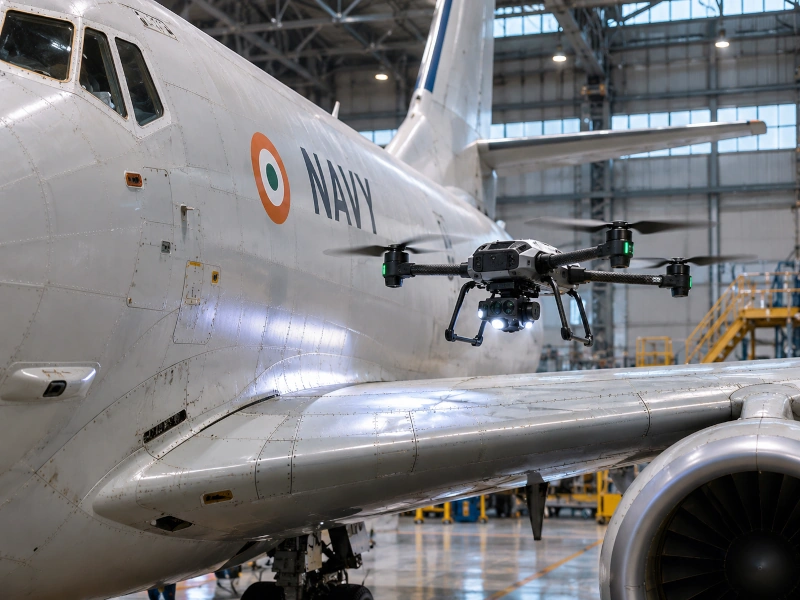
The project, designated DI-NAAIS (Drone Inspector – Naval Aircraft Automated Inspection System), represents an emerging application of unmanned aerial technology in aircraft maintenance. Rather than relying exclusively on conventional manual inspections, the proposed system will employ drones to examine aircraft surfaces and identify potential structural defects.
XINFINITI Aerospace has identified DI-NAAIS as one of its ongoing development programmes with the Indian Navy. The technology also featured in the company’s coverage associated with the Navy’s Swavlamban 2026 innovation initiative, highlighting the increasing involvement of Indian startups in developing specialised aviation maintenance solutions.
Automated Detection of Aircraft Surface Defects
The DI-NAAIS system is being developed to identify visible damage on aircraft structures, including cracks, scratches, burns and surface deformations. These defects can develop during routine operations, maintenance activities and prolonged exposure to demanding environmental conditions.
The proposed drone-based inspection process would allow maintenance personnel to examine aircraft surfaces systematically and identify areas requiring closer attention. The system is intended to determine the location, nature and approximate dimensions of detected defects, providing maintenance teams with information to support further technical assessments.
Automating preliminary inspections could reduce the time required to examine large aircraft surfaces while helping technicians focus on specific areas of concern. This approach would be particularly useful for aircraft operating in demanding maritime environments, where regular inspection and preventive maintenance are essential to maintaining operational availability.
Strengthening Maintenance Capabilities in Naval Aviation
Indian naval aircraft operate in environments characterised by high humidity, salt exposure and demanding operational schedules. These conditions make systematic inspection of airframes and external components particularly important.
Aircraft maintenance involves identifying structural deterioration, assessing surface damage and ensuring that aircraft remain fit for operational deployment. Conventional inspections can require personnel to examine extensive surfaces, sometimes using specialised access equipment to reach elevated or otherwise difficult locations.
Drone-based inspection technology offers an alternative method of conducting preliminary visual assessments. Equipped with suitable imaging equipment, unmanned aerial platforms can examine external aircraft structures and collect imagery for subsequent technical evaluation.
For the Indian Navy, such systems could support maintenance planning by improving the documentation of visible defects and helping engineering teams prioritise detailed inspections. The technology could also contribute to more consistent maintenance records, supporting the monitoring of aircraft condition over successive inspections.
Indigenous Innovation Through the iDEX Programme
The development of DI-NAAIS forms part of the Indian Navy’s broader effort to encourage domestic companies and technology startups to address specialised defence requirements.
The Innovations for Defence Excellence initiative provides a framework for collaboration between the Armed Forces, startups, MSMEs and other technology developers. It seeks to accelerate indigenous solutions in areas where emerging technologies can improve operational capabilities and reduce dependence on imported systems.
At the fifth edition of the Naval Innovation and Indigenisation Seminar, Swavlamban 2026, held in New Delhi on 26–27 October 2026, the Navy highlighted technologies covering autonomous platforms, artificial intelligence, advanced communications and other emerging defence applications.
The Ministry of Defence stated that the event featured more than 100 exhibition stalls involving startups and MSMEs working on naval technology requirements. The exhibition demonstrated the growing role of India’s domestic innovation ecosystem in addressing operational challenges identified by the Armed Forces.
XINFINITI Aerospace Expanding Indigenous Naval Technologies
Bengaluru-headquartered XINFINITI Aerospace specialises in aerospace engineering, systems integration, autonomous aircraft development and aviation safety technologies.
The company was incorporated in 2024 and brings together specialists with experience in military aviation and aerospace engineering. Its development activities include aircraft modification, manned-to-unmanned conversion, flight testing and support for airworthiness certification.
Alongside DI-NAAIS, XINFINITI is working on the Naval Chetak Autonomous System (NCAS), which aims to convert the Chetak helicopter into an unmanned aircraft platform. Another programme involves the Helicopter Emergency Flotation System (HEFS), designed to improve helicopter safety during emergency water landings.
These initiatives reflect the company’s expanding involvement in indigenous aviation technologies, particularly systems intended to improve aircraft safety, operational flexibility and maintenance capabilities.
Advancing India’s Indigenous Aerospace Maintenance Ecosystem
The DI-NAAIS project illustrates how drone technology can be employed beyond conventional surveillance, reconnaissance and combat applications.
Aircraft inspection represents an important area for automation because maintenance activities directly influence fleet availability, operational readiness and lifecycle costs. Indigenous inspection systems could enable Indian defence organisations to develop specialised maintenance solutions suited to their aircraft and operating environments.
The technology also has potential applications beyond naval aviation, including military transport aircraft, helicopters and civilian aircraft maintenance. Automated inspection platforms could eventually support maintenance facilities responsible for large and diverse aircraft fleets.
DI-NAAIS remains an ongoing development programme, with publicly available information not yet establishing completed operational trials, inspection accuracy or induction into naval service. Its development nevertheless demonstrates the increasing participation of Indian aerospace startups in specialised engineering and maintenance technologies.
Through collaborations such as this, the Indian Navy is expanding opportunities for domestic companies to develop technologies addressing practical aviation requirements, strengthening India’s indigenous aerospace engineering and defence maintenance ecosystem.
You may also like
-
INS Surat Arrives in Oman for Naseem Al Bahr 2026, Strengthening India’s Maritime Security Partnership
-
AstraZeneca to Introduce Advanced Breast Cancer Medicine Datverzo in India in November
-
IIT Kanpur-Incubated ScaNxt Secures Investment to Expand AI-Powered Soil Testing and Precision Agriculture
-
Indore Agritech Startup Pragyanik AI Develops Autonomous Agricultural Robot for Precision Weeding and Spraying
-
Indian-Founded Robotics Startup Ottonomy Raises $4.2 Million to Expand Autonomous Healthcare and Industrial Logistics
