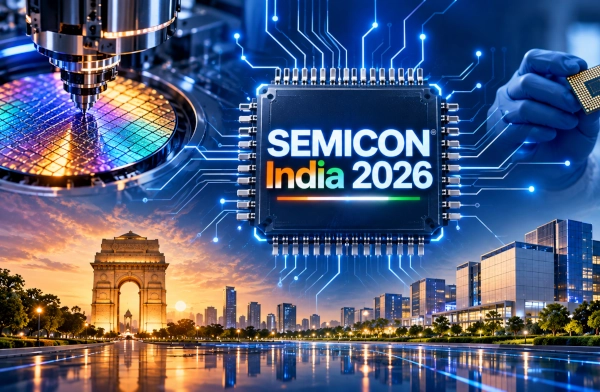
India has announced a $13.5 billion second phase of its semiconductor mission as the country moves from building its initial chip-manufacturing ecosystem towards commercial production, deeper research and a broader domestic supply chain.
Prime Minister Narendra Modi announced the expansion while inaugurating SEMICON India 2026 in New Delhi on September 17, saying semiconductor projects established under India’s first phase have begun progressing from policy approvals and construction to production.
The government now wants the next stage of the programme to extend beyond semiconductor fabrication and assembly by strengthening Indian capabilities in chip design, intellectual property, equipment, materials, chemicals, advanced packaging and emerging technologies such as silicon photonics.
India Moves From Semiconductor Plans to Production
India launched its semiconductor programme in 2021 and held the first SEMICON India conference in 2022, when much of the country’s semiconductor strategy remained at the policy and investment-attraction stage.
Four years later, the ecosystem is beginning to move into manufacturing.
Modi said semiconductor chips produced at Indian facilities have started reaching customers in India and overseas. He also referred to the commencement of commercial production at two additional facilities in Mohali and Surat, presenting the transition as evidence that India’s semiconductor programme is moving beyond project announcements.
Developing a domestic semiconductor industry involves considerably more than constructing fabrication plants. Chip design, fabrication, assembly, testing, packaging, specialised machinery, gases, chemicals and materials must operate as parts of an interconnected supply chain.
India’s next phase is intended to develop more of these capabilities domestically.
Semiconductor Mission 2.0 Gets $13.5 Billion Push
The Prime Minister announced a $13.5 billion second phase of the India Semiconductor Mission, substantially extending the country’s effort to establish itself within the global semiconductor supply chain.
The government is also introducing regulatory changes intended to make collaboration easier among international semiconductor companies, Indian startups and chip-design firms.
While semiconductor fabrication attracts much of the attention because of the cost and technological complexity of fabs, the government is increasingly focusing on the industries surrounding them.
India wants to develop a larger base of fabless semiconductor companies, encourage creation of Indian intellectual property and attract manufacturers and suppliers of semiconductor equipment, speciality chemicals, gases and materials.
With 12 semiconductor projects approved, the government sees an opportunity to create a domestic supplier ecosystem around the facilities rather than allowing most specialised inputs to continue arriving from overseas.
India Wants More Semiconductor Intellectual Property
Chip manufacturing is only one part of the economic value generated by the semiconductor industry. Considerable value lies in the intellectual property used to design processors, communication chips, power electronics, sensors and specialised computing systems.
India already has a large engineering workforce involved in semiconductor design for international companies. The next objective is to translate more of that engineering capability into intellectual property and products developed within the country.
The government is therefore encouraging the expansion of fabless semiconductor companies — businesses that design chips while outsourcing their physical manufacturing to semiconductor foundries.
Modi also identified silicon photonics as an area requiring greater attention, particularly as artificial intelligence and high-performance computing increase demand for faster movement of data between processors, memory and other components.
70,000 Engineering Students Already Trained
Human capital forms another major component of India’s semiconductor strategy.
The government has established a target of training 100,000 engineering students in semiconductor-related disciplines, of whom approximately 70,000 have already undergone training, according to the Prime Minister.
Indian students are also gaining experience designing custom chips, providing a potential pipeline of engineers for semiconductor design houses, manufacturing facilities and startups.
Modi called on Indian researchers working overseas to participate in the development of advanced technologies in India while urging semiconductor companies to establish more research and development operations within the country.
For India, attracting semiconductor R&D alongside manufacturing would be important because it would allow the domestic ecosystem to participate in technological development rather than functioning primarily as a manufacturing location.
AI Is Changing What Semiconductor Companies Need
The rapid growth of artificial intelligence is also changing the semiconductor industry’s technological requirements.
For decades, semiconductor advancement was closely associated with reducing transistor dimensions and placing progressively more transistors onto individual chips. That remains important, but AI computing has increased the significance of system-level integration, advanced packaging, memory architecture, high-speed interconnects and thermal management.
AI accelerators need enormous quantities of data to move rapidly between processors and memory. At the same time, high-performance chips generate substantial heat and consume large amounts of electricity.
This creates opportunities across semiconductor packaging, memory integration, silicon photonics, cooling technologies and power electronics — areas India wants its emerging ecosystem to address rather than concentrating exclusively on conventional fabrication.
Semiconductor Ambitions Increasingly Linked to India’s Energy Strategy
The expansion of AI infrastructure and semiconductor manufacturing also creates an enormous energy requirement.
Semiconductor fabs require highly reliable electricity, while AI data centres can consume power on a scale comparable with major industrial facilities. Building both industries therefore depends partly on the availability of large quantities of uninterrupted electricity.
Modi linked India’s semiconductor strategy with the country’s expansion of its electricity infrastructure, pointing to solar capacity that has now crossed 160 GW and plans to increase nuclear-energy capacity.
The government is also opening parts of the nuclear-energy sector to private participation and pursuing technologies including small modular reactors, which could eventually provide additional sources of reliable low-carbon electricity for energy-intensive industries and data centres.
Energy availability is consequently becoming an increasingly important component of India’s attempt to attract semiconductor and AI infrastructure investment.
Global Supply-Chain Diversification Creates an Opening for India
India’s semiconductor push comes as manufacturers and governments reassess the geographic concentration of critical technology supply chains.
The semiconductor shortages experienced earlier in the decade demonstrated how disruptions at a relatively small number of manufacturing centres could affect automobiles, electronics, telecommunications equipment and other industries around the world.
India is seeking to position itself as another large and reliable manufacturing location as companies diversify production and supply chains.
Its potential advantages include a large engineering workforce, a rapidly expanding electronics market, growing domestic manufacturing demand and government incentives for semiconductor projects.
The challenge is to develop the specialised supplier networks, infrastructure, technical expertise and manufacturing scale accumulated over decades by established semiconductor centres.
From Silicon Manufacturing to a Complete Ecosystem
The next stage of India’s semiconductor programme therefore extends considerably beyond producing chips within the country’s borders.
The government’s stated objective is an ecosystem encompassing chip design, fabrication, packaging and testing, equipment, materials, gases, chemicals, intellectual property, research and a trained engineering workforce.
The emergence of AI adds another layer to that strategy by increasing demand for specialised processors, memory, advanced packaging, silicon photonics and high-performance computing infrastructure.
With commercial production beginning at Indian facilities, 12 semiconductor projects approved, around 70,000 engineering students already trained and $13.5 billion being committed to the second phase of the semiconductor mission, India’s semiconductor programme is entering a different stage.
The first phase was largely about establishing that semiconductor manufacturing could be built in India. The next phase will determine how much of the semiconductor value chain India can build around it.
References
Press Information Bureau, Government of India. “Prime Minister Shri Narendra Modi inaugurates SEMICON India 2026.” Prime Minister’s Office, 17 September 2026.
India Semiconductor Mission (ISM), Ministry of Electronics and Information Technology, Government of India. Official information on India’s semiconductor ecosystem and semiconductor manufacturing programme.
Ministry of Electronics and Information Technology (MeitY), Government of India. Semiconductor and electronics manufacturing initiatives under the India Semiconductor Mission.
SEMICON India 2026. Official conference and industry programme, New Delhi, 17–19 September 2026.
You may also like
-
Nayan Technologies Selected by JSW MG Motor to Advance AI-Based Road Monitoring and Smart Mobility
-
From ‘We Will Coup Whoever We Want’ to Starlink in India: Elon Musk, Corporate Pressure and National Sovereignty
-
Starlink-Ukraine, Myanmar and Drug Smuggling: Why India Must Regulate Satellite Internet for National Security
-
Four ICAR-Developed Potato Varieties Account for Nearly 75% of India’s Cultivation Area
-
JSW Steel’s Crude Steel Production Rises 5% to 7.27 Million Tonnes in Q2 FY2027
