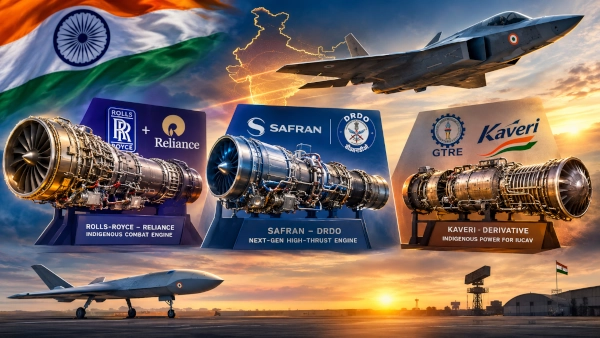
India’s long-standing dependence on foreign fighter-engine technology may be approaching its most consequential phase yet. Three separate propulsion tracks are now taking shape around the country’s effort to build sovereign military aero-engine capability: the newly announced Rolls-Royce–Reliance partnership, the government-led engagement with France and Safran, and DRDO’s continuing development of the indigenous Kaveri and Kaveri Derivative Engine family.
The three should not, however, be confused as three engines already ordered for the Advanced Medium Combat Aircraft. Their status and objectives differ considerably.
Rolls-Royce and Reliance Industries announced their strategic intent on August 14, 2026 to jointly offer an indigenous combat-engine solution for the AMCA programme. India is separately pursuing an aero-engine development process with France under the government’s National Aero Engine Mission, with Safran positioned as the principal French propulsion company. Meanwhile, DRDO’s Gas Turbine Research Establishment continues to develop the Kaveri technology base, including a flightworthy dry derivative intended for an indigenous unmanned combat aircraft.
Taken together, these developments show that India is no longer looking merely for another imported fighter engine. The larger objective is to acquire the capability to design, develop, test, manufacture, upgrade and support advanced gas turbines inside India.
The Engine Remains India’s Biggest Fighter-Technology Gap
India has successfully developed increasingly sophisticated combat aircraft, missiles, radars, electronic-warfare systems and weapons. Yet the powerplants of its frontline fighters remain overwhelmingly foreign-origin.
The Tejas Mk1 and Mk1A use GE Aerospace’s F404 family, while the more powerful F414-GE-INS6 has been selected for the LCA Mk2 and for the development, testing and certification phase of the AMCA. GE Aerospace has officially confirmed that the first AMCA aircraft will initially be powered by twin F414s.
The Rolls-Royce, Safran and Kaveri efforts are about India’s longer-term sovereign propulsion capability. They do not replace the F414 overnight, nor do they mean that an indigenous AMCA engine will be available for the first prototype.
The real target is the generation of aircraft that follows the initial AMCA configuration and India’s future combat-air programmes.
1. Rolls-Royce and Reliance Enter the AMCA Engine Race
The newest development came on August 14, 2026, when Reliance Industries and Rolls-Royce formally announced their strategic intent to collaborate on a sovereign indigenous combat engine for India’s AMCA.
Their official statement says the two companies intend to combine Rolls-Royce’s propulsion technology with Reliance’s manufacturing and industrial capabilities across design, development, manufacturing and delivery of the proposed engine.
The partnership goes considerably further than simply proposing to assemble an existing foreign engine in India.
Rolls-Royce and Reliance say they will explore establishing a dedicated Aerospace Gas Turbine Complex in India, envisioned as a centre of excellence for advanced power and propulsion technology.
According to their announcement, the proposed complex would develop end-to-end Indian capability covering:
design and engineering, development, manufacturing, engine testing, production and through-life support.
True engine sovereignty requires far more than manufacturing components under licence. It requires the ability to understand the complete engine, modify it, improve it, diagnose failures and develop subsequent generations without returning to the foreign original equipment manufacturer for every critical change.
Rolls-Royce has repeatedly argued that India should possess intellectual property and design capability rather than remaining limited to licensed production. The company has worked with India’s military aviation ecosystem for decades, and more than 750 Rolls-Royce engines of ten types have powered Indian military aircraft.
Reliance Brings a Major Private-Sector Player Into Aero Engines
The Reliance element makes the proposal particularly interesting.
Reliance Industries brings enormous financial capacity, advanced manufacturing experience and the ability to establish industrial infrastructure on a scale that few Indian private companies can match.
Anant Ambani, Executive Director of Reliance Industries, said the objective is to combine Rolls-Royce’s advanced propulsion knowledge with Reliance’s manufacturing, technology and execution capabilities to create an indigenous aero-engine ecosystem.
If the partnership eventually wins a government programme, it could also mark a significant change in India’s defence-industrial model by placing a major private-sector company at the centre of one of the country’s most difficult strategic technologies.
However, there is an important qualification.
The August 14 announcement is a strategic intent and industrial proposal. It is not an announcement that the Government of India has awarded the AMCA engine development contract to Rolls-Royce and Reliance.
That distinction should remain clear until the Ministry of Defence or DRDO announces a formal selection.
2. Safran and DRDO: The French Route to a New High-Thrust Engine
The second track is older and has progressed through government-to-government discussions between India and France.
Defence Minister Rajnath Singh provided one of the clearest official updates during his visit to DRDO’s Gas Turbine Research Establishment in Bengaluru on February 16, 2026.
The Ministry of Defence said GTRE had undertaken a joint study with the United Kingdom for aero-engine development and that a process had also been initiated with France under the National Aero Engine Mission.
Safran is central to the French propulsion proposition.
The company has an extensive existing relationship with India. Its M88 engine powers the Rafale, while Safran and HAL have jointly built a large helicopter-engine ecosystem around the Shakti/Ardiden family. Safran says more than 1,200 of its helicopter turbine engines are in service with the Indian Armed Forces.
More importantly for a future fighter engine, Safran and HAL signed an agreement as far back as 2021 covering potential cooperation on the design and development of high-thrust engines of 110 kN and above, including the transfer of key technologies.
That thrust class moves the discussion firmly into the territory required for future medium-weight combat aircraft.
A Clean-Sheet Engine Rather Than Another M88
India’s objective is not simply to manufacture the Rafale’s M88 engine under licence.
The strategic requirement is for a substantially more powerful next-generation engine designed around India’s future fighter requirements.
Public reporting has placed the proposed engine broadly in the 120 kN-class or above, although the final specifications will depend on the government’s approved programme and the AMCA’s evolving requirements. The Ministry of Defence has officially confirmed that cooperation with France has been initiated under the National Aero Engine Mission, but it has not yet publicly announced a final production contract containing all technical, financial and intellectual-property terms.
That distinction becomes especially important following the Rolls-Royce–Reliance announcement.
India now appears to have more than one potential route to acquiring the technologies required for its future high-thrust combat engine.
Safran Has Been Building an Engine Ecosystem in India
Safran’s proposition is strengthened by a rapidly expanding industrial presence in India.
The company operates 18 sites and employs around 3,500 people in India, according to its current corporate profile. It has established civil-engine manufacturing and maintenance operations, works with HAL on helicopter engines and has announced an M88 maintenance facility in Hyderabad for Rafale engines.
Safran and HAL also have experience in genuine engine co-development rather than simple assembly. The Shakti engine used by India’s ALH Dhruv and LCH Prachand emerged from this partnership and is produced in Bengaluru with substantial Indian participation.
The challenge will be whether this experience can be extended into the vastly more demanding world of high-performance afterburning turbofans for stealth fighters.
3. Kaveri: India’s Indigenous Engine Programme Is Far From Dead
The third track is fundamentally different.
Unlike the Rolls-Royce and Safran pathways, Kaveri originated as an Indian engine designed by DRDO’s Gas Turbine Research Establishment.
The programme originally sought to power the Light Combat Aircraft, but the engine could not achieve the performance required by the evolving Tejas design. India ultimately selected GE’s F404 for the aircraft.
That setback often causes Kaveri to be described as a failed or abandoned engine. That description is now incomplete.
The technologies developed through Kaveri have continued to evolve, and the programme has increasingly shifted toward derivatives suitable for other aircraft.
The strongest official evidence came on February 16, 2026, when Defence Minister Rajnath Singh visited GTRE and personally witnessed a full-afterburner test of the Kaveri engine.
That test demonstrated that the afterburning Kaveri technology programme remains active even though the original engine is no longer intended to power the Tejas.
Kaveri Dry Engine Moves Towards an Unmanned Combat Aircraft
The most mature potential operational application is the Kaveri Derivative Engine, or KDE.
In an official parliamentary reply, the Ministry of Defence identified the KDE as the intended powerplant for India’s remotely piloted strike aircraft, also described as the IUCAV aircraft.
Two dedicated projects have been sanctioned:
Flightworthy Kaveri Dry Engine Development — ₹472.42 crore
and
Technology Demonstration of Kaveri Derivative ‘Dry’ Engine — ₹251.17 crore.
A “dry” engine operates without an afterburner. That makes it particularly suitable for an unmanned combat aircraft where endurance, fuel efficiency and reduced infrared signature can be more important than the enormous short-duration thrust required by a supersonic fighter during combat manoeuvres.
DRDO has publicly displayed the Kaveri Dry Engine Prototype alongside its other indigenous propulsion technologies.
If the Kaveri derivative completes flight qualification and enters service on an Indian unmanned combat platform, it would mark an important transition: technology born from India’s unsuccessful attempt to independently power the Tejas would finally enter an operational aircraft of a different class.
Kaveri’s Real Value Goes Beyond One Engine
The most important contribution of Kaveri may ultimately be the engineering base it created.
Military turbofans require expertise across compressors, combustors, high-pressure turbines, afterburners, digital engine controls, bearings, thermal-barrier coatings, high-temperature alloys, cooling systems and precision manufacturing.
These technologies cannot simply be acquired by purchasing finished foreign engines.
During his February 2026 GTRE visit, Rajnath Singh specifically highlighted the complexity of aero-engine development and noted the importance of areas such as thermodynamics, material science, fluid mechanics and advanced mechanical engineering. He also pointed to GTRE’s work on high-temperature composites.
The experience accumulated through Kaveri consequently provides India with something extremely valuable when negotiating a future partnership with Rolls-Royce or Safran: an existing body of engineers who understand the challenges of designing a military gas turbine.
India would be attempting to absorb foreign technology into an established domestic propulsion programme rather than beginning from zero.
Two Foreign Partnerships — But One Sovereign Objective
The emergence of the Rolls-Royce–Reliance proposal alongside the French Safran track does not necessarily mean India will build two different 120-kN-class engines for AMCA.
That would be extraordinarily expensive and technically demanding.
A more accurate interpretation is that India currently has multiple pathways towards the same strategic objective: acquiring sovereign high-thrust combat-engine capability.
Rolls-Royce and Reliance are positioning themselves to offer one industrial-development model.
India and France are pursuing another framework under the National Aero Engine Mission, with Safran possessing the relevant fighter-engine expertise.
GTRE and Kaveri provide the indigenous technological foundation on which India can absorb and subsequently improve whatever technologies emerge from an international collaboration.
The government will ultimately have to decide how these tracks fit together.
AMCA Mk1 Will Still Begin With GE F414
None of these developments means that India is waiting for the future indigenous engine before flying the AMCA.
GE Aerospace has officially confirmed that the F414-GE-INS6 is selected for AMCA prototype development, testing and certification and that the first AMCA aircraft will initially use two F414 engines.
This gives India a lower-risk route to getting the stealth fighter airborne.
The indigenous high-thrust programme can then mature alongside the aircraft instead of holding up the entire AMCA development schedule.
The broad strategy therefore becomes:
F414 for the initial AMCA development and early aircraft, followed by a substantially more indigenous next-generation engine for later AMCA variants and future fighters.
That approach also creates time for India to develop the materials, manufacturing processes, test infrastructure and engineering workforce required to absorb sophisticated engine technologies.
Three Tracks Serving Different Missions
The three propulsion efforts can therefore be understood as follows:
| Programme | Current Role | Status |
|---|---|---|
| Rolls-Royce–Reliance | Proposed sovereign combat engine for future AMCA | Strategic partnership announced August 14, 2026; government engine award not yet announced |
| Safran–India/DRDO | High-thrust next-generation fighter engine under National Aero Engine Mission | Government has confirmed process initiated with France; detailed final contract not publicly announced |
| Kaveri / Kaveri Derivative | Indigenous technology base; dry engine for unmanned combat aircraft and continued afterburning-engine research | Active DRDO development; flightworthy dry-engine projects sanctioned; full-afterburner Kaveri test demonstrated in February 2026 |
These are therefore three strands of one much larger propulsion strategy, rather than three identical competing projects.
From Manufacturing Engines to Owning Engine Technology
India already manufactures several foreign-origin engines and engine components domestically. HAL has decades of experience producing and maintaining powerplants for aircraft ranging from Jaguars and Sukhois to helicopters.
But licensed manufacture is different from technological ownership.
A country that genuinely controls an aero-engine must be able to alter the compressor, increase turbine temperatures, redesign cooling passages, modify the combustor, integrate new materials, improve thrust, extend component life and develop another engine from the knowledge acquired.
That is the capability India is now attempting to build.
Rolls-Royce and Reliance explicitly describe their objective as sovereign end-to-end capability in India. The government is pursuing French cooperation under its National Aero Engine Mission. Meanwhile, GTRE continues to run indigenous engines and develop Kaveri derivatives.
Together, these represent a major change from India’s traditional approach of purchasing a foreign engine and progressively localising its manufacture.
The Next Five to Seven Years Will Be Critical
Rajnath Singh’s remarks at GTRE perhaps best capture the urgency surrounding the programme.
The Defence Minister noted that countries can take 25 to 30 years to develop advanced aero engines, but urged India’s scientific community to compress those timelines. He argued that India should behave as though two decades of that development period had already passed and only five to seven years remained to achieve the next breakthrough.
That reflects the strategic reality confronting the country.
India is simultaneously developing the LCA Mk2, AMCA, unmanned combat aircraft and future naval and combat-air platforms. An indigenous aircraft industry that remains permanently dependent on imported engines cannot achieve complete strategic autonomy.
The Kaveri programme showed just how difficult the technology is. But it also created laboratories, engineers, materials knowledge and test infrastructure that India did not possess when the programme began.
Safran offers one route towards closing the remaining technological gaps. Rolls-Royce, now partnered with Reliance Industries, has offered another.
The critical measure of success will therefore not simply be whether India produces an engine carrying an Indian nameplate.
Success will come when Indian engineers possess the design knowledge, materials technology, manufacturing capability, test infrastructure and intellectual property required to create the next engine themselves.
If that objective is achieved, the Rolls-Royce–Reliance proposal, the Safran collaboration and the Kaveri programme could eventually be remembered not as three disconnected engine projects, but as the period in which India finally crossed one of the last major technological barriers to becoming a fully sovereign combat-aircraft power.
Official Sources
Rolls-Royce — August 14, 2026: Official announcement of strategic intent with Reliance Industries to develop and deliver an indigenous combat engine for the AMCA and explore an Aerospace Gas Turbine Complex in India.
Reliance Industries — August 14, 2026: Joint corporate announcement detailing the proposed Rolls-Royce–Reliance partnership and sovereign end-to-end engine capabilities.
Ministry of Defence / PIB — February 16, 2026: Official account of Defence Minister Rajnath Singh’s visit to GTRE, confirmation of the full-afterburner Kaveri test and confirmation that the process with France has been initiated under the National Aero Engine Mission.
Ministry of Defence / PIB — July 25, 2025: Official parliamentary reply confirming the Kaveri Derivative Engine for the IUCAV and sanction of ₹472.42 crore for the flightworthy dry engine and ₹251.17 crore for technology demonstration.
Safran Aircraft Engines: Official HAL-Safran agreement covering potential design and development of high-thrust engines of 110 kN and above, including transfer of key technology.
GE Aerospace: Official confirmation that F414-GE-INS6 engines will support AMCA prototype development, testing and certification and initially power the first AMCA aircraft.
You may also like
-
India Moves Towards Five-Year Assured Orders for Defence Startups Under New Procurement Reforms
-
Zen Technologies Introduces Indigenous Hyper-Strike Falcon AI-Guided Counter-Drone Interceptor
-
L&T and Germany’s SCHOTTEL Expand Partnership for Controllable Pitch Propeller Systems in Indian Shipbuilding
-
India to Train 60,000 Civil Defence Volunteers Across 12 States and UTs with Indian Army Support
-
Indian Army’s Northern Command Opens 75-Day Defence Technology Internship Programme for Young Innovators
