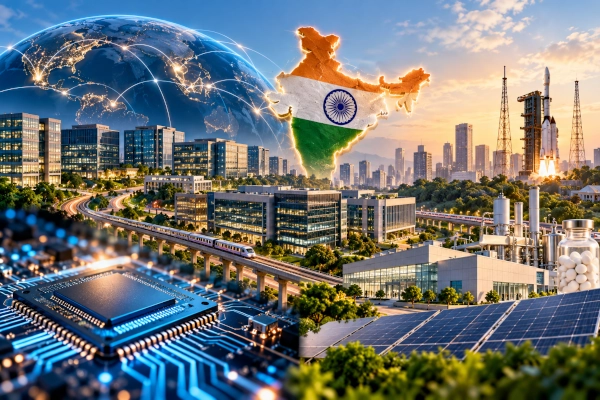
India has strengthened its position as a major centre for global technology, innovation and advanced engineering, hosting more than half of the world’s Global Capability Centres (GCCs). Prime Minister Narendra Modi highlighted this achievement while addressing the NDTV World Summit 2026 in New Delhi on 22 October, stating that India now ranks among the world’s top three artificial intelligence and startup ecosystems.
The Prime Minister emphasised that India’s contribution to international technology industries has evolved considerably over the past decade. Global companies increasingly rely on Indian professionals for sophisticated activities involving artificial intelligence, cloud computing, engineering research, data analytics and product development. These responsibilities extend far beyond the conventional support services that initially established India’s reputation in the international technology sector.
Modi described this transformation as India’s transition from the world’s back office to a centre for advanced intellectual and technological work. He also highlighted the country’s expanding capabilities in semiconductor design, scientific research, digital payments, intellectual property development and indigenous manufacturing. Together, these developments reflect India’s efforts to move towards higher-value participation in global technology and industrial supply chains.
India Hosts More Than Half of the World’s Global Capability Centres
Prime Minister Modi stated that more than half of the world’s Global Capability Centres operate in India, reflecting the country’s established position in international business and technology services. These centres, established by multinational corporations, perform specialised functions that support their global operations, ranging from information technology and financial management to engineering, research and product development.
India’s GCC industry has undergone an important transformation as companies have expanded the responsibilities assigned to their Indian operations. Many centres now participate in artificial intelligence development, cloud architecture, cybersecurity, advanced analytics and digital product engineering. Indian teams contribute to designing technologies and managing complex systems that support businesses and customers across international markets.
This shift has increased the importance of India’s skilled engineering workforce. Global enterprises are drawing upon domestic expertise in software development, electronics, data science and industrial research to undertake projects that require specialised technical knowledge. The expansion of these responsibilities also creates opportunities for cooperation between multinational companies, Indian universities, research institutions and domestic technology enterprises.
The Prime Minister described this change as a movement from Talent at Scale towards Thinking at Scale, reflecting the growing importance of original ideas, technological expertise and innovation within India’s economic development. The country’s ability to combine a large skilled workforce with expanding research and engineering capabilities has become a major factor in attracting complex international technology operations.
India Emerges Among World’s Leading AI and Startup Ecosystems
India ranks among the world’s top three artificial intelligence and startup ecosystems, according to Prime Minister Modi. He presented these achievements as evidence of the country’s expanding technological capabilities and the growing contribution of entrepreneurs to innovation-led economic development.
India’s artificial intelligence ecosystem includes technology startups, established information technology companies, multinational research centres, universities and government-supported institutions. These organisations are developing applications across healthcare, agriculture, financial services, education, manufacturing and industrial automation. Advances in machine learning, natural language processing and data analytics are also creating opportunities for Indian companies to develop products for domestic and international markets.
The startup ecosystem has expanded beyond consumer-facing digital services into technology-intensive sectors requiring substantial research and engineering expertise. Indian enterprises are increasingly active in semiconductor technologies, robotics, aerospace engineering, biotechnology, advanced materials and clean-energy systems. Such businesses contribute to the development of specialised technologies and encourage closer interaction between research institutions, investors and industrial manufacturers.
Government initiatives supporting entrepreneurship, digital infrastructure and indigenous technology development have contributed to this environment. However, the global rankings cited by the Prime Minister were not accompanied by a specific international index or methodology in the address. They are therefore best understood as his assessment of India’s position within the international innovation landscape.
Indian Engineers Represent Nearly 20% of Global Chip-Design Workforce
India’s expanding semiconductor design capabilities formed an important part of the Prime Minister’s address. Modi stated that approximately 20% of the world’s semiconductor chip-design workforce is based in India, with Indian engineers participating in the development of advanced technologies involving 2-nanometre and 3-nanometre semiconductor process designs.
Semiconductor design is a highly specialised field involving electronic architecture, circuit engineering, verification, software tools and performance optimisation. These activities support the development of chips used in computers, smartphones, telecommunications equipment, automobiles, artificial intelligence systems and other sophisticated electronic products. India’s large pool of engineering talent has encouraged major international semiconductor companies to establish design and development operations within the country.
The Prime Minister also highlighted the contribution of Indian academic institutions, stating that students have designed more than 325 semiconductor chips. Such projects provide opportunities for practical training in electronics, circuit design and advanced engineering. They also help educational institutions develop closer relationships with industry by preparing students for specialised technological roles.
Semiconductor design expertise represents an important foundation for India’s wider ambitions in electronics manufacturing. Although chip design and semiconductor fabrication are distinct activities, strengthening domestic knowledge across the semiconductor value chain can encourage research, intellectual property development and the growth of specialised Indian technology companies.
Scientific Research and Patent Filings Reflect Growing Innovation Activity
Prime Minister Modi stated that India ranks third globally in scientific research publications and recorded approximately 1.5 lakh patent filings during 2025. He presented these figures as indicators of the country’s expanding research capabilities and growing emphasis on innovation.
Scientific research in India covers a broad range of disciplines, including engineering, medicine, agriculture, biotechnology, materials science, information technology and fundamental sciences. Universities, national laboratories, specialised research institutions and industrial research centres contribute to this output through studies that advance scientific understanding and support technological development.
The increasing attention given to patent protection reflects the importance of intellectual property in modern industrial competition. Patents provide a legal framework through which inventors and organisations may protect eligible technological developments. For research-intensive companies, intellectual property can support commercialisation, licensing, technology partnerships and further investment in product development.
Patent applications, however, should be distinguished from patents granted or inventions that have achieved commercial success. Similarly, research publication volume does not independently measure scientific quality or practical impact. Nevertheless, both indicators provide useful insights into India’s expanding participation in organised research and innovation activities.
The combination of scientific research, specialised engineering education and intellectual property development can strengthen India’s ability to design original technologies rather than depend exclusively on imported products and technical solutions.
India’s Digital Economy Strengthens Its Global Technology Position
The Prime Minister highlighted India’s position as one of the world’s largest digital economies and its leading role in real-time digital payments. The expansion of digital infrastructure has transformed financial transactions, public services and commercial activities across the country.
The Unified Payments Interface (UPI) has become an important component of India’s digital financial ecosystem by enabling electronic transactions between individuals and businesses through participating financial institutions and payment applications. Its widespread adoption has encouraged digital payments across retail establishments, service providers, small enterprises and other segments of the economy.
India’s digital public infrastructure has also created opportunities for financial technology startups, software developers and businesses to build services around interoperable technology platforms. Digital identity, electronic payments and online service delivery have helped establish an environment in which technology-enabled commercial activity can expand across different regions and income groups.
The development of digital infrastructure complements India’s growing capabilities in artificial intelligence, cloud computing and enterprise technology. A large domestic market provides opportunities to develop and test digital services, while the country’s engineering workforce supports their expansion into international markets.
These developments illustrate how India’s digital transformation extends beyond the information technology industry to influence financial inclusion, entrepreneurship, public administration and everyday commercial transactions.
India Pursues Long-Term Economic Growth Through Technology and Manufacturing
Prime Minister Modi reaffirmed India’s ambition to become one of the world’s three largest economies while describing the country as the fastest-growing major economy. He linked this objective with continued investment in infrastructure, technological development, manufacturing and economic participation.
The Prime Minister highlighted India’s expanding capabilities in green energy, industrial production and digital technologies as important elements of its long-term development. These sectors contribute to economic activity through investment, employment, domestic production and participation in international supply chains.
India’s economic transformation increasingly depends on the relationship between manufacturing capacity and technological expertise. Advanced engineering, research and digital systems can support productivity improvements, while reliable industrial infrastructure provides a foundation for expanding production and attracting investment.
The country’s growing participation in Global Capability Centres and semiconductor design demonstrates its strength in specialised technical services. At the same time, domestic manufacturing programmes seek to increase India’s ability to produce important goods and industrial inputs.
The Prime Minister presented these complementary developments as part of the government’s broader Viksit Bharat objective, which seeks to strengthen India’s economic capabilities and support its long-term development.
Merchandise Exports Rise Nearly 25% in September 2026
India’s merchandise exports increased by nearly 25% year-on-year during September 2026, according to figures cited by Prime Minister Modi. He highlighted the improvement while discussing India’s expanding participation in international trade and its efforts to strengthen domestic industrial competitiveness.
Merchandise exports encompass a wide range of sectors, including engineering goods, electronics, pharmaceuticals, chemicals, agricultural products and other manufactured items. Their performance is influenced by international demand, production capacity, transportation costs, trade policies and broader economic conditions.
The Prime Minister also noted that India’s seafood exports had more than doubled over the preceding 12 years. The fisheries and seafood-processing industries contribute to export earnings while supporting employment and economic activity in coastal communities. Improvements in processing facilities, cold-chain infrastructure, product quality and market access can strengthen the industry’s participation in international trade.
The export figures cited in the address illustrate the importance of maintaining competitive domestic production capabilities. As India seeks to expand its presence in international markets, manufacturing quality, technological development, infrastructure and trade relationships will remain important factors in supporting sustained export activity.
More Than 3.5 Crore Rural Women Become Lakhpati Didis
Women’s economic participation featured prominently in the Prime Minister’s assessment of India’s development. Modi stated that more than 3.5 crore women had become Lakhpati Didis, compared with the government’s target of six crore.
The Lakhpati Didi initiative focuses on strengthening the income-generating capacity of women associated with rural self-help groups. It encourages sustainable livelihoods through entrepreneurship, skill development, financial access and participation in productive economic activities.
Women associated with self-help groups undertake a wide range of activities, including agriculture, food processing, handicrafts, small-scale manufacturing and local services. Support for training, enterprise development and market access can help participants develop more reliable sources of income.
The programme also contributes to the wider objective of increasing women’s participation in economic decision-making. Greater earning capacity can support household financial security and create opportunities for women to invest in education, healthcare and entrepreneurial activities.
The Prime Minister presented the progress of the initiative as an important component of India’s rural development strategy. The six-crore target represents the next stage of the programme’s planned expansion.
Employment Initiatives Support India’s Expanding Workforce
Prime Minister Modi also referred to employment generation under the Pradhan Mantri Viksit Bharat Rozgar Yojana, stating that approximately 70 lakh new jobs had been created under the programme.
The scheme is designed to encourage formal employment through incentives associated with eligible workers and employers. Its broader objectives include supporting individuals entering the workforce, encouraging businesses to recruit additional employees and expanding participation in formal social security arrangements.
Employment-linked incentives operate alongside other measures intended to strengthen industrial development, entrepreneurship and workforce participation. Their effectiveness depends on business demand, investment activity and the availability of appropriately skilled workers.
India’s expanding technology and manufacturing sectors create opportunities for employment across engineering, production, logistics, research, business services and supporting industries. Skill development and vocational training remain important for connecting workers with the requirements of emerging industries.
The employment figure cited by the Prime Minister reflects the government’s reported progress under the scheme. Continued assessment of programme outcomes will help establish the relationship between employment incentives and sustained workforce participation.
Penicillin G Manufacturing Resumes in Andhra Pradesh After Decades
The Prime Minister highlighted the resumption of domestic Penicillin G manufacturing at Kakinada in Andhra Pradesh as an important achievement under India’s efforts to strengthen pharmaceutical self-reliance.
Penicillin G is an important pharmaceutical ingredient used in the production of certain antibiotics. Although India has developed a substantial pharmaceutical manufacturing industry, the country has historically depended on imported supplies of several critical raw materials and active pharmaceutical ingredients.
According to Modi, domestic production of Penicillin G has resumed after a gap of approximately two to three decades. The development reflects the government’s efforts to encourage investment in manufacturing capabilities that had declined or become dependent on international suppliers.
The Production Linked Incentive framework seeks to support domestic manufacturing of selected pharmaceutical ingredients through incentives connected with eligible production activities. Such investments can strengthen supply-chain resilience while creating opportunities for specialised chemical manufacturing and industrial employment.
The resumption of Penicillin G production demonstrates how targeted industrial programmes can encourage companies to re-establish manufacturing capabilities in strategically important pharmaceutical segments.
Active Pharmaceutical Ingredient Manufacturing Attracts Over ₹5,000 Crore
The Prime Minister stated that the Production Linked Incentive Scheme for Active Pharmaceutical Ingredients had attracted investments exceeding ₹5,000 crore across approximately 40 projects.
Active Pharmaceutical Ingredients, commonly known as APIs, are the components responsible for the intended therapeutic effects of medicines. Their availability is essential for pharmaceutical manufacturers producing finished formulations for domestic and international markets.
Domestic API manufacturing requires specialised chemical processes, technical expertise, quality-control systems and reliable industrial infrastructure. Establishing these capabilities can involve substantial investments in production facilities, equipment and environmental management.
India’s pharmaceutical industry supplies medicines to numerous international markets, making supply-chain reliability particularly important. Greater domestic production of selected APIs can help reduce dependence on external sources while supporting industrial diversification.
The reported investments demonstrate the participation of pharmaceutical manufacturers in expanding India’s production capacity for critical ingredients. These projects also create opportunities for domestic suppliers of chemicals, machinery, testing services and other industrial inputs.
The government’s emphasis on pharmaceutical self-reliance forms part of its wider strategy to strengthen domestic manufacturing in sectors that are important to public health and economic security.
India’s Innovation Ecosystem Connects Research with Industrial Development
The technological and economic developments highlighted by the Prime Minister demonstrate the growing relationship between scientific research, engineering capabilities and industrial manufacturing in India.
Global Capability Centres contribute to advanced technology development, while semiconductor design programmes strengthen specialised engineering expertise. Universities and research institutions support these activities through scientific investigation, technical education and the development of new intellectual property.
India’s startup ecosystem provides another channel for translating technological knowledge into commercial products and services. Entrepreneurs working in artificial intelligence, electronics, biotechnology, robotics and advanced manufacturing increasingly depend on research capabilities and specialised technical talent.
Domestic manufacturing initiatives complement these activities by expanding opportunities to produce technologically sophisticated goods and critical industrial materials. The renewed production of Penicillin G illustrates the practical relationship between policy support, industrial investment and supply-chain development.
Together, these developments indicate a broader transition towards an economy in which technological knowledge, original design and manufacturing capabilities play increasingly important roles.
India Strengthens Its Position in Global Technology and Manufacturing
Prime Minister Narendra Modi’s address at the NDTV World Summit highlighted India’s expanding participation in international technology industries and its efforts to strengthen domestic innovation and manufacturing capabilities.
The country’s large network of Global Capability Centres demonstrates the confidence multinational enterprises place in Indian engineering and research expertise. Its semiconductor design workforce, academic chip-development activities and growing scientific research output provide additional foundations for advanced technological development.
India’s digital infrastructure and startup ecosystem are creating opportunities for new products, services and enterprises, while manufacturing programmes seek to strengthen domestic production in strategically important sectors.
The Prime Minister’s remarks also connected technological progress with wider economic development, including export growth, women’s entrepreneurship, employment generation and pharmaceutical manufacturing.
India’s transformation from a major provider of technology services towards a broader centre for research, design and innovation reflects the expanding capabilities of its workforce, institutions and industries. Continued investment in advanced engineering, scientific research, entrepreneurship and domestic manufacturing will strengthen the country’s participation in global technology value chains and support its long-term economic development.
References
- Prime Minister’s Office, Government of India. PM’s Address During Participation in NDTV World Summit. Official English rendering of the address delivered on 22 October 2026.
https://www.pmindia.gov.in/en/news_updates/pms-address-during-participation-in-ndtv-world-summit/ - Press Information Bureau, Prime Minister’s Office. Prime Minister Shri Narendra Modi Addresses the NDTV World Summit 2026 in New Delhi. Published 22 October 2026. Release ID: 2327006.
https://www.pib.gov.in/PressReleseDetailm.aspx?PRID=2327006&lang=1®=3 - Press Information Bureau, Prime Minister’s Office. English Rendering of PM’s Address in NDTV World Summit. Published 22 October 2026. Release ID: 2326985.
https://www.pib.gov.in/PressReleseDetailm.aspx?PRID=2326985&lang=1®=3 - Prime Minister’s Office, Government of India. PM Addresses the NDTV World Summit 2026 in New Delhi. Official summary of the Prime Minister’s remarks concerning technology, innovation and economic development.
https://www.pmindia.gov.in/en/news_updates/pm-addresses-the-ndtv-world-summit-2026-in-new-delhi/
You may also like
-
PM Modi to Inaugurate RBI’s Tier IV Data Centre and Cybersecurity Training Institute in Bhubaneswar
-
India Creates 11 Crore Digital Farmer IDs Five Months Ahead of Target, Strengthening AgriStack Infrastructure
-
Chak-Hao Black Rice of Manipur and Nagaland: The Aromatic Purple Heritage Grain with GI Recognition
-
Oil India Discovers Natural Gas in Krishna-Godavari Basin, Records Peak Flow of 2 Lakh Cubic Metres Per Day
-
India’s Business Confidence Index Rebounds to 107.8 as Industry Sentiment Improves in Q2 FY 2026–27
