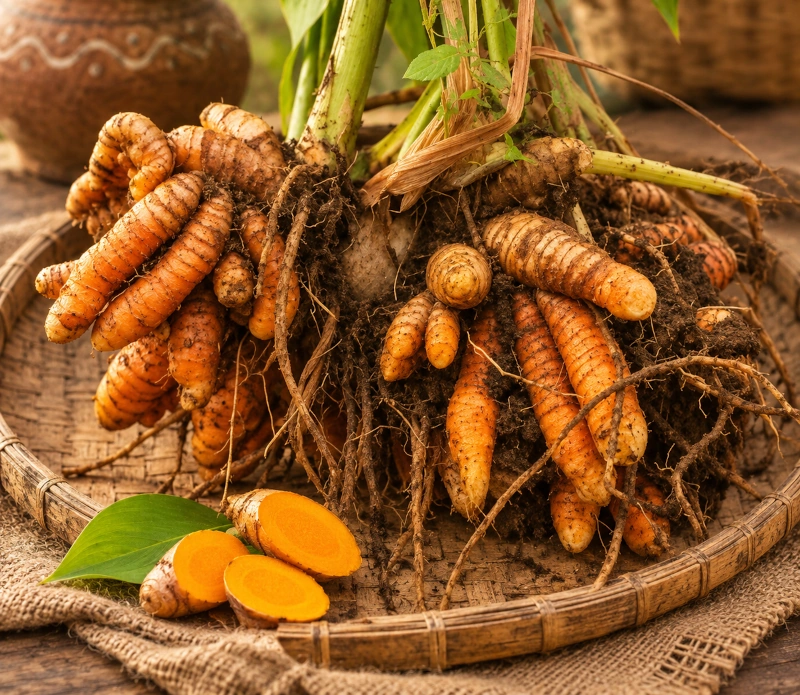
In the verdant hills of Meghalaya, where abundant monsoon rainfall nourishes fertile agricultural landscapes and generations of farming communities have preserved traditional cultivation practices, grows one of India’s most remarkable varieties of turmeric. Lakadong Turmeric, renowned for its deep golden-yellow colour, distinctive aroma and exceptionally high curcumin content, represents an agricultural heritage closely associated with the Jaintia Hills of northeastern India. Cultivated by local farming communities through methods developed over generations, this valuable spice has emerged as an important symbol of Meghalaya’s agricultural identity and its growing participation in India’s premium spice economy.
Derived from the underground rhizomes of Curcuma longa L., Lakadong Turmeric is distinguished by its characteristic golden-orange flesh and high concentration of curcuminoids, particularly curcumin. While turmeric is cultivated extensively across India, Lakadong has gained particular recognition because its curcumin content is commonly reported at approximately 7–10%, with some official publications recording values reaching 12%. This unusually high concentration contributes to the variety’s commercial reputation, particularly in markets for premium spices, natural colourants and turmeric-derived products.
The cultivation of Lakadong Turmeric is especially associated with the Lakadong–Shangpung region and surrounding villages of West Jaintia Hills district. Its identity reflects the relationship between Meghalaya’s distinctive growing environment, indigenous agricultural knowledge and the contribution of local communities, particularly women farmers, who have helped preserve and expand cultivation.
Lakadong Turmeric received Geographical Indication (GI) registration on 30 March 2024, formally recognising its geographical identity under India’s Geographical Indications of Goods (Registration and Protection) Act, 1999. The registration was obtained through the Directorate of Horticulture, Government of Meghalaya, with the support of agricultural institutions and farmer organisations. The GI recognition provides legal protection for a product whose reputation has become closely associated with the traditional agricultural heritage and economic development of the Jaintia Hills.
Historical Origins and Agricultural Heritage of Lakadong Turmeric
Turmeric has occupied an important place in Indian agriculture, culinary traditions and cultural practices for centuries. The plant belongs to the ginger family, Zingiberaceae, and is widely cultivated in tropical and subtropical regions for its aromatic rhizomes. In India, turmeric has historically served as a culinary ingredient, natural colouring material and component of traditional medicinal preparations.
The origins of Lakadong Turmeric are closely associated with the indigenous agricultural traditions of Meghalaya’s Jaintia Hills. The variety derives its name from Lakadong, a village in the region where farmers developed a reputation for cultivating turmeric distinguished by its colour, aroma and quality.
The Jaintia Hills have long supported agricultural systems based on local knowledge of rainfall, soil characteristics and crop adaptation. Farmers traditionally cultivated turmeric alongside other food and commercial crops, preserving suitable planting material from one growing season to the next.
The cultivation of Lakadong Turmeric became an important source of agricultural income for households in villages surrounding the Lakadong–Shangpung belt. Its suitability for the local environment and the commercial value of its rhizomes encouraged farmers to maintain the variety even as other agricultural crops became available.
The preservation of Lakadong Turmeric reflects the contribution of indigenous communities whose knowledge of planting material, field preparation, harvesting and processing helped maintain the crop’s distinctive characteristics. This agricultural tradition also demonstrates how regional varieties can develop strong commercial identities through a combination of geographical conditions and generations of farmer selection.
As scientific studies began documenting the high curcumin content of Lakadong Turmeric, the variety attracted increasing attention from agricultural institutions, spice traders and food-processing enterprises. Its reputation expanded beyond Meghalaya, creating opportunities to introduce the traditional crop into premium domestic and international markets.
The transition from a locally cultivated agricultural product to a nationally recognised geographical indication represents an important development in the preservation and commercial promotion of Meghalaya’s agricultural heritage.
Geographical Origin and Cultivation Areas
Lakadong Turmeric is traditionally associated with the Jaintia Hills of Meghalaya, particularly the agricultural villages of West Jaintia Hills district. The region’s climate, soil conditions and established cultivation practices contribute to the distinctive geographical identity of the product.
The Meghalaya Department of Agriculture identifies the Nongbah–Shangpung belt as an important traditional cultivation area for the Lakadong variety. The crop is also associated with villages such as Lakadong, Mulieh and other settlements where local farming communities have maintained turmeric cultivation across generations.
The geographical identity of Lakadong Turmeric is particularly strong in West Jaintia Hills, where the crop has been recognised under the Government of India’s One District One Product initiative. This recognition reflects the importance of turmeric cultivation to the district’s agricultural economy and its potential for value addition and commercial development.
Traditional growing areas include agricultural landscapes located at elevations of approximately 900–1,800 metres above sea level. These locations experience substantial seasonal rainfall and possess environmental conditions suitable for turmeric cultivation.
The region’s soils, frequently enriched with organic matter, provide favourable conditions for rhizome development when adequate drainage is maintained. The humid climate supports vegetative growth, while the seasonal distribution of rainfall influences crop establishment and maturity.
The Geographical Indications Registry identifies Meghalaya as the registered geographical area of Lakadong Turmeric. Its historical and commercial identity nevertheless remains particularly associated with the Jaintia Hills, where the traditional variety developed its reputation.
The geographical character of Lakadong Turmeric therefore reflects more than the location of its cultivation. It represents the relationship between a distinctive agricultural landscape, locally adapted planting material and the knowledge of farming communities responsible for maintaining the variety.
Unique Characteristics of Lakadong Turmeric
Lakadong Turmeric belongs to the botanical species Curcuma longa L., a perennial herbaceous plant cultivated for its underground rhizomes. The rhizomes develop beneath the soil and contain pigments, aromatic compounds and other naturally occurring constituents that contribute to the spice’s appearance and flavour.
One of the most distinctive characteristics of Lakadong Turmeric is its exceptionally high concentration of curcumin. The Meghalaya Department of Agriculture has traditionally reported curcumin content of approximately 7.4%, while more recent government publications identify a broader range of approximately 7–10%.
Other official publications have recorded values reaching 12%, reflecting differences in the samples examined and the conditions under which the crop was cultivated and processed. The frequently cited range of 7–12% therefore represents reported values rather than a guarantee that every batch will contain an identical concentration.
Curcumin is a naturally occurring yellow-orange pigment belonging to the curcuminoid group of compounds. Its presence contributes substantially to the characteristic colour of turmeric and is an important parameter in commercial quality assessment.
Lakadong Turmeric is also valued for its deep golden-orange rhizome flesh, distinctive earthy aroma and characteristic flavour. These features contribute to its reputation in premium spice markets and influence its suitability for different culinary and industrial applications.
The Meghalaya Department of Agriculture records volatile oil content in dried Lakadong Turmeric ranging from approximately 3.6% to 4.8%. These aromatic oils contain compounds that contribute to the characteristic fragrance of turmeric.
The high curcumin concentration and established geographical reputation distinguish Lakadong from many other commercially cultivated turmeric varieties. Its quality nevertheless depends on several factors, including planting material, growing conditions, harvesting maturity, drying methods and storage.
These characteristics form the foundation of its commercial identity and explain why the variety has attracted attention from agricultural researchers, food processors and enterprises involved in premium turmeric products.
Scientific Characteristics and Curcumin Content
The scientific importance of Lakadong Turmeric is closely associated with its high concentration of curcuminoids. These naturally occurring compounds are responsible for much of turmeric’s yellow-orange pigmentation and have been extensively investigated in laboratory and biomedical research.
Curcumin is the best-known curcuminoid, while demethoxycurcumin and bisdemethoxycurcumin are also important constituents of turmeric. The relative concentrations of these compounds vary among turmeric varieties and can be influenced by agricultural and post-harvest conditions.
Lakadong Turmeric has attracted particular research interest because its reported curcumin concentration is substantially higher than that commonly found in many other commercial turmeric varieties. Government publications have frequently compared its 7–10% curcumin levels with the approximately 2–3% concentrations reported for several conventional varieties.
This comparison is significant for commercial applications involving turmeric extraction, natural pigments and standardised spice products. Higher curcumin concentrations may increase the quantity of the desired compound obtainable from a given quantity of raw material, although actual extraction yields depend on processing efficiency and product quality.
Scientific analysis of turmeric commonly involves methods such as high-performance liquid chromatography and other chromatographic techniques. These methods allow researchers to measure curcuminoid concentrations and assess the chemical characteristics of turmeric samples.
The quality of Lakadong Turmeric cannot, however, be determined by curcumin concentration alone. Rhizome maturity, moisture content, cleanliness, essential-oil composition and freedom from contaminants also influence its suitability for commercial processing.
Research into curcumin has examined its antioxidant and anti-inflammatory properties under experimental conditions. However, laboratory findings do not establish that ordinary dietary consumption of turmeric can prevent or treat specific diseases. Medicinal products and concentrated extracts require separate evaluation for safety, effectiveness and appropriate use.
The scientific significance of Lakadong Turmeric lies in its distinctive chemical composition, geographical identity and potential for high-value agricultural processing. Its high curcumin content provides an important foundation for research, quality differentiation and the development of standardised turmeric-derived products.
Traditional Cultivation and Agricultural Practices
Lakadong Turmeric is cultivated primarily from rhizomes selected from healthy, mature plants. Unlike crops propagated through conventional seeds, turmeric is generally established using portions of underground rhizomes that contain viable buds capable of producing new shoots.
Farmers traditionally retain suitable planting material from previous harvests, selecting healthy rhizomes for replanting. This practice has contributed to the preservation of the Lakadong variety across generations.
Field preparation involves loosening the soil and creating suitable planting conditions that allow rhizomes to develop without prolonged waterlogging. Organic matter is commonly incorporated into the soil, while drainage arrangements are important in a region characterised by substantial monsoon rainfall.
Planting generally takes place before or during the early monsoon period, allowing the developing crop to benefit from seasonal moisture. Farmers place the rhizomes in prepared beds or fields at appropriate depths and spacing, depending on local agricultural practices.
The emerging plants produce broad green leaves and develop a network of underground rhizomes during the growing season. Adequate moisture supports vegetative growth, while soil fertility and suitable drainage influence the development of healthy rhizomes.
Traditional farming practices frequently include the use of farmyard manure, compost and locally available organic materials. Such inputs contribute to soil structure and nutrient availability when appropriately managed.
Weeding and field maintenance remain important throughout the growing period. Farmers remove competing vegetation and maintain suitable soil conditions to support plant growth.
The crop generally requires several months to reach maturity, with harvesting undertaken when the leaves begin to yellow and dry. The exact harvesting period depends on planting date, seasonal rainfall and local growing conditions.
Rhizomes are carefully dug from the soil and separated from the remaining plant material. Healthy portions may be retained as planting material, while the remainder is prepared for processing and marketing.
The cultivation of Lakadong Turmeric reflects a combination of traditional agricultural knowledge and adaptation to the environmental conditions of Meghalaya. Farmers’ experience in selecting planting material and managing the crop remains central to preserving the characteristics associated with this distinctive variety.
The Role of Meghalaya’s Climate and Soil Conditions
The climatic conditions of the Jaintia Hills play an important role in the cultivation of Lakadong Turmeric. Meghalaya receives substantial monsoon rainfall, while its hill landscapes support agricultural environments characterised by varying elevations, temperatures and soil conditions.
Turmeric requires adequate moisture during its vegetative growth period, making the seasonal availability of rainfall an important factor in crop development. The humid environment of the Jaintia Hills provides favourable conditions when rainfall is accompanied by suitable drainage.
The region’s soils often contain appreciable organic matter, supporting the growth of crops that require fertile and well-structured growing conditions. Turmeric rhizomes develop most effectively when the soil allows adequate root growth and does not remain excessively saturated.
Elevation also influences temperature and the duration of the growing season. Traditional Lakadong cultivation areas occupy hill environments where climatic conditions differ from those of many lowland turmeric-producing regions.
The relationship between rainfall and drainage is particularly important. Excessive moisture can increase the risk of rhizome deterioration and disease, while insufficient moisture during active growth may reduce crop performance.
Farmers must therefore manage planting dates, soil conditions and field drainage according to local weather patterns. Traditional agricultural knowledge provides practical guidance for these decisions, while scientific recommendations can help improve crop health and productivity.
The geographical identity of Lakadong Turmeric is closely connected with these environmental characteristics. Its commercial reputation reflects the interaction between the traditional variety, the agricultural landscapes of the Jaintia Hills and the cultivation methods developed by local communities.
Harvesting, Curing and Traditional Processing
The post-harvest processing of Lakadong Turmeric is an important stage in preserving its colour, aroma and commercial quality. Freshly harvested rhizomes contain substantial moisture and require appropriate handling before they can be stored or processed into turmeric powder.
After harvesting, the rhizomes are cleaned to remove soil, roots and other unwanted material. Suitable rhizomes may be separated according to size and intended use, while portions retained for planting are handled separately.
Traditional turmeric processing generally involves boiling or curing the cleaned rhizomes before drying. Curing helps prepare the rhizomes for further processing and influences the texture, colour and physical characteristics of the finished product.
Drying is particularly important because excessive moisture can encourage microbial deterioration and reduce storage stability. Farmers and processors use suitable drying methods to reduce moisture while preserving the desirable characteristics of the spice.
Traditional sun-drying remains familiar in many agricultural communities, although controlled mechanical drying systems provide opportunities for more consistent processing, particularly during periods of high humidity.
After drying, turmeric may be polished to improve its surface appearance and remove residual outer material. The dried rhizomes can then be marketed whole or ground into powder for culinary and industrial applications.
Processing conditions influence the concentration and stability of curcuminoids. Excessive heat, unsuitable storage and prolonged exposure to adverse environmental conditions can affect product quality, making improved post-harvest practices important for maintaining the reputation of Lakadong Turmeric.
The development of modern drying, grinding, packaging and testing infrastructure provides opportunities for farmers to obtain greater value from their produce. These improvements complement traditional processing knowledge while supporting the production of consistent, high-quality turmeric products.
Culinary Importance and Traditional Uses
Lakadong Turmeric forms part of the wider Indian culinary tradition in which turmeric is valued for its colour, flavour and versatility. Its distinctive golden-orange pigmentation makes it particularly suitable for preparations where a rich turmeric colour is desired.
In Meghalaya, turmeric is used in selected traditional dishes and household food preparations. Local culinary practices vary among communities, but turmeric contributes colour and flavour to curries, vegetable preparations and other foods.
Across India, turmeric is an important ingredient in spice mixtures, rice dishes, lentil preparations, pickles and numerous regional recipes. Its earthy and mildly bitter flavour complements other spices and contributes to the characteristic appearance of many Indian dishes.
Lakadong Turmeric is increasingly marketed as a premium culinary ingredient because of its strong pigmentation and recognised geographical identity. It is available in forms such as dried rhizomes, ground powder and selected processed preparations.
Turmeric also has a long history of use in Ayurveda, where it is known as Haridra. Classical Ayurvedic literature describes its use in traditional formulations associated with digestion, skin care and other applications.
The traditional importance of turmeric extends beyond medicine. It is used in various religious and cultural ceremonies, where its golden colour carries symbolic associations with auspiciousness, purity and prosperity.
In contemporary markets, turmeric is also used in food colourants, beverages, cosmetics and products derived from curcumin extracts. These applications have increased commercial interest in varieties possessing high curcuminoid concentrations.
The continuing popularity of turmeric reflects its place in India’s culinary and cultural heritage, while Lakadong’s distinctive characteristics provide opportunities for specialised markets based on quality and geographical origin.
Women Farmers and the Preservation of Lakadong Turmeric
One of the most important features of Lakadong Turmeric’s agricultural heritage is the contribution of women farmers to its cultivation, preservation and commercial development.
Women in the Jaintia Hills have participated extensively in agricultural activities, including planting, crop maintenance, harvesting, processing and local marketing. Their knowledge of traditional cultivation methods has helped maintain the identity of Lakadong Turmeric across generations.
The contribution of Trinity Saioo, a farmer from West Jaintia Hills, is particularly significant. She became widely recognised for mobilising women farmers to cultivate Lakadong Turmeric and improve their access to markets.
Working with local communities and agricultural institutions, Saioo encouraged collective farming, improved production practices and the development of commercial opportunities for women growers.
Her efforts contributed to the expansion of Lakadong cultivation and greater awareness of the economic opportunities associated with the crop. She received the Padma Shri in 2020, recognising her contribution to agriculture and the empowerment of women farmers in Meghalaya.
Government publications have highlighted how women-led turmeric cultivation contributed to improved household incomes and greater participation in organised agricultural activities.
The growth of Self-Help Groups and cooperative organisations has provided additional opportunities for women to participate in turmeric production and processing.
These groups can support collective procurement, shared processing facilities, training and access to commercial markets. Such arrangements are particularly valuable for smallholder farmers who may otherwise face difficulties in obtaining equipment or negotiating with large buyers.
The role of women farmers demonstrates that the heritage of Lakadong Turmeric is not limited to its botanical and chemical characteristics. It is also a story of community leadership, agricultural entrepreneurship and the preservation of traditional knowledge.
Mission Lakadong and Agricultural Development
The Government of Meghalaya introduced Mission Lakadong in 2018 as a dedicated initiative to strengthen the cultivation, processing and commercial development of the state’s distinctive turmeric variety.
The programme sought to expand production while improving the agricultural value chain. Its objectives included strengthening farmer mobilisation, improving planting material, promoting better post-harvest management and developing opportunities for value addition.
The mission also emphasised the importance of intellectual property protection and geographical identity, recognising that Lakadong Turmeric’s commercial reputation could be strengthened through formal GI registration.
The state government established ambitious production targets, including the objective of increasing annual Lakadong Turmeric production to approximately 50,000 metric tonnes. This represented a development target rather than an achieved production figure.
Farmer training and organised producer participation formed important components of the initiative. Government programmes supported the development of Self-Help Groups, cooperatives and agricultural enterprises involved in cultivation and processing.
The programme also encouraged improvements in drying, grinding, packaging and marketing. Such activities were intended to reduce the dependence of farmers on the sale of unprocessed rhizomes and increase their participation in higher-value commercial products.
The development of Mission Lakadong marked an important transition in the state’s approach to the crop. Rather than treating turmeric solely as a traditional agricultural commodity, the programme recognised its potential as a geographically distinctive product capable of supporting rural entrepreneurship and premium markets.
Geographical Indication Recognition of Lakadong Turmeric
Lakadong Turmeric received formal recognition under India’s Geographical Indications of Goods (Registration and Protection) Act, 1999, following an application submitted by the Director of Horticulture, Government of Meghalaya.
The application was filed on 15 February 2021 under Application No. 741, seeking registration of Lakadong Turmeric as an agricultural product associated with Meghalaya.
The process of securing geographical indication recognition had begun earlier. According to the Meghalaya Farmers’ (Empowerment) Commission, institutional efforts commenced in October 2019, when the Meghalaya Institute of Entrepreneurship initiated arrangements for professional assistance with the GI application.
The registration effort involved cooperation among the Directorate of Horticulture, Directorate of Agriculture, district horticulture officials, farmer representatives and the Lakadong Turmeric Cooperative Union Limited in Jowai.
The Geographical Indications Registry examined the application through its statutory procedures. The official record includes formality check reports, supporting documents, an examination report and subsequent proceedings relating to the application.
The application appeared in Geographical Indications Journal No. 185, which the registry records as available on 29 November 2023.
Following completion of the statutory registration process, the registry issued Certificate No. 575 on 30 March 2024, formally recognising Lakadong Turmeric under Class 30.
The registered geographical area is Meghalaya, and the registered proprietor is identified as the Director of Horticulture, Government of Meghalaya.
The registration remains valid until 14 February 2031, subject to renewal under the applicable legislation.
GI recognition provides a legal framework for protecting the registered name and supporting its use by eligible producers and authorised users in accordance with the geographical indication requirements.
GI Tag Journey of Lakadong Turmeric
The GI recognition of Lakadong Turmeric represents the formal protection of an agricultural tradition closely associated with the Jaintia Hills. Its journey reflects the efforts of farmers, cooperative societies, agricultural institutions and government agencies to strengthen the commercial identity of one of Meghalaya’s most distinctive crops.
| Period / Date | Milestone |
|---|---|
| Traditional agricultural period | Farming communities in the Jaintia Hills maintained Lakadong Turmeric cultivation through locally adapted planting material and traditional agricultural practices. |
| 26 May 2004 | A North Eastern Council-supported turmeric cultivation expansion project was launched in Meghalaya, including Lakadong and other turmeric varieties. |
| 2018 | The Government of Meghalaya launched Mission Lakadong to strengthen cultivation, processing and marketing. |
| October 2019 | Institutional preparations for GI registration began through the Meghalaya Institute of Entrepreneurship and other government agencies. |
| 2020 | Trinity Saioo received the Padma Shri for her contribution to agriculture and women-led turmeric cultivation. |
| 15 February 2021 | The Director of Horticulture, Government of Meghalaya, filed GI Application No. 741. |
| 23 August 2021 | The Geographical Indications Registry issued a second formality check report relating to the application. |
| 5 February 2022 | A government-supported drone demonstration examined the transportation of Lakadong Turmeric from remote agricultural areas in West Jaintia Hills. |
| 20 June 2022 | The applicant submitted responses to the GI Registry’s formality requirements. |
| 18 September 2023 | The GI Registry issued its examination report. |
| 29 November 2023 | Lakadong Turmeric appeared in Geographical Indications Journal No. 185. |
| 30 March 2024 | Lakadong Turmeric received GI Certificate No. 575. |
| 21 July 2026 | Mission Golden Spice was launched with a proposed investment of ₹175.45 crore to strengthen the Lakadong Turmeric value chain. |
| 14 February 2031 | The current GI registration remains valid until this date, subject to renewal. |
The timeline demonstrates how traditional cultivation, farmer participation and government-supported development programmes contributed to the recognition of Lakadong Turmeric as a geographically distinctive agricultural product.
GI Details at a Glance
| Particular | Details |
|---|---|
| Geographical Indication | Lakadong Turmeric |
| State | Meghalaya |
| Botanical Name | Curcuma longa L. |
| Botanical Family | Zingiberaceae |
| Product Category | Agricultural |
| GI Class | 30 |
| Application Number | 741 |
| Date of Filing | 15 February 2021 |
| Registered Proprietor | Director of Horticulture, Government of Meghalaya |
| Registered Proprietor’s Address | Cleve Colony, Shillong, Meghalaya – 793003 |
| GI Journal | No. 185 |
| GI Journal Availability Date | 29 November 2023 |
| Certificate Number | 575 |
| GI Certificate Date | 30 March 2024 |
| Registered Geographical Area | Meghalaya |
| Traditional Cultivation Centre | Jaintia Hills, particularly West Jaintia Hills |
| Principal Cultivation Belt | Lakadong–Shangpung and surrounding villages |
| Characteristic Colour | Deep golden-yellow to orange |
| Reported Curcumin Content | Commonly 7–10%; some official reports record up to 12% |
| Reported Volatile Oil Content | Approximately 3.6–4.8% |
| State Development Programme | Mission Lakadong |
| Major 2026 Initiative | Mission Golden Spice |
| Current GI Status | Registered |
| Registration Valid Until | 14 February 2031 |
Mission Golden Spice: ₹175.45-Crore Initiative for Global Markets
A major development in the commercial future of Lakadong Turmeric occurred on 21 July 2026, when Union Minister for Development of North Eastern Region Jyotiraditya M. Scindia and Meghalaya Chief Minister Conrad K. Sangma launched Mission Golden Spice – Integrated Lakadong Turmeric Value Chain Enhancement Project.
The initiative involves a proposed investment of ₹175.45 crore and is designed to strengthen the cultivation, processing, branding and marketing of Lakadong Turmeric.
The programme has been structured as a five-year development roadmap covering 2025–2030, with implementation divided into two principal phases. The first phase focuses on strengthening the existing value chain, while the second is intended to support expansion and scaling.
The initiative is anchored by the Ministry of Development of North Eastern Region and the North Eastern Council, with cooperation envisaged from several central and state institutions.
These include the Ministry of Agriculture and Farmers Welfare, Ministry of Food Processing Industries, Ministry of Commerce and Industry, APEDA, Spices Board, National Turmeric Board, ICAR, NABARD and other organisations.
The programme seeks to address structural challenges affecting the sector, particularly inadequate processing infrastructure, limited value addition, weak market connections and insufficient commercial exploitation of the GI identity.
A major objective is to expand the production and marketing of high-value turmeric products rather than depending primarily on the sale of raw agricultural material.
The initiative also seeks to strengthen quality assurance, traceability, organised processing and commercial branding. These measures are intended to position Lakadong Turmeric as a premium Indian spice in domestic and international markets.
Government statements associated with the launch highlighted the importance of women farmers and smallholder agricultural communities in the development of the crop.
Mission Golden Spice therefore represents an important effort to connect Meghalaya’s traditional agricultural heritage with modern processing technologies, institutional investment and organised market development.
Economic Importance and Opportunities for Farmers
Lakadong Turmeric has become an increasingly important agricultural commodity in Meghalaya because of its high curcumin content and growing recognition in premium spice markets.
The crop provides income opportunities for farming households in the Jaintia Hills, particularly those cultivating turmeric on relatively small agricultural holdings.
Its commercial value is influenced by curcumin concentration, rhizome quality, processing methods, product purity and market demand. Properly processed turmeric with reliable geographical traceability can attract interest from buyers seeking premium ingredients.
However, the sale of unprocessed rhizomes often provides farmers with a smaller share of the value generated through the final consumer product. Processing, grading, packaging and branding create opportunities to increase the commercial value of the crop.
The development of farmer cooperatives and Self-Help Groups has therefore become an important part of Meghalaya’s turmeric sector. Collective organisations can help farmers obtain better access to processing facilities, agricultural inputs, technical training and commercial markets.
The Government of India’s One District One Product initiative has also supported the recognition of Lakadong Turmeric as a priority agricultural commodity for West Jaintia Hills.
In February 2022, government agencies demonstrated the use of drones to transport Lakadong Turmeric from remote agricultural areas. The initiative examined how unmanned aerial vehicles could address first-mile connectivity challenges affecting farmers in difficult terrain.
Such technological interventions illustrate the potential for modern logistics to complement traditional agricultural production. Better transportation, improved processing and organised marketing can help reduce avoidable losses and strengthen farmer participation in the value chain.
The GI registration provides an additional commercial advantage by establishing a protected geographical identity. When combined with quality assurance and appropriate traceability, this recognition can help distinguish authentic Lakadong Turmeric from products that do not meet the registered geographical requirements.
Lakadong Turmeric and India’s Growing Spice Economy
India is one of the world’s major producers, consumers and exporters of turmeric. The crop is cultivated across numerous states, including Telangana, Maharashtra, Tamil Nadu, Karnataka, Odisha, Andhra Pradesh and Meghalaya.
Lakadong Turmeric occupies a specialised position within this wider industry because of its reported high curcumin content and established regional reputation.
The commercial opportunities associated with the variety extend beyond conventional turmeric powder. Potential value-added products include standardised spice preparations, natural colourants, curcumin extracts and selected food-processing ingredients.
The development of these products requires suitable extraction technologies, scientific quality testing and compliance with applicable food safety and product standards.
The National Turmeric Board, established to support the development of India’s turmeric sector, provides an institutional framework for strengthening cultivation, processing, research, export promotion and market development.
For Meghalaya, the combination of GI recognition, Mission Lakadong and Mission Golden Spice creates opportunities to connect traditional cultivation with national initiatives supporting agricultural value addition.
The development of premium turmeric products can also contribute to the broader economic integration of northeastern India with domestic and international agricultural markets.
Lakadong Turmeric demonstrates how a geographically distinctive crop can support regional entrepreneurship while strengthening India’s reputation for producing specialised agricultural commodities.
Protecting Authenticity and Product Quality
The GI registration of Lakadong Turmeric establishes a legal framework for protecting its geographical identity. Maintaining the value of this recognition requires appropriate documentation, quality management and compliance with the registered specifications.
The Geographical Indications Registry identifies several authorised users associated with Lakadong Turmeric, including cooperative societies and producer organisations linked to the traditional cultivation region.
These organisations play an important role in connecting farmers with the formal GI system and supporting the commercial identity of the registered product.
Traceability is particularly important because turmeric is traded in several forms, including fresh rhizomes, dried rhizomes, powder and processed extracts. Reliable records of cultivation, procurement, processing and distribution can help establish the geographical origin of marketed products.
Scientific quality assessment provides another important layer of protection. Laboratory analysis can measure curcumin concentration and evaluate relevant characteristics such as moisture content, purity and the presence of contaminants.
Accurate product labelling is essential because the high curcumin reputation of Lakadong Turmeric creates opportunities for misleading claims. Products marketed under the registered name should satisfy the relevant geographical indication requirements.
Farmers and processors can strengthen consumer confidence through appropriate testing, hygienic handling and reliable commercial documentation.
The GI system and scientific quality assurance therefore perform complementary functions. Registration protects geographical identity, while laboratory testing and processing standards help establish the characteristics and safety of the finished product.
Lakadong Turmeric and India’s GI Agricultural Heritage
India’s geographical indication system recognises agricultural products whose distinctive characteristics, reputation or quality are associated with particular regions.
Lakadong Turmeric occupies an important place within this heritage because its identity is closely connected with the indigenous agricultural traditions of Meghalaya’s Jaintia Hills.
Unlike several other GI-protected Indian spices associated with coastal or plantation agriculture, Lakadong Turmeric reflects the distinctive farming environment of northeastern India’s hill regions.
Its recognition also demonstrates the contribution of local communities to the preservation of agricultural biodiversity. Traditional planting material and cultivation knowledge have helped maintain a variety that possesses commercially significant chemical characteristics.
Lakadong Turmeric joins other registered geographical indications from Meghalaya, including Khasi Mandarin and Memong Narang, highlighting the state’s diverse agricultural resources.
The product also represents the growing importance of women-led agricultural entrepreneurship in northeastern India. The contributions of Trinity Saioo and other community leaders demonstrate how traditional farming knowledge can be combined with organised production and market development.
The GI registration provides a framework for preserving this geographical identity while supporting the wider recognition of Meghalaya’s agricultural heritage.
Future Prospects for Lakadong Turmeric
The future development of Lakadong Turmeric is closely connected with the preservation of its traditional growing areas, the improvement of agricultural productivity and the expansion of high-value processing industries.
Scientific cultivation practices can support farmers through better planting material, improved soil management and appropriate disease-control measures. Research into rhizome development, curcumin concentration and post-harvest quality can further strengthen the commercial identity of the variety.
Modern processing infrastructure offers additional opportunities. Controlled drying, hygienic grinding, laboratory testing and improved packaging can help preserve product quality while supporting access to more demanding markets.
The ₹175.45-crore Mission Golden Spice initiative provides an institutional platform for addressing these needs. Its emphasis on value-chain development, processing, branding and market access reflects the importance of moving beyond conventional agricultural commodity trading.
The participation of women farmers, cooperatives and local entrepreneurs will remain central to this development. Strengthening their access to technology, training and commercial opportunities can help ensure that the economic benefits associated with the GI identity reach the communities responsible for maintaining the crop.
The growing international interest in natural ingredients and premium agricultural products also provides opportunities for Lakadong Turmeric. Its distinctive characteristics, established geographical reputation and high curcumin content create a foundation for specialised markets based on authenticated quality.
Lakadong Turmeric represents an exceptional combination of agricultural heritage, geographical identity and scientific distinctiveness. Its golden-orange rhizomes, high curcumin concentration and traditional cultivation methods reflect the environmental conditions of Meghalaya and the knowledge of farming communities who have preserved the crop across generations.
The Geographical Indication registration granted in March 2024 formally recognised this heritage, while government-supported initiatives have created opportunities to strengthen cultivation, processing and commercial development.
From the traditional turmeric fields of the Jaintia Hills to India’s expanding markets for premium agricultural products, Lakadong Turmeric stands as a living expression of Meghalaya’s farming heritage, the contribution of women-led agricultural communities and the growing economic potential of India’s distinctive regional spices.
References
1. Geographical Indications Registry, Government of India — Lakadong Turmeric, Application No. 741.
Official registration record confirming the filing date, registered proprietor, geographical area, GI Journal details, Certificate No. 575 and registration validity until 14 February 2031.
https://search.ipindia.gov.in/GIRPublicSearch/Application/Details/741
2. Meghalaya Farmers’ (Empowerment) Commission — Government of Meghalaya Secures GI Tag for Lakadong Turmeric, 30 March 2024.
Official account of the institutional process leading to GI registration, including the contribution of farmer organisations, the Directorate of Horticulture and the Meghalaya Institute of Entrepreneurship.
Govt of Meghalaya secures the prestigious Geographical Indication (GI) tag for Lakadong Turmeric
3. Department of Agriculture, Government of Meghalaya — Spices of Meghalaya.
Official agricultural information identifying the Nongbah–Shangpung cultivation belt, reported curcumin content of approximately 7.4% and volatile oil content of 3.6–4.8%.
https://megagriculture.gov.in/PUBLIC/crops_spices.aspx/PUBLIC/SECURE/contact_icc.aspx
4. Meghalaya Tourism, Government of Meghalaya — Lakadong Turmeric.
Official information concerning the geographical origin, cultivation environment, reported curcumin concentration and role of traditional farming communities.
https://www.meghalayatourism.in/meghalaya-mosaic/lakadong-turmeric
5. Press Information Bureau, Ministry of Development of North Eastern Region — Mission Golden Spice, 21 July 2026.
Official announcement of the ₹175.45-crore Integrated Lakadong Turmeric Value Chain Enhancement Project and its development objectives.
https://www.pib.gov.in/PressReleasePage.aspx?PRID=2287186
6. Government of Meghalaya, Information and Public Relations Department — Mission Golden Spice, 21 July 2026.
State government documentation of the new value-chain initiative, institutional participation and plans for strengthening processing and market access.
https://megipr.gov.in/pr/PR-2026-07.html
7. Press Information Bureau, Ministry of Commerce and Industry — Drone Demonstration for Lakadong Turmeric Transportation, 5 February 2022.
Official report on the use of UAV technology to address first-mile connectivity challenges affecting turmeric farmers in West Jaintia Hills.
https://www.pib.gov.in/PressReleasePage.aspx?PRID=1795761
8. Meghalaya Farmers’ (Empowerment) Commission — Recognition of Excellence: Lakadong Turmeric Receives GI Tag, 3 April 2024.
Government documentation of GI recognition and the reported high curcumin content of the traditional variety.
https://www.meghalaya.gov.in/sites/default/files/press_release/Press_Release_161.pdf
9. Government of Meghalaya — Meghalaya on the Move: Agricultural Development and Mission Lakadong.
Official publication describing the cultivation area, production ambitions and agricultural development objectives associated with Mission Lakadong.
https://dofpmeghalaya.org/wp-content/uploads/2024/09/Meghalaya-on-the-Move-Brochure-2.pdf
10. Ministry of Micro, Small and Medium Enterprises — Strategic Investment Plan for Meghalaya under the RAMP Scheme.
Government report discussing the commercial potential of Lakadong Turmeric, curcumin extraction, value addition and agricultural entrepreneurship.
https://ramp.msme.gov.in/ramp/pdf-documents/sip-states/meghalaya.pdf
11. Press Information Bureau, Ministry of Commerce and Industry — One District One Product Outreach Programme in Meghalaya.
Official documentation highlighting the contribution of Padma Shri Trinity Saioo and the expansion of Lakadong Turmeric marketing.
https://www.pib.gov.in/PressReleasePage.aspx?PRID=1998792
12. National Portal of India — One District One Product: Lakadong Turmeric, West Jaintia Hills.
Government identification of Lakadong Turmeric as an important GI-recognised agricultural product of West Jaintia Hills.
https://www.india.gov.in/explore-india/odop/details/lakadong-turmeric
You may also like
-
ISRO Successfully Tests Upgraded PSLV Third Stage at Sriharikota
-
IIT Madras Develops SEANAV Digital Twin Platform for Autonomous Maritime Navigation
-
Cochin Shipyard and SFO Technologies Develop India’s First Indigenous Hybrid Laser Arc Welding System
-
India Targets First Made-in-India Civil Aircraft Within Two Years as Indigenous Aviation Manufacturing Gains Momentum
-
India Ranks First in Macroeconomic Resilience Among World’s Ten Largest Economies: ASSOCHAM
