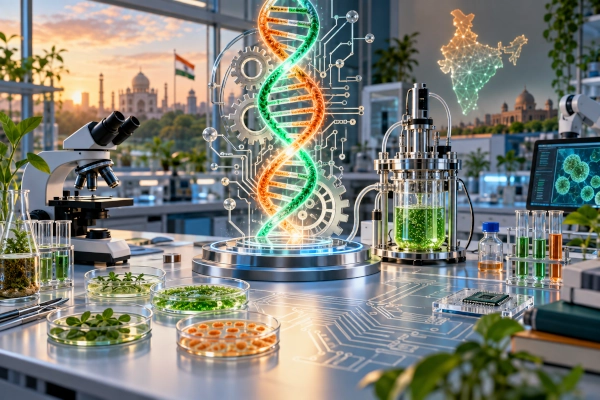
India has announced the introduction of its first Engineering Biology graduation course, creating a new academic pathway designed to prepare students for the convergence of biology, engineering, medicine and advanced computing.
The initiative was announced by Union Minister of State for Science and Technology Dr. Jitendra Singh during the launch of the roadmap titled “Building India as a Leading Bioeconomy Powerhouse by 2035”. The roadmap sets out a strategy to expand India’s biotechnology and biomanufacturing capabilities while building the skilled workforce needed to support them.
Engineering Biology Positioned as a New Foundational Discipline
The Government has described Engineering Biology as a discipline that could play a role in the next phase of industrial and technological development comparable to the role computer science played during the digital revolution.
Engineering Biology combines principles from biology, engineering, genetics, computation and design to develop biological systems with useful functions. Its applications can extend across healthcare, agriculture, food systems, industrial biotechnology, clean energy and environmental technologies.
The proposed graduation programme is intended to create professionals capable of working across these traditionally separate fields rather than being trained within a single conventional discipline.
IITs Begin Developing Interdisciplinary Programmes
According to the official announcement, IITs have already begun submitting proposals for interdisciplinary programmes in collaboration with medical institutions.
This approach reflects the growing overlap between engineering and life sciences, particularly in areas such as synthetic biology, precision medicine, biomaterials, diagnostics and computational biology.
Linking engineering institutions with medical centres can allow students to work directly on problems that require both technological design and biological understanding.
Building a Workforce for Biomanufacturing
The new course forms part of a broader effort to develop the human capital required for India’s expanding biomanufacturing sector.
Modern biomanufacturing increasingly uses genetically engineered cells, enzymes and biological systems to produce medicines, chemicals, fuels, food ingredients and advanced materials.
India’s long-term strategy therefore requires not only research laboratories and industrial plants but also scientists and engineers trained to design, optimise and scale biological production systems.
Bioeconomy Target Set at Nearly $700 Billion
The 2035 roadmap envisages India’s bioeconomy expanding to nearly US$700 billion.
Government figures presented during the launch noted that India’s bioeconomy has grown sharply from around US$10 billion in 2014 to roughly US$95 billion, while the country now hosts more than 11,000 biotechnology startups.
The roadmap also places emphasis on creating stronger links between universities, research laboratories, startups, manufacturers and investors so that scientific discoveries can move more rapidly into commercial production.
AI and Biology Begin to Converge
Artificial intelligence is expected to play an increasingly important role within Engineering Biology.
AI systems can assist researchers in analysing large biological datasets, predicting protein structures, identifying genetic targets and designing new molecules or biological pathways.
This convergence can shorten development cycles in areas ranging from drug discovery to agriculture and industrial biotechnology.
The Government’s roadmap therefore treats AI-enabled biology and advanced biomanufacturing as central technologies for the next stage of biotechnology development in India.
Synthetic Biology Expands the Scope of Biotechnology
Engineering Biology is closely connected with synthetic biology, where scientists redesign biological components or construct new biological systems for specific purposes.
Research can involve modifying DNA, engineering proteins and enzymes, designing genetic circuits and programming microorganisms to manufacture useful compounds.
India is already participating in international research programmes in these areas. The Department of Biotechnology and the US National Science Foundation have previously launched collaborative research opportunities covering synthetic and engineering biology, computational biology and future biomanufacturing technologies.
Applications Across Healthcare and Agriculture
Healthcare is expected to be one of the largest areas influenced by Engineering Biology.
Potential applications include engineered cell therapies, gene-based treatments, vaccines, diagnostic platforms, personalised medicine and biologically produced pharmaceuticals.
Agriculture offers another major field of application, with opportunities involving crop resilience, biological fertilisers, engineered microbes, improved nutrition and sustainable pest-management technologies.
The same technologies can also contribute to food production, waste treatment, environmental remediation and the manufacture of biological alternatives to petroleum-derived products.
BioE3 Policy Provides Broader Framework
The new academic programme fits within India’s wider biotechnology strategy centred on the BioE3 Policy — Biotechnology for Economy, Environment and Employment.
The policy promotes high-performance biomanufacturing and seeks to move biotechnology from laboratory research towards commercial-scale production.
Developing specialised university programmes is therefore an important supporting component because advanced biomanufacturing requires personnel trained simultaneously in biology, engineering, automation and data science.
Proposed ₹50,000 Crore Bioeconomy Growth Fund
The 2035 roadmap also envisages a proposed ₹50,000 crore Bioeconomy Growth Fund to support the expansion of the biotechnology ecosystem.
NITI Aayog member Prof. Gobardhan Das said during the launch that India’s bioeconomy had expanded nearly sixteen-fold during the previous decade and that the roadmap seeks to position the country among the leading global biotechnology powers.
The proposed financing framework would complement investments in research infrastructure, manufacturing capacity, startup development and specialised talent.
From Biotechnology Education to Engineering Biology
Traditional biotechnology courses have generally concentrated on biological sciences, laboratory techniques and industrial biotechnology.
Engineering Biology introduces a more design-oriented approach in which biological systems are treated as platforms that can be engineered, modelled and optimised.
The introduction of a dedicated graduation course therefore represents an attempt to align higher education more closely with emerging industrial fields rather than simply expanding existing biotechnology curricula.
Building the Next Generation of Biotechnology Professionals
India’s decision to introduce Engineering Biology at the graduation level reflects the increasing strategic importance of biology-based technologies.
The country already has a substantial pharmaceutical, vaccine and biotechnology manufacturing base, but the next phase of growth will require deeper capabilities in original research, synthetic biology, AI-assisted discovery and advanced biomanufacturing.
Creating a dedicated undergraduate pathway can help develop that workforce at an earlier stage and provide students with multidisciplinary training suited to industries that are likely to expand over the coming decade.
With the national roadmap targeting a US$700 billion bioeconomy by 2035, Engineering Biology is being positioned not merely as a new academic subject, but as part of the technological foundation for India’s next generation of biotechnology industries.
References
Press Information Bureau, Ministry of Science & Technology — Union Minister Dr. Jitendra Singh Announces India’s First Engineering Biology Graduation Course to Build Future Biotechnology Workforce, July 16, 2026.
Department of Biotechnology, Government of India — DBT–NSF collaborative research programme covering synthetic biology, engineering biology and future biomanufacturing.
Ministry of Science & Technology, Government of India — Building India as a Leading Bioeconomy Powerhouse by 2035 roadmap.
You may also like
-
National Institute of Naturopathy Opens Admissions for BNYS Programme at Pune for 2026–27
-
Yudhishthira’s Counter-Diplomacy With Shalya: Working With an Ally Who Has Joined the Other Side
-
Gnani AI Launches Nationwide Challenge Offering Up to 100 Paid AI Internships
-
NMMSS Scholarship Application Deadline Extended to October 31, 2026
-
DGCA Introduces Training Framework for Gyroplane Pilots in India
