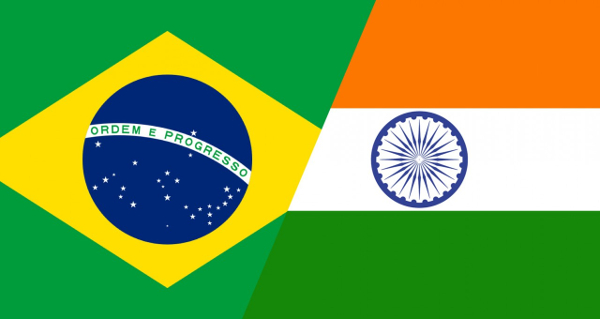
India and Brazil have moved closer to substantially expanding the existing India–Mercosur Preferential Trade Agreement, with the two sides completing the terms of reference that will guide negotiations on a broader trade arrangement. The development marks an important step in efforts to deepen India’s commercial engagement with South America and widen market access beyond the limited tariff coverage of the present agreement.
The issue was discussed between Commerce and Industry Minister Piyush Goyal and Brazilian Minister of Development, Industry, Trade and Services Márcio Elias Rosa on the sidelines of the G20 Trade Ministers’ Meeting in Milwaukee. Brazil has argued that the existing preferential arrangement covers only a small proportion of the goods traded between India and the Mercosur bloc and no longer reflects the scale or potential of the economic relatioIndia and Australia Deepen Defence and Security Cooperation Under New Frameworknship.
India–Mercosur Trade Agreement Has Been in Force Since 2009
The India–Mercosur Preferential Trade Agreement has been operational since June 1, 2009. Under the existing arrangement, India offers tariff preferences on 450 tariff lines, while Mercosur extends preferences on 452 tariff lines.
The preferences under the agreement are generally provided at margins of 10%, 20% or 100%, depending on the product. The relatively narrow coverage means that a large part of merchandise trade between India and South America continues to take place outside the preferential framework.
Mercosur originally comprised Argentina, Brazil, Paraguay and Uruguay, with Bolivia subsequently joining the South American economic bloc. Brazil is the largest economy within Mercosur and has become one of India’s most important commercial partners in Latin America.
The original India–Mercosur framework was signed in 2004 as a step towards closer economic integration. Negotiations subsequently produced the Preferential Trade Agreement, which entered into force in 2009.
India and Brazil Complete Terms of Reference for Wider Negotiations
The latest discussions represent a more concrete stage in the long-running effort to expand the agreement. According to the Brazilian side, India and Brazil have now completed work on the terms of reference required for broader negotiations.
The terms of reference establish the framework within which negotiators can begin developing proposals covering additional products and areas of economic cooperation. While the final scope will have to be negotiated with the Mercosur members collectively, India and Brazil have emerged as important drivers of the expansion process.
Brazilian authorities have repeatedly stated that the current agreement does not adequately reflect the commercial potential between India and Mercosur. India has similarly been pursuing greater economic engagement with Latin America as it seeks to diversify export destinations and strengthen access to resource-rich emerging markets.
Trade Between India and Brazil Has Expanded Rapidly
The push to widen the Mercosur agreement comes as India–Brazil economic relations continue to grow. Brazil’s Ministry of Development, Industry, Trade and Services reported that bilateral merchandise trade reached approximately $10.1 billion during the first seven months of 2026.
This represented an increase of 32.9% compared with the corresponding period of the previous year, highlighting the rapid expansion of commercial exchanges between the two major emerging economies.
India and Brazil have also set a broader objective of increasing bilateral trade to $20 billion by 2030. Expanding the India–Mercosur Preferential Trade Agreement could support that goal by reducing tariff barriers across a much larger range of products and providing businesses with more predictable access to each other’s markets.
India exports products such as pharmaceuticals, chemicals, engineering goods, machinery, vehicles and petroleum products to Latin American markets, while Brazil is an important supplier of agricultural commodities, minerals and other industrial inputs.
Bioeconomy and Circular Economy Enter the Trade Agenda
The proposed expansion is not being discussed solely as a conventional tariff-cutting exercise. India and Brazil are also examining cooperation in emerging economic sectors that could become important components of their long-term strategic partnership.
Among the areas identified for deeper cooperation is the bioeconomy, which involves using biological resources, biotechnology and sustainable production systems to generate industrial and economic value.
Both countries possess substantial agricultural sectors, large biodiversity resources and growing biotechnology capabilities. Cooperation in the bioeconomy could therefore extend into areas such as biofuels, biomanufacturing, agricultural technologies, biotechnology and sustainable materials.
The circular economy has also emerged as an area of interest. This includes technologies and industrial processes designed to reduce waste, recover materials, extend product life and improve the efficiency with which natural resources are used.
Digital Technologies and Artificial Intelligence Gain Importance
India and Brazil are also looking beyond traditional merchandise trade towards the digital economy. Artificial intelligence, digital technologies and skills development are among the sectors being discussed alongside the proposed trade expansion.
India has developed substantial capabilities in information technology, digital public infrastructure, software services and emerging artificial intelligence technologies. Brazil, meanwhile, represents one of Latin America’s largest digital markets.
Greater cooperation could create opportunities for Indian technology companies in Latin America while supporting joint projects in areas including digital services, fintech, artificial intelligence, cybersecurity and skills development.
Such cooperation would broaden the India–Mercosur relationship from a primarily goods-based preferential trade arrangement into a more diversified economic partnership.
Defence Cooperation Could Become Another Growth Area
Defence has also been identified as an area for greater India–Brazil cooperation. The two countries already maintain defence and strategic ties and possess significant domestic aerospace and defence industries.
Brazil has considerable expertise in aircraft manufacturing, aerospace systems and defence platforms, while India is rapidly expanding indigenous production across missiles, electronics, aircraft, naval systems, drones and land platforms.
A stronger commercial framework could support greater industrial interaction, technology partnerships and joint opportunities between Indian and Brazilian defence companies.
Defence cooperation would remain distinct from the tariff negotiations themselves, but its inclusion in wider economic discussions shows how the India–Brazil relationship is expanding beyond conventional trade.
August Trade Talks Built Momentum for the Expansion
The latest development builds on the eighth meeting of the India–Brazil Trade Monitoring Mechanism held in Brazil on August 28, 2026.
Commerce Secretary Rajesh Agrawal led the Indian delegation, while Brazil was represented by Secretary of Foreign Trade Tatiana Prazeres. The meeting examined expansion of the Mercosur–India Preferential Trade Agreement, market access, trade barriers, export diversification and investment promotion.
Brazilian government data released following the meeting highlighted the strong increase in bilateral commerce during 2026 and described expansion of the Mercosur agreement as an important element of the two countries’ economic relationship.
The discussions also continued the political commitment made in October 2025, when India and Brazil issued a joint declaration supporting deeper preferential trade arrangements between India and the Mercosur member states.
Expansion Would Strengthen India’s Latin America Trade Strategy
Latin America has become increasingly important to India as both an export destination and a source of critical raw materials, energy products, agricultural commodities and minerals.
India’s total merchandise trade with Latin America and the Caribbean stood at $39.19 billion during 2024–25, according to the Commerce Ministry. Indian exports to the region were valued at $15.17 billion, while imports reached $24.02 billion.
The Commerce Ministry has identified significant complementarities between the two economies. Latin America possesses extensive reserves of minerals, metal ores and agricultural products, while India has strengths in engineering goods, pharmaceuticals, information technology, textiles and manufacturing.
Expanding the India–Mercosur Preferential Trade Agreement would therefore give Indian companies wider access to one of South America’s largest integrated markets while providing Mercosur exporters with greater opportunities in India.
The completion of the negotiating framework moves the process beyond general expressions of intent towards detailed trade negotiations. By combining wider tariff preferences with cooperation in the bioeconomy, digital technologies, artificial intelligence, skills and defence, India and Brazil are laying the groundwork for a broader economic relationship connecting two of the largest emerging-market regions in the Global South.
References
Ministry of Commerce and Industry, Government of India — Latin America and Caribbean Division
https://www.commerce.gov.in/ministryofcommerce/node/3392
Government of Brazil, Ministry of Development, Industry, Trade and Services — Brazil and India Advance Efforts to Expand Trade and Investment
https://www.gov.br/mdic/pt-br/assuntos/noticias/2026-periodo-eleitoral/agosto/brasil-e-india-avancam-para-ampliar-comercio-e-investimentos/
Government of Brazil, Siscomex — Expansion of the Mercosur–India Preferential Trade Agreement
https://www.gov.br/siscomex/pt-br/acordos-comerciais/ampliacao-do-acp-mercosul-india
Government of Brazil, Siscomex — Mercosur–India Preferential Trade Agreement
https://www.gov.br/siscomex/pt-br/acordos-comerciais/mercosul-india
Government of Brazil — India–Brazil Joint Declaration on Deepening the Mercosur–India Trade Agreement
https://www.gov.br/mdic/pt-br/assuntos/noticias/2025/outubro/declaracao-conjunta-india2013brasil-sobre-o-aprofundamento-do-acordo-de-comercio-mercosul2013india/
Akashvani News — Brazil, India Move to Widen Mercosur Trade Pact
https://newsonair.gov.in/brazil-india-move-to-widen-mercosur-trade-pact/
You may also like
-
Rajnath Singh to Lead Indian Delegation at ASEAN Defence Summit in Philippines, Strengthening Indo-Pacific Security Cooperation
-
India Hosts 12th BRICS Parliamentary Forum in New Delhi
-
India Strengthens Trade Ties with Netherlands as Piyush Goyal Visits Port of Rotterdam
-
India to Train 600 Nigerian Army Soldiers in Specialised Jungle and Mountain Warfare
-
India and Russia Strengthen Parliamentary Diplomacy as Om Birla Meets State Duma Chairman Vyacheslav Volodin
