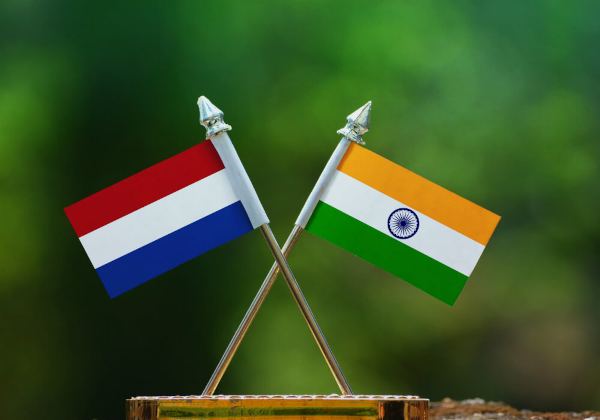
India is seeking to expand its trade, investment and maritime logistics partnership with the Netherlands as Union Commerce and Industry Minister Piyush Goyal began an official visit to the European country on 25 October 2026. The visit included engagements with maritime industry representatives, a tour of the Port of Rotterdam and interactions with the Indian business and professional community in Amsterdam.
The engagements come as India and the European Union advance their economic relationship through the India-EU Free Trade Agreement. The Netherlands occupies an important position in India’s European trade network, supported by its advanced ports, logistics infrastructure and extensive commercial connections across the continent.
During his visit, Goyal highlighted the Port of Rotterdam’s importance as a gateway for Indian goods entering European markets. The discussions also reflected India’s interest in strengthening international supply chains, improving market connectivity and developing new opportunities for Indian exporters.
Piyush Goyal Visits Europe’s Largest Port at Rotterdam
Piyush Goyal visited the Port of Rotterdam, accompanied by its Chief Executive Officer, Boudewijn Siemons. The engagement focused on the port’s strategic role in international maritime trade and its importance for commercial connectivity between India and Europe.
Rotterdam is Europe’s largest port and one of the continent’s principal maritime logistics centres. Its infrastructure supports the movement of cargo between international shipping routes and European industrial and consumer markets. The port’s connections with inland waterways, railways and road networks make it an important distribution centre for goods arriving from different parts of the world.
The Ministry of Commerce and Industry highlighted Rotterdam’s ability to facilitate the movement of Indian products into European markets. Its logistics infrastructure and established transport networks provide opportunities for Indian exporters seeking access to customers beyond the Netherlands.
The visit also brought attention to the role of modern port infrastructure in supporting international trade. Efficient cargo handling, multimodal transport and integrated logistics services are important factors in maintaining reliable supply chains and improving the competitiveness of exporters.
For India, stronger engagement with established European logistics centres can complement domestic initiatives to modernise ports, expand maritime connectivity and improve the efficiency of international cargo movement.
Port of Rotterdam Offers Strategic Access to European Markets
The Port of Rotterdam occupies a significant position in Europe’s maritime transport network because of its connectivity with major manufacturing, distribution and consumption centres.
Goods arriving through Rotterdam can move onward to several European countries using established transport corridors. These connections make the port particularly relevant to businesses seeking efficient distribution arrangements across the European market.
For Indian exporters, maritime connectivity with Rotterdam provides access to a logistics ecosystem capable of handling diverse cargo categories. These include petroleum products, chemicals, manufactured goods, machinery, agricultural commodities and containerised merchandise.
The Netherlands’ geographical location and extensive transport infrastructure also make it an important commercial gateway to neighbouring European economies. Efficient movement through such logistics centres can help exporters improve delivery schedules, coordinate distribution and manage international supply chains.
Goyal’s engagement with Rotterdam’s maritime stakeholders highlighted the potential for stronger cooperation in logistics infrastructure and trade facilitation. The visit provided an opportunity to examine how existing European port capabilities could support expanding commercial exchanges between India and the European Union.
India-EU Free Trade Agreement Creates New Opportunities for Exporters
The minister’s visit took place against the backdrop of closer economic integration between India and the European Union.
The Ministry of Commerce and Industry identified the India-EU Free Trade Agreement as an important consideration in the discussions surrounding Rotterdam’s role in international trade. The agreement is expected to create additional opportunities for Indian exporters through improved market access and stronger commercial engagement with European businesses.
The Netherlands’ port infrastructure could play an important role in supporting trade flows resulting from deeper India-EU economic cooperation. Its established logistics networks offer Indian companies access to distribution systems serving several European markets.
The potential benefits extend beyond merchandise exports. Closer economic engagement can encourage cooperation in supply-chain management, warehousing, transport technology, logistics services and industrial investment.
However, the commercial benefits of the agreement will depend on its implementation, applicable trade provisions and the ability of businesses to use emerging opportunities. The Rotterdam visit represented an engagement to strengthen economic cooperation rather than the announcement of a new port agreement or investment commitment.
Netherlands Remains an Important European Trading Partner for India
India and the Netherlands maintain substantial bilateral trade relations covering manufactured products, energy commodities, pharmaceuticals, chemicals, engineering goods and technology-related merchandise.
According to trade information published by the Embassy of India in the Netherlands, bilateral merchandise trade reached approximately USD 23.29 billion during the financial year 2025–26. India exported goods worth approximately USD 17.50 billion to the Netherlands and imported merchandise valued at approximately USD 5.79 billion.
These figures reflect the scale of the commercial relationship and the Netherlands’ continuing importance within India’s international trading network. India recorded a merchandise trade surplus of approximately USD 11.71 billion with the Netherlands during the financial year.
The major categories of Indian exports include petroleum products, telecommunications equipment, pharmaceuticals, organic chemicals, garments, iron and steel products, and electronic instruments.
Indian imports from the Netherlands include electronic components, medical and scientific instruments, industrial machinery, chemical products and other specialised manufactured goods.
The composition of bilateral trade demonstrates the relationship’s importance across several industrial sectors. The Netherlands serves both as a market for Indian products and as a logistics centre through which international merchandise can reach other European destinations.
Dutch Investment Supports India’s Industrial and Technology Sectors
Investment represents another important component of India-Netherlands economic relations.
According to official Indian investment statistics, the Netherlands remained the fourth-largest source of cumulative foreign direct investment equity inflows into India during the period from April 2000 to March 2026.
Cumulative FDI equity inflows from the Netherlands reached approximately USD 56.68 billion during this period, accounting for around 7% of India’s total FDI equity inflows.
During the financial year 2025–26, India received approximately USD 3.37 billion in FDI equity inflows from the Netherlands. Dutch investment has supported activities across services, technology, manufacturing and other sectors of the Indian economy.
The bilateral investment relationship also extends in the opposite direction. Indian companies have established operations and undertaken investments in the Netherlands, using the country’s industrial infrastructure, business environment and European market connections.
The Embassy of India has identified a substantial presence of companies from both countries in each other’s markets. Their activities span information technology, pharmaceuticals, manufacturing, energy, shipping, financial services and engineering.
These established commercial relationships provide a foundation for further investment cooperation, particularly in sectors where Indian manufacturing capabilities and Dutch technological expertise can complement one another.
Maritime Logistics and Supply-Chain Cooperation Gain Importance
Maritime logistics has emerged as a significant area of economic cooperation between India and the Netherlands.
India’s expanding manufacturing and export sectors require efficient access to international shipping routes, modern cargo-handling facilities and reliable distribution networks. The Netherlands offers considerable experience in port management, inland logistics and integrated transport infrastructure.
Cooperation in these areas can support the development of stronger connections between Indian producers and European markets. It can also create opportunities for companies specialising in shipping services, logistics technology and international cargo management.
India is simultaneously pursuing the modernisation of its domestic maritime infrastructure through initiatives associated with Maritime India Vision 2030 and Maritime Amrit Kaal Vision 2047.
These programmes aim to improve port efficiency, strengthen logistics networks and enhance India’s participation in international maritime commerce.
Engagement with established maritime economies such as the Netherlands provides opportunities to exchange experience in areas including port operations, infrastructure planning and supply-chain management.
Closer commercial interaction can also encourage collaboration among logistics companies, port operators, exporters and industrial enterprises in both countries.
India and Netherlands Expand Cooperation Beyond Traditional Trade
The India-Netherlands economic partnership extends beyond the movement of merchandise.
Both countries have identified opportunities for collaboration in water management, agriculture, food processing, renewable energy, advanced manufacturing, semiconductors and maritime technology.
The Netherlands possesses established technological capabilities in several of these areas, while India’s large domestic market, expanding manufacturing base and growing technology ecosystem offer opportunities for industrial cooperation.
The two countries have also strengthened their broader institutional relationship through engagement on innovation, sustainable development and technological partnerships.
Their economic cooperation increasingly includes activities associated with research, industrial modernisation, advanced technologies and the development of resilient supply chains.
Within this wider relationship, the Rotterdam visit highlighted the continuing importance of physical infrastructure and maritime connectivity in supporting trade and investment.
The combination of technological cooperation and efficient logistics can provide a stronger foundation for businesses seeking to establish long-term partnerships across both markets.
Piyush Goyal Interacts with Indian Business Community in Amsterdam
As part of his visit, Piyush Goyal participated in an interaction with the Indian community in Amsterdam, organised by the Embassy of India.
The gathering took place at the Waldorf Astoria Amsterdam and brought together approximately 70 participants, including business representatives, professionals and members of the Indian diaspora.
The interaction provided an opportunity to engage with Indians contributing to the Netherlands’ business, technology and professional sectors. It also highlighted the role of the overseas Indian community in maintaining commercial and cultural connections between the two countries.
Indian professionals and entrepreneurs in the Netherlands contribute to sectors including information technology, financial services, engineering, research and international business.
Their professional networks can facilitate commercial engagement by connecting Indian enterprises with Dutch businesses, institutions and potential partners.
The Ministry of Commerce and Industry recognised the Indian community’s contribution to strengthening bilateral economic, cultural and people-to-people relations.
Such interactions complement formal government and industry engagements by maintaining communication with professionals who participate directly in the economic relationship between the two countries.
India-Netherlands Partnership Supports Stronger Economic Connectivity
Piyush Goyal’s visit to the Netherlands reflects India’s continued efforts to strengthen trade relationships with important European partners.
The engagement at the Port of Rotterdam placed particular emphasis on maritime logistics, access to European markets and the infrastructure required to support international trade.
The discussions also highlighted the potential opportunities associated with the India-EU Free Trade Agreement and the importance of established logistics centres in facilitating future commercial exchanges.
With bilateral merchandise trade exceeding USD 23 billion in 2025–26 and substantial investment flowing between the two economies, India and the Netherlands have a strong foundation for further economic cooperation.
Continued engagement between government institutions, maritime operators, exporters, investors and business communities can support new commercial partnerships while strengthening international supply chains.
As India expands its manufacturing capabilities and international trade relationships, cooperation with the Netherlands offers opportunities to improve market connectivity, deepen technological collaboration and strengthen the country’s participation in European and global commerce.
References
- Press Information Bureau, Ministry of Commerce and Industry, 25 October 2026. Union Minister Piyush Goyal Holds Trade and Investment Talks in the Netherlands. Release ID: 2328254.
- Embassy of India, The Hague, 2026. Bilateral Trade and Investment. Official statistics covering India-Netherlands merchandise trade, exports, imports and foreign direct investment during FY 2025–26.
- Ministry of External Affairs, Government of India, 2026. Brief on India-Netherlands Bilateral Relations. Information on bilateral economic relations, maritime cooperation and institutional engagement.
- Press Information Bureau, Government of India, 2026. India-Netherlands: Driving Innovation, Trade and Sustainability. Official background on economic cooperation, investment, semiconductors, maritime technology and sustainability.
- European Commission, Directorate-General for Trade and Economic Security. EU-India Free Trade Agreement: Netherlands Factsheet. Information on the economic relationship between India, the Netherlands and the European Union.
You may also like
-
India to Train 600 Nigerian Army Soldiers in Specialised Jungle and Mountain Warfare
-
India and Russia Strengthen Parliamentary Diplomacy as Om Birla Meets State Duma Chairman Vyacheslav Volodin
-
India Seeks South Korean Shipbuilding Partnerships as Sarbananda Sonowal Begins Four-Day Visit to Busan
-
India and Italy Hold First Maritime Security Dialogue in Rome, Strengthen Strategic Maritime Cooperation
-
India and Azerbaijan Agree to Strengthen Security, Trade, Energy and Economic Cooperation
