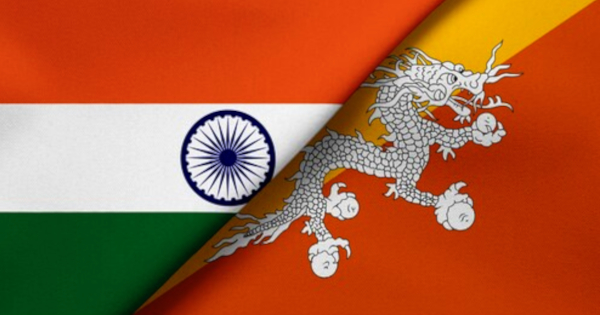
India and Bhutan have advanced a new set of development projects covering hydropower, healthcare and road connectivity as External Affairs Minister S. Jaishankar began a two-day official visit to Bhutan on September 16.
Jaishankar held talks with Bhutan’s Minister of Foreign Affairs and External Trade, Lyonpo D.N. Dhungyel, in Bumthang, reviewing cooperation across development, energy, trade, connectivity, culture and people-to-people relations. The visit also saw the two ministers participate in ceremonies connected with three India-supported projects located in different parts of Bhutan.
The projects range from bringing electricity to some of Bhutan’s most isolated Himalayan communities to expanding specialised maternal and child healthcare in the country’s east and strengthening an important road corridor connecting eastern districts.
500-kW Lunana Hydropower Project to Reach Remote Himalayan Settlements
Jaishankar and Dhungyel laid the foundation stone for the 500-kW Lunana Mini Hydropower Project in Gasa, one of Bhutan’s most remote and geographically challenging regions. The project is intended to provide reliable electricity to settlements that remain outside the country’s regular electricity network.
Lunana lies deep in the Himalayas at elevations of around 4,000 metres and above, making conventional infrastructure development exceptionally difficult. Bhutan’s own development plans identify the 500-kW project as part of its 13th Five-Year Plan, while construction and associated transmission infrastructure are being supported through India-Bhutan development cooperation.
The Indian Embassy in Thimphu said earlier this year that the project is intended to help electrify Bhutan’s last ten unelectrified villages, covering around 173 households and approximately 700 people. Druk Green Power Corporation is responsible for the generation works, while Bhutan Power Corporation is handling the transmission and local distribution network.
The project is notable because Bhutan is already one of South Asia’s major hydropower producers. Yet the country’s mountainous geography means that small and isolated communities can remain difficult to connect even while large hydropower stations generate electricity for domestic use and export.
The Lunana project therefore represents a different dimension of India-Bhutan energy cooperation. Rather than being designed primarily around large generating capacity or cross-border electricity trade, it focuses on supplying dependable power to remote settlements where geography makes grid extension difficult.
Hydropower Remains a Foundation of India-Bhutan Relations
Energy cooperation has been one of the most durable components of the relationship between India and Bhutan. Formal hydropower cooperation between the two countries dates back decades and has expanded into large generating projects, electricity exports, transmission infrastructure and more recently renewable-energy development.
In August, the two governments reviewed major projects including Punatsangchhu-I, Punatsangchhu-II, Sankosh and Chukha, while also discussing cross-border electricity trade, transmission connectivity and renewable energy. India and Bhutan have increasingly begun looking beyond conventional large hydropower projects towards solar power, smaller hydro installations and wider energy integration.
The relatively small capacity of the Lunana project should therefore be viewed in the context of its purpose rather than its generating scale. Its importance lies in taking electricity into isolated high-altitude communities that are among the hardest places in Bhutan to serve with conventional infrastructure.
New Mother and Child Hospital Strengthens Healthcare in Eastern Bhutan
The second major development during Jaishankar’s visit was the inauguration of the 65-bed Gyaltsuen Jetsun Pema Mother & Child Hospital at Mongar.
The specialised hospital has been developed with Indian assistance and is intended to improve maternal, neonatal and paediatric healthcare for eastern Bhutan. According to the Indian Embassy in Thimphu, the hospital was designed to provide both regular and specialised services for patients from Mongar, Trashigang, Pemagatshel, Trashiyangtse, Lhuentse, Samdrup Jongkhar and Bumthang.
The facility includes obstetrics and gynaecology, paediatrics and neonatology departments, intensive-care facilities for children and newborns, operation theatres, emergency and trauma services, laboratories and other specialised medical infrastructure.
The project has been funded by India through its Project Tied Assistance mechanism. Bhutanese reporting placed the revised project budget at approximately Nu 960 million after construction and equipment requirements evolved during implementation.
For eastern Bhutan, the importance of the hospital goes beyond additional bed capacity. Patients requiring specialised maternal or paediatric treatment have historically faced the possibility of travelling considerable distances, including referrals towards larger medical centres. A dedicated specialist facility at Mongar can reduce that pressure while strengthening healthcare coverage for several eastern districts.
Project Dantak Completes 80-Metre Bridge in Eastern Bhutan
Jaishankar also inaugurated the 80-metre Jaganathan Bridge at Samdrup Jongkhar, constructed by Project Dantak of India’s Border Roads Organisation.
The bridge is expected to improve connectivity between Trashigang and Samdrup Jongkhar, strengthening movement through eastern Bhutan. It represents another addition to the extensive road and bridge network developed under Project Dantak during more than six decades of India-Bhutan infrastructure cooperation.
Project Dantak was established in Bhutan in 1961 and remains the Border Roads Organisation’s oldest overseas undertaking. Over the decades, it has constructed roads and bridges and contributed to infrastructure associated with airports, telecommunications and hydropower development in Bhutan.
Road connectivity has particular importance in Bhutan because difficult Himalayan terrain can make relatively short geographical distances challenging to traverse. Better bridges and all-weather roads therefore have direct consequences for trade, access to healthcare and education, movement between districts and the transportation of construction material and agricultural produce.
The Jaganathan Bridge reflects this practical dimension of bilateral cooperation. Rather than being an isolated structure, it forms part of a much longer Indian involvement in building and maintaining connectivity infrastructure across Bhutan.
Development Partnership at the Centre of the Visit
The three projects highlighted during Jaishankar’s visit cover very different sectors, but together they illustrate the character of India’s development partnership with Bhutan. The Lunana project addresses electricity access in isolated Himalayan communities, the Mongar hospital expands specialised healthcare in eastern Bhutan, while the Jaganathan Bridge strengthens regional transport connectivity.
The bilateral talks in Bumthang extended beyond these individual projects. Jaishankar and Dhungyel reviewed energy, development cooperation, trade, connectivity, cultural relations and people-to-people exchanges. Jaishankar is also scheduled during the visit to receive an audience with Bhutan’s King Jigme Khesar Namgyel Wangchuck and meet Prime Minister Tshering Tobgay.
The engagement comes amid continuing expansion of the India-Bhutan economic and energy relationship. In recent discussions, the two sides have examined additional hydropower development, cross-border transmission links, renewable energy, river management and new infrastructure projects.
For India and Bhutan, the September 16 developments demonstrate how their relationship continues to operate simultaneously at the strategic and local levels. Large hydropower and electricity arrangements remain important to the economic partnership, but smaller projects that bring electricity, healthcare and transport links to remote communities continue to give the bilateral relationship a visible presence on the ground.
You may also like
-
India and Côte d’Ivoire Move to Strengthen Defence, Counterterrorism and Economic Cooperation
-
India and Ghana Expand Agricultural Partnership Through New ICAR–CSIR-CRI Agreement
-
India Hands Over Three Tonnes of Anti-Tuberculosis Medicines to Sri Lanka
-
India and Austria Move to Deepen Security and Strategic Cooperation
-
India Offers Space-Based Climate Monitoring and Ocean Science Expertise to Pacific Partners at Pre-COP31
