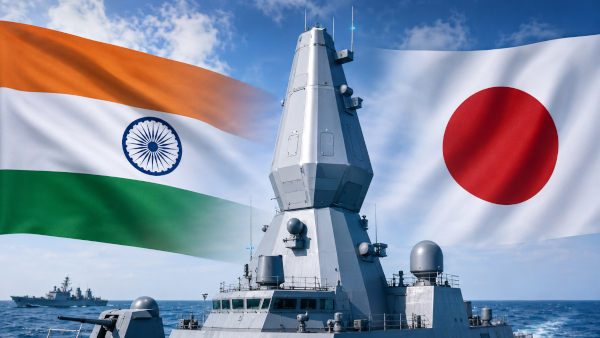
India and Japan have agreed to significantly expand defence manufacturing, naval technology collaboration, joint military exercises and maritime security cooperation, with particular emphasis on accelerating the proposed transfer of Japan’s Unified Complex Radio Antenna (UNICORN) technology and strengthening industrial partnerships under the “Design with Japan, Make in India” framework.
The agreements and understandings emerged from the fourth India–Japan Foreign and Defence Ministers’ Meeting, commonly known as the 2+2 Dialogue, held in Tokyo on 19 November 2026. The meeting brought together Defence Minister Rajnath Singh, External Affairs Minister Dr S. Jaishankar, Japanese Foreign Minister Toshimitsu Motegi and Japanese Defence Minister Shinjiro Koizumi.
The discussions marked a further development in the India–Japan Special Strategic and Global Partnership, reflecting the growing importance of defence technology, maritime security, industrial collaboration and military interoperability in the Indo-Pacific region.
A major outcome was the decision to accelerate arrangements concerning UNICORN naval technology, alongside the signing of a Letter of Intent allowing Japan’s Self-Defence Forces to undertake future live-fire training at Indian military ranges.
UNICORN Naval Technology Emerges as a Major Priority
One of the most important technological developments discussed during the meeting was the proposed cooperation involving the Unified Complex Radio Antenna, commonly known as UNICORN.
UNICORN is a Japanese integrated naval antenna system designed to consolidate multiple communication and electronic functions within a streamlined mast arrangement aboard warships. Modern naval vessels carry numerous antennas and electronic systems used for communications, surveillance and other operational requirements. Conventional arrangements distribute these components across different parts of a ship’s superstructure, potentially increasing its radar signature and complicating equipment integration.
Integrated antenna arrangements such as UNICORN are intended to improve the organisation of these systems while reducing the external profile of antenna installations. This approach is particularly relevant to modern surface combatants, where radar signature management, electromagnetic compatibility and efficient use of available space are important considerations.
The proposed India–Japan cooperation would provide an opportunity to integrate Japanese naval technology into India’s expanding naval modernisation and indigenous warship construction programmes.
During the Tokyo discussions, both countries expressed their expectation that arrangements concerning UNICORN would be concluded at an early date. They also identified February 2027 as the expected timeframe for India to obtain an Acceptance of Necessity for the proposed acquisition.
The Acceptance of Necessity is an important step in India’s defence procurement process, establishing formal recognition of an operational requirement before subsequent acquisition procedures are undertaken.
The November 2026 announcement therefore represents progress towards a possible procurement and technology partnership rather than confirmation that UNICORN systems have already been ordered, transferred or installed aboard Indian warships.
Importance of Integrated Stealth Mast Technology for the Indian Navy
The significance of UNICORN extends beyond the installation of an individual communication system. It reflects the broader technological evolution of naval platforms towards integrated electronic architecture and reduced observable signatures.
Modern destroyers, frigates and other major surface combatants depend on interconnected communication equipment, radar systems, electronic warfare sensors and combat-management networks. Their effectiveness increasingly depends on the ability to coordinate these systems without creating unnecessary electromagnetic interference or compromising the vessel’s operational characteristics.
Integrated mast technology addresses some of these challenges by bringing selected antenna systems into a more compact and carefully designed configuration.
For the Indian Navy, access to such technology could support future work involving advanced surface combatants, depending on the scope of the proposed arrangement, technology-transfer provisions and compatibility with indigenous systems.
India already possesses substantial warship design and construction capabilities through its naval design establishments and domestic shipyards. Cooperation with Japan on specialised naval subsystems could complement these capabilities while creating opportunities for technological learning and industrial collaboration.
However, the exact configuration, intended Indian naval platforms, production responsibilities and technology-transfer arrangements associated with UNICORN have not yet been formally announced.
‘Design with Japan, Make in India’ to Strengthen Defence Manufacturing
A central theme of the Tokyo meeting was the expansion of defence industrial cooperation under the “Design with Japan, Make in India” framework.
The approach brings together Japan’s technological and engineering expertise with India’s growing defence manufacturing infrastructure, potentially creating opportunities for joint design, production, systems integration and industrial development.
Unlike conventional defence equipment purchases, collaborative design and manufacturing arrangements can provide opportunities for Indian companies to participate more extensively in the development and production of advanced military systems.
India has been steadily strengthening its defence industrial ecosystem through public-sector enterprises, private manufacturers, research organisations and specialised technology companies. Japanese participation could expand the range of international technological partnerships available to these organisations.
The two countries welcomed the third India–Japan Defence Industries Forum, held in Tokyo in October 2026, as an important platform for strengthening connections between their respective defence manufacturing industries.
The forum provides an institutional mechanism for identifying opportunities involving defence equipment, specialised components, research collaboration and industrial partnerships.
The proposed UNICORN cooperation represents one of the areas through which this broader defence industrial relationship could develop into a specific technology programme.
India and Japan Explore Joint Naval Shipbuilding and Design
Beyond UNICORN, the two countries agreed to advance discussions on naval shipbuilding, vessel design and mine countermeasure capabilities.
During separate bilateral talks between Rajnath Singh and Shinjiro Koizumi, the defence ministers reviewed progress under the Memorandum of Arrangement on Maritime Security Cooperation signed in August 2026.
They confirmed that a working group headed at the Joint Secretary and Director General level would follow up on discussions concerning improved mine countermeasure capabilities and the possibility of joint development in naval shipbuilding and design.
Mine countermeasure capabilities are important for protecting naval bases, ports, shipping routes and coastal approaches from underwater explosive threats. They involve specialised detection, identification, classification and neutralisation technologies.
Cooperation in this field could provide opportunities for exchanges involving naval sensors, autonomous systems, operational procedures and specialised maritime technologies.
The discussions on joint shipbuilding are particularly significant because India has developed considerable experience in constructing indigenous destroyers, frigates, aircraft carriers, submarines and specialised naval platforms.
Japanese expertise in maritime engineering, advanced equipment integration and shipbuilding technologies could complement India’s existing design and production capabilities.
At present, however, the two governments have identified these as areas for further exploration. No specific jointly developed warship class, construction contract or production schedule was announced during the meeting.
Japanese Forces to Conduct Live-Fire Training at Indian Military Ranges
Another important outcome was the signing of a Letter of Intent concerning the use of Indian military firing ranges by Japan’s Self-Defence Forces.
The proposed arrangement would allow Japanese military personnel to conduct live-fire training in India for the first time, including exercises involving surface-to-ship missiles.
Surface-to-ship missiles are designed to engage maritime targets from land-based launch positions. Such systems are important components of coastal defence and maritime denial capabilities.
Training at Indian firing ranges could provide Japan’s Self-Defence Forces with additional opportunities to conduct exercises in different geographical and operational environments.
The agreement also reflects the increasing level of military cooperation between India and Japan, extending beyond traditional naval visits and exercises into more specialised training activities.
Both governments agreed to accelerate coordination between their respective defence authorities to implement the proposed arrangement.
The Letter of Intent establishes a framework for moving forward, while detailed training schedules, locations, participating units and operational arrangements remain to be finalised.
Joint Military Exercises to Become More Complex
India and Japan also agreed to increase the complexity and operational scope of their bilateral military exercises.
The ministers reviewed progress in cooperation between their armed forces, including the participation of Japanese fighter aircraft in the bilateral air exercise Veer Guardian 2026 in India.
The exercise marked the first visit of Japan Air Self-Defence Force fighter aircraft to India for the bilateral air training programme.
Both countries agreed to pursue more advanced training activities involving integrated unmanned systems, complex operational scenarios and exercises organised at shorter notice.
The emphasis on unmanned systems reflects their growing importance in modern military operations, where drones and remotely operated platforms increasingly contribute to surveillance, reconnaissance, logistics and other operational missions.
India and Japan also reviewed their participation in major maritime exercises, including Malabar 2026, involving India, Japan, the United States and Australia, and the bilateral Japan–India Maritime Exercise JAIMEX 2026.
Both naval exercises were conducted in Japan during November 2026.
The defence ministers additionally agreed to advance exchanges between their special operations forces, strengthening professional cooperation across different military domains.
Maritime Security Cooperation Across the Indo-Pacific
Maritime security formed another major component of the discussions, particularly cooperation between the Indian Navy and the Japan Maritime Self-Defence Force.
Both countries agreed to pursue practical cooperation in Maritime Domain Awareness, Air Domain Awareness, search and rescue, information sharing and humanitarian assistance and disaster relief.
Maritime Domain Awareness involves collecting, analysing and sharing information about activities in maritime areas, including vessel movements, potential threats, environmental conditions and other developments relevant to maritime safety and security.
Improved cooperation in this field can support the monitoring of important shipping routes, strengthen maritime safety and facilitate more coordinated responses to emergencies.
The Indo-Pacific contains some of the world’s most important international sea lanes, connecting major manufacturing centres, energy producers and consumer markets.
For India, maritime cooperation with Japan is relevant to the security of shipping routes across the Indian Ocean and the wider Indo-Pacific.
For Japan, which depends heavily on maritime trade and imported energy, secure sea lines of communication are an important strategic consideration.
The two countries also agreed to strengthen cooperation between their coast guards and welcomed India’s hosting of the fifth Coast Guard Global Summit in February 2027.
DRDO and Japan’s ATLA to Advance Defence Research Cooperation
The Tokyo discussions also identified opportunities for closer research and development cooperation between India’s Defence Research and Development Organisation and Japan’s Acquisition, Technology and Logistics Agency.
During their bilateral meeting, the defence ministers affirmed their intention to advance cooperation between DRDO and ATLA in advanced missile and defence technologies.
ATLA is a major Japanese organisation responsible for defence equipment acquisition, research, technological development and logistics-related functions.
Closer cooperation between DRDO and ATLA could provide an institutional basis for technical exchanges and future collaborative research.
Such engagement would be relevant to India’s continuing efforts to expand domestic capabilities in sophisticated defence technologies, including sensors, missile systems, advanced materials and electronic equipment.
The November 19 announcement did not identify a specific jointly developed missile programme, confirmed research contract or production agreement. It nevertheless established advanced missile and defence technologies as areas for further bilateral research cooperation.
Cybersecurity, Artificial Intelligence and Space Cooperation
India and Japan also agreed to strengthen cooperation in emerging strategic technologies, recognising the growing importance of cybersecurity, artificial intelligence and space-based capabilities.
The two countries identified cybersecurity as an important area for institutional cooperation, particularly the protection of critical infrastructure and the security of artificial intelligence systems.
They agreed to pursue renewal of their existing cybersecurity cooperation arrangement and organise the next India–Japan Cyber Dialogue.
In the space sector, both governments expressed interest in expanding cooperation in Space Situational Awareness and the use of satellite capabilities for Maritime Domain Awareness.
Space Situational Awareness involves monitoring satellites, orbital debris and other objects in space to improve the safety and reliability of space operations.
Satellite-supported maritime surveillance can also contribute to identifying and tracking vessel movements across large oceanic areas.
India and Japan additionally reaffirmed cooperation under the Japan–India AI Cooperation Initiative, which seeks to support research partnerships and the development of artificial intelligence capabilities.
These discussions demonstrate the widening scope of bilateral strategic cooperation beyond traditional military platforms into digital infrastructure, information systems and emerging technologies.
Economic Security and Resilient Defence Supply Chains
The ministers also examined the relationship between economic security and defence preparedness, particularly the importance of reliable supply chains for critical industrial technologies.
India and Japan agreed to encourage project-based cooperation in semiconductors, critical minerals, information and communication technologies, clean energy and pharmaceuticals.
Semiconductors, specialised electronic components and critical minerals are essential inputs for many advanced defence systems, including radar equipment, communications systems, precision-guided weapons and electronic warfare technologies.
Disruptions in these supply chains can affect manufacturing schedules, equipment availability and technological development.
The emphasis on economic security therefore complements the broader defence industrial partnership by encouraging cooperation in the industries and materials that support advanced manufacturing.
Both countries also recognised the value of closer engagement among government organisations, research institutions and private industries to identify opportunities for investment and technology collaboration.
Building on an Expanding Strategic Partnership
The fourth India–Japan 2+2 Dialogue built upon the Joint Declaration on Security Cooperation adopted during the India–Japan Annual Summit in August 2025.
The two countries have progressively expanded their defence relationship through ministerial consultations, joint military exercises, maritime cooperation and industrial exchanges.
The November 2026 meeting brought several of these areas together within a more comprehensive framework that connects military training, naval technologies, industrial development and strategic research.
The proposed UNICORN arrangement provides a specific technological focus, while the “Design with Japan, Make in India” framework offers a broader direction for defence manufacturing partnerships.
The Letter of Intent for Japanese military training in India introduces another dimension to bilateral military cooperation.
Meanwhile, discussions involving joint naval design, mine countermeasure capabilities, advanced missile research and maritime surveillance demonstrate the range of areas in which the two countries are seeking closer engagement.
A New Phase in India–Japan Defence Technology Cooperation
The agreements and understandings reached in Tokyo on 19 November 2026 reflect the continuing evolution of India–Japan relations towards a more technology-oriented and operationally integrated defence partnership.
The proposed UNICORN naval antenna arrangement is particularly important because it links a specific Japanese defence technology with India’s requirements for advanced naval capabilities and its broader indigenous defence manufacturing objectives.
At the same time, cooperation in naval shipbuilding, specialised military training, defence research, unmanned systems and maritime surveillance provides opportunities for the two countries to develop complementary capabilities.
The next steps will involve translating these understandings into practical arrangements, including the proposed UNICORN procurement process, implementation of the firing-range training framework and identification of specific industrial and research projects.
For India, the expanding partnership offers opportunities to strengthen indigenous defence manufacturing, improve access to specialised technologies and deepen cooperation with an important Indo-Pacific partner.
By bringing together Japan’s engineering capabilities and India’s growing defence industrial base, the “Design with Japan, Make in India” approach establishes a constructive framework for future technological collaboration, greater industrial participation and stronger maritime security cooperation across the Indo-Pacific.
You may also like
-
Sigma Advanced Systems and Spain’s Escribano Launch Joint Venture for Advanced Defence Manufacturing in India
-
India and Indonesia Review Trade Cooperation, Market Access and Investment Opportunities at New Delhi Meeting
-
Ṣāḍguṇya: The Six Measures of Foreign Policy in Kauṭilya’s Arthaśāstra
-
Rāvaṇa’s Council of Ministers: The Failure of Collective Decision-Making Before War
-
India–Malaysia Joint Military Exercise Harimau Shakti–VI Begins in Malaysia with Focus on Counter-Terrorism and Drone Warfare
