India and Belgium have moved to significantly deepen their defence relationship, combining expanded military-to-military engagement with a stronger push for industrial cooperation, technology partnerships and joint production of advanced defence systems. The emerging framework places particular emphasis on maritime security, artificial intelligence, unmanned platforms, cyber security, underwater systems and complex weapons.
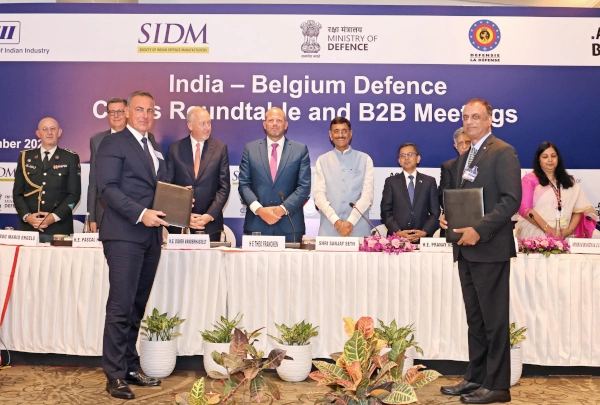
The new momentum followed a series of high-level engagements in New Delhi on September 3, 2026, during the official visit of Belgian Prime Minister Bart De Wever. Defence Minister Rajnath Singh held bilateral talks with Belgium’s Minister of Defence and Foreign Trade Theo Francken, while Francken later joined Minister of State for Defence Sanjay Seth at the India-Belgium Defence CEOs Roundtable and business-to-business meetings involving defence companies from both countries.
During their bilateral meeting, Rajnath Singh and Theo Francken reviewed the full spectrum of defence and defence-industrial cooperation. The two sides agreed to strengthen the relationship through a structured defence cooperation dialogue, high-level visits, professional military exchanges, training and capacity building.
Maritime security has emerged as an important component of the partnership. India and Belgium discussed the evolving regional security environment and agreed on the need for stronger cooperation in the Indo-Pacific, particularly in securing maritime interests. The discussions complement broader India-Belgium engagement in defence, security and emerging technologies and indicate that the relationship is expanding beyond conventional commercial ties into strategic cooperation.
The industrial dimension received greater attention at the India-Belgium Defence CEOs Roundtable, where Francken highlighted the potential for Indian and Belgian companies to jointly strengthen the capabilities of their armed forces. He pointed to the growing strategic partnership between India and the European Union and the development of institutional engagement in maritime security, information security and aerospace.
India, meanwhile, presented its expanding defence manufacturing ecosystem as a platform through which Belgian technological expertise could be combined with Indian engineering capability, production capacity and supply chains.
Sanjay Seth called on Belgian defence manufacturers to pursue co-development and co-production of niche defence technologies in India, rather than limiting cooperation to conventional buyer-seller relationships. The approach is aligned with India’s broader effort to reduce import dependence while simultaneously building international industrial partnerships capable of serving both domestic requirements and overseas markets.
India identified cyber security, AI-enabled unmanned aerial systems, underwater-domain vehicles and complex weapon systems as particularly promising areas for bilateral cooperation. These fields correspond closely with the changing requirements of modern armed forces, where autonomous systems, artificial intelligence, networked sensors, electronic technologies and uncrewed platforms are increasingly important.
Indian defence innovation programmes such as Innovations for Defence Excellence (iDEX) and the Acing Development of Innovative Technologies with iDEX, or ADITI, could provide additional channels for Belgian companies and research organisations to work with Indian startups, MSMEs and established manufacturers. Current innovation priorities include artificial intelligence, quantum technologies, military communications, counter-drone systems and adaptive camouflage.
India’s defence industrial base has expanded considerably in recent years and now combines Defence Public Sector Undertakings, large private-sector companies, startups and more than 16,000 MSMEs. These companies operate across aerospace, naval systems, land platforms, defence electronics, space technologies, cyber security and unmanned systems.
The government is attempting to use this industrial network not only to substitute defence imports but also to attract foreign technology and integrate Indian companies into international supply chains. Department of Defence Production initiatives increasingly encourage technology transfer, local manufacturing, joint development and industrial partnerships with foreign original equipment manufacturers.
India has also highlighted its investment framework as an incentive for Belgian companies considering manufacturing operations or technology partnerships. Foreign direct investment of up to 74% is permitted in the defence sector under the automatic route, while investments of up to 100% can be considered through the government route in eligible cases. India’s space sector has separately been opened to significantly greater foreign investment under the country’s revised space policy.
Defence Industrial Corridors in Uttar Pradesh and Tamil Nadu provide another potential base for Indo-Belgian manufacturing partnerships. The government has also indicated plans for additional defence industrial corridors in Maharashtra, Assam and other regions, potentially widening the geographical footprint available to international manufacturers seeking Indian production partners.
The most tangible industrial outcome of the September 3 engagement was the exchange of several agreements involving Indian and Belgian defence companies. These partnerships span robotics, weapons, electro-optics, defence engineering and other specialised technologies.
The agreements announced during the engagement include:
- Society of Indian Defence Manufacturers and Belgian Security & Defence Industry, creating an industry-level mechanism for closer cooperation.
- Larsen & Toubro and Exail Robotics, involving Exail’s French and Belgian operations.
- Kalyani Strategic Systems and FN Herstal, linking one of India’s major private defence manufacturers with the Belgian small-arms and weapon-systems company.
- Tembo Classic Engineering and Lachaussée SA.
- India Optel Limited and OIP, bringing together Indian and Belgian capabilities in electro-optical technologies.
- Krishna Industries and Pitagone.
- DGVK Enterprises and Sol1 BV.
- Kalyani Strategic Systems, Thales Belgium and Thales India, creating another potential channel for advanced defence technology cooperation.
The range of companies involved indicates that the bilateral defence relationship is being structured across multiple levels rather than around a single procurement programme. Large Indian defence groups, public-sector manufacturers, specialist engineering companies and European technology suppliers are all being encouraged to identify areas where Belgian technology can be industrialised at Indian scale.
The involvement of FN Herstal, OIP, Exail Robotics and Thales Belgium is particularly notable because Belgian industry possesses established capabilities in areas ranging from weapon systems and electro-optics to robotics, sensors and defence electronics. India offers these companies access to a rapidly expanding domestic defence market alongside a large manufacturing ecosystem and increasingly export-oriented production base.
For India, this model fits the transformation of its defence procurement strategy from dependence on imported finished equipment towards indigenous manufacturing and international technology partnerships. Strategic autonomy increasingly involves obtaining critical technologies while ensuring that manufacturing, integration, maintenance and future upgrades can be undertaken domestically.
For Belgium, closer cooperation with India provides access to one of the world’s largest defence markets and an industrial base capable of supporting larger production volumes. It also places bilateral cooperation within the expanding India-EU strategic relationship, particularly as security concerns in Europe and the Indo-Pacific increase demand for resilient defence supply chains and diversified manufacturing partnerships.
The September 3 engagements therefore mark a shift from general defence dialogue towards a more structured India-Belgium defence-industrial partnership. Military exchanges, maritime cooperation and training will form one side of the relationship, while co-development, technology transfer, joint manufacturing and industrialisation of advanced systems will form the other.
You may also like
-
India and Azerbaijan Agree to Strengthen Security, Trade, Energy and Economic Cooperation
-
Zen Technologies Introduces Indigenous Hyper-Strike Falcon AI-Guided Counter-Drone Interceptor
-
L&T and Germany’s SCHOTTEL Expand Partnership for Controllable Pitch Propeller Systems in Indian Shipbuilding
-
India to Train 60,000 Civil Defence Volunteers Across 12 States and UTs with Indian Army Support
-
Indian Army’s Northern Command Opens 75-Day Defence Technology Internship Programme for Young Innovators
