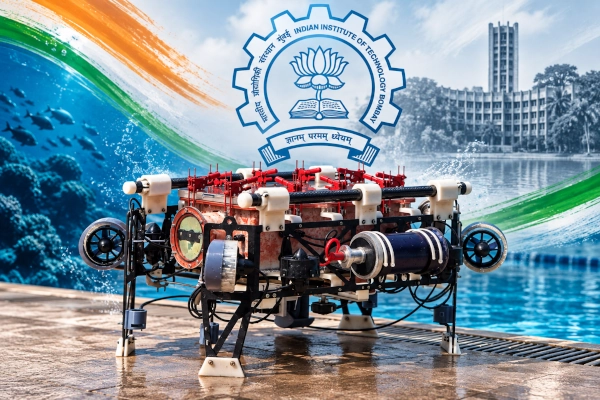
A student robotics team from the Indian Institute of Technology Bombay has demonstrated two autonomous underwater vehicles operating together at RoboSub 2026 in California, securing two first-place honours and several other top finishes against 58 teams from nine countries.
The AUV-IITB team deployed its flagship Matsya 7 alongside the newly developed Mini Matsya, marking the first time the team had operated two autonomous underwater vehicles in parallel during the international competition. IIT Bombay said the dual-vehicle arrangement allowed the robots to divide complex underwater tasks and perform them with greater speed and efficiency.
RoboSub 2026 was held from July 11 to 16 at the Woollett Aquatics Center in Irvine, California. The annual competition challenges university teams to design autonomous underwater robots capable of completing tasks that reflect problems encountered in real marine environments, including navigation, mapping, object detection, manipulation and pipeline tracking.
Matsya 7 Joined by Smaller Mini Matsya
Matsya is IIT Bombay’s long-running family of autonomous underwater vehicles, developed by students working across mechanical engineering, electronics, embedded systems, computer vision, controls and artificial intelligence.
Matsya 7 is the team’s principal full-sized autonomous platform. It had already competed internationally before the 2026 event, finishing sixth in the RoboSub 2025 Autonomy Challenge. For the 2026 competition, however, IIT Bombay introduced a second vehicle, Mini Matsya, specifically designed to support the larger robot.
RoboSub’s official programme describes Mini Matsya as a compact vehicle built to operate alongside Matsya 7. Rather than relying on one robot to complete every task sequentially, the team developed a system in which the two vehicles could operate simultaneously.
This represents a more demanding form of underwater autonomy. A single autonomous vehicle must already determine its position, interpret sensor information, recognise targets and execute manoeuvres without direct human control. Operating two vehicles together adds the need to coordinate missions while avoiding interference and ensuring that each platform performs the appropriate task.
IIT Bombay Secures Two First-Place Honours
IIT Bombay’s official announcement says AUV-IITB secured first place overall in the Wildcard Challenge and first place in Website Evaluation at RoboSub 2026.
The team also finished second in the MathWorks Simulation Challenge and fifth in the main Global Autonomy Challenge, placing IIT Bombay among the highest-ranked teams at the international event.
RoboSub’s final official standings confirm IIT Bombay’s fifth-place finish in the Autonomy Challenge and second place in the MathWorks Simulation Challenge. The official competition record also gives AUV-IITB Top Website recognition and joint third place in Overall Design Documentation following a post-event scoring correction.
The correction is relevant because IIT Bombay’s September 9 announcement originally listed the team as second in Design Documentation. RoboSub subsequently revised the scores, placing Nanyang Technological University second and IIT Bombay and Ohio State University jointly third.
Gripper Completes Complex Underwater Manipulation
One of the technical milestones highlighted by IIT Bombay was the successful operation of its underwater gripper system.
After several years of development, the team successfully used the mechanism to manipulate multiple underwater objects during the competition. This is a difficult problem because an autonomous vehicle must first identify the object, manoeuvre into the correct position and then operate the manipulator accurately despite water currents and limited visual conditions.
Manipulation capability considerably expands what an autonomous underwater vehicle can do. A robot limited to observation can map or inspect an underwater area, but a vehicle equipped with a reliable manipulator can potentially interact with submerged infrastructure, retrieve samples, handle equipment or perform limited intervention tasks.
The challenge therefore requires the integration of computer vision, localisation, vehicle control and mechanical design rather than the performance of the gripper alone.
RoboSub Tests Underwater Autonomy Without Human Control
RoboSub is designed around autonomous operation rather than remote piloting.
Participating teams build vehicles that must interpret their surroundings and complete missions without an operator continuously controlling their movement. According to RoboSub, the competition’s tasks are simplified versions of problems encountered in areas such as oceanographic exploration, underwater mapping, object detection and manipulation, and pipeline identification and tracking.
This makes the event different from competitions involving remotely operated underwater vehicles. Once an autonomous mission begins, the robot’s onboard software and sensors must determine how it navigates and reacts to the environment.
For student teams, this requires work across several disciplines. Cameras and other sensors provide environmental data, computer-vision algorithms identify objects, navigation software determines position, and control algorithms translate those decisions into movements produced by the vehicle’s thrusters.
Reliable performance underwater is particularly difficult because GPS signals cannot be used normally below the surface, visibility can deteriorate rapidly and water movement can push a vehicle away from its intended trajectory.
Competition Drew 58 Teams From Nine Countries
The 29th RoboSub competition brought together 58 teams representing Bangladesh, Brazil, Canada, India, Mexico, Poland, Singapore, Türkiye and the United States.
The main Autonomy Challenge was won by the National University of Singapore’s Bumblebee Autonomous Systems, followed by Istanbul Technical University and Nanyang Technological University. IIT Bombay finished fifth, ahead of teams including McGill University and Arizona State University.
This result improved IIT Bombay’s position from the previous year, when Matsya 7 had finished sixth in the RoboSub 2025 Autonomy Challenge.
The 2026 competition therefore represented progress not simply in ranking but in system complexity, because the team moved from deploying Matsya 7 as a single autonomous vehicle to fielding Matsya 7 and Mini Matsya together.
From One Autonomous Vehicle to a Cooperative System
The most interesting part of IIT Bombay’s 2026 entry is the move towards cooperative underwater robotics.
Using more than one autonomous vehicle can allow a larger mission to be divided between platforms. One robot could search an area while another performs inspection or manipulation, potentially reducing the time needed to complete a mission.
A smaller vehicle can also complement a larger platform by entering spaces where the main robot may have difficulty manoeuvring. The concept has relevance beyond competitions because real underwater operations increasingly require fleets of autonomous systems rather than a single highly specialised vehicle.
Possible applications for such technologies include seabed mapping, offshore infrastructure inspection, oceanographic research, environmental monitoring and underwater search operations.
Military and maritime-security organisations are also studying cooperative autonomous underwater systems for surveillance and mine-countermeasure missions, although IIT Bombay’s RoboSub vehicles are university research platforms rather than operational military systems.
Matsya Has Become a Long-Running IIT Bombay Research Platform
The Matsya programme represents more than a vehicle built for one annual competition.
IIT Bombay students have developed successive generations of the AUV over more than a decade, using each version to improve underwater perception, controls, electronics, mechanical design and autonomous decision-making.
The institute has described Matsya as a platform for developing expertise in underwater robotics and autonomous systems. RoboSub provides a demanding external test environment in which the team can measure those technologies against systems built by universities from around the world.
The introduction of Mini Matsya adds another dimension to that programme by requiring the team to solve problems associated with multiple autonomous platforms rather than continuing to increase the capability of a single vehicle indefinitely.
IIT Bombay Moves Towards Multi-Robot Underwater Autonomy
IIT Bombay officially highlighted the RoboSub results on September 9, 2026, several weeks after the competition concluded in California.
The results show progress in several areas. AUV-IITB retained a place among the leading teams in the main autonomy competition, secured first-place recognition in two categories according to IIT Bombay, took second in the MathWorks Simulation Challenge and successfully demonstrated its long-developed underwater manipulation system.
The larger engineering milestone, however, was the simultaneous deployment of Matsya 7 and Mini Matsya.
Moving from a single autonomous underwater vehicle to two machines capable of operating in parallel brings IIT Bombay’s programme closer to the broader direction of modern marine robotics, where multiple specialised autonomous platforms can cooperate rather than relying on one large vehicle to carry every sensor and perform every task.
For AUV-IITB, RoboSub 2026 therefore represented more than another competition result. It demonstrated the transition of the Matsya programme from a single autonomous robot towards a cooperative underwater robotic system capable of dividing and executing complex missions between multiple vehicles.
Sources:
Indian Institute of Technology Bombay — IIT Bombay DEXA AUV Triumphs at RoboSub 2026, California!, published 9 September 2026
RoboSub / RoboNation — RoboSub 2026: Final Standings, published 17 July 2026
RoboSub / RoboNation — RoboSub 2026 Official Programme and AUV-IITB Team Profile
You may also like
-
3,898 Indian Scientists Feature in 2026 Global Top 2% Research Database; IISc Leads Indian Institutions
-
New Metal-free Porous Material can Help Produce Affordable Clean Energy
-
A Decade of Cosmic Flickering Reveals New Clues About A Rare Giant Binary Black Hole System
-
Indian Researchers Screen 94 Pea Lines to Identify High-Protein, Mineral-Rich Breeding Material
-
Indian Researchers Combine AI and Infrared Spectroscopy to Detect Parkinson’s-Linked Biochemical Changes in Fruit Flies
