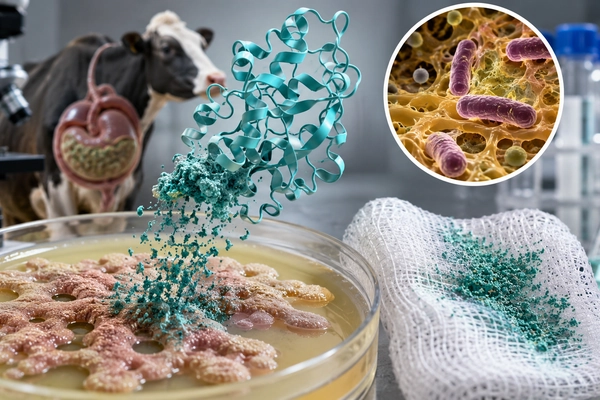
Researchers at the Indian Institute of Science (IISc), Bengaluru, have identified a bacterial biofilm-breaking enzyme derived from microbes inhabiting the bovine rumen, opening a potentially new route for treating difficult infections that can withstand conventional antibiotics.
The enzyme, named CRhAB — Cow Rumen Hydrolase against Acinetobacter baumannii — attacks the protective extracellular matrix surrounding bacterial communities rather than attempting to kill the bacteria directly. IISc announced the research on 25 August 2026, while the peer-reviewed study was published in npj Biofilms and Microbiomes on 31 July 2026.
Targeting the Shield Around Drug-Resistant Bacteria
The research focuses primarily on Acinetobacter baumannii, an opportunistic pathogen that poses a serious challenge in hospitals and other healthcare environments. The bacterium can colonise wounds and medical surfaces and is particularly difficult to eradicate because of both its growing antimicrobial resistance and its ability to form highly protective biofilms.
Biofilms form when communities of bacteria become embedded within a self-produced extracellular matrix composed largely of polysaccharides, along with proteins, lipids and extracellular DNA. This matrix acts like a protective shield, limiting the ability of antibiotics and immune cells to reach the bacteria living inside it.
Polysaccharides can account for roughly 45% to 95% of the biofilm matrix, making them particularly attractive targets for disrupting its physical structure. Rather than developing another molecule designed simply to kill bacteria, the IISc researchers investigated whether this structural defence could itself be dismantled.
Why Researchers Looked Inside the Bovine Rumen
The researchers turned to the rumen, the largest compartment of the bovine stomach, because it contains an extraordinarily diverse microbial ecosystem capable of breaking down complex plant carbohydrates such as cellulose.
Using genomic information from rumen microbes, the scientists searched for enzymes capable of degrading complex polysaccharides. This led them to identify and characterise CRhAB, a previously unexplored polysaccharide-degrading enzyme with the ability to attack components of bacterial biofilms.
Importantly, the discovery does not involve simply extracting an enzyme from a cow and applying it to wounds. The biological information present in rumen microorganisms provided the researchers with a source for identifying an enzyme with useful molecular properties that could then be studied and engineered in the laboratory.
CRhAB Breaks Down Established Biofilms
Experiments showed that CRhAB could strongly interfere with the ability of A. baumannii to build biofilms and could also disrupt already established biofilm structures.
The treatment substantially suppressed the expression of important biofilm-related genes while degrading the polysaccharide-rich extracellular matrix that holds the bacterial community together.
This distinction could be important in the fight against antimicrobial resistance. Conventional antibiotics generally exert direct pressure on bacteria by killing them or preventing their growth. Surviving organisms can consequently evolve resistance mechanisms that allow subsequent generations to withstand the drug.
CRhAB instead attacks the architecture protecting the bacterial population. By stripping away that defence without directly targeting bacterial viability, the strategy could leave bacteria more vulnerable to antibiotics and to the body’s own immune response while potentially imposing less selective pressure for resistance.
Laboratory studies found that disruption of the matrix restored greater access for immune cells, including macrophages, enabling them to infiltrate the biofilm environment and improve bacterial clearance.
One Enzyme Shows Activity Against Two Major Pathogens
The findings extend beyond A. baumannii. CRhAB was also effective against biofilms formed by Klebsiella pneumoniae, another major hospital-associated pathogen capable of causing pneumonia, bloodstream infections and other serious illnesses.
Both A. baumannii and K. pneumoniae belong to the group of particularly difficult-to-treat pathogens commonly associated with antimicrobial resistance. The ability of a single enzyme to interfere with biofilms from both bacteria therefore increases the potential significance of the approach.
The work also builds on earlier IISc research examining bovine-rumen enzymes against K. pneumoniae. In 2024, an IISc team reported another rumen-derived enzyme, GH-B2, capable of breaking down K. pneumoniae biofilms and dramatically increasing bacterial susceptibility to the antibiotic meropenem.
The latest research extends the concept towards A. baumannii and, importantly, towards a practical medical material.
Enzyme-Loaded Gauze Developed for Wound Care
One of the most promising aspects of the project is the researchers’ effort to translate the molecular discovery into a usable wound-care technology.
The team covalently immobilised CRhAB onto clinical-grade gauze, creating a bioactive dressing capable of retaining the enzyme while it acts on bacterial biofilms.
In experiments involving infected wounds in mice, the enzyme-functionalised gauze reduced bacterial colonisation and accelerated wound healing, demonstrating that the concept can work beyond laboratory biofilm cultures.
This could eventually prove useful for difficult chronic wounds where persistent bacterial biofilms are an important obstacle to healing. The researchers are now developing a more advanced patch-like dressing, with diabetic foot infections identified as one potential application.
Diabetic wounds are particularly challenging because impaired circulation, reduced immune response and persistent infection can prevent normal healing. Biofilm-producing bacteria can further complicate treatment and, in severe cases, contribute to tissue damage requiring amputation.
Researchers Exploring an Inhalable Version
The IISc team is also examining applications beyond wound care. One longer-term objective is to develop inhalable or nebulisable CRhAB formulations capable of delivering the enzyme directly to the lungs.
Such a formulation could potentially be investigated against chronic respiratory infections involving A. baumannii or K. pneumoniae, where biofilms can contribute to persistent disease and make antibiotic therapy less effective. Researchers are additionally exploring combinations of different enzymes that could attack a wider variety of pathogenic biofilms.
These applications remain at the research stage and would require extensive additional safety, formulation and clinical testing before they could be considered treatments for patients.
A Different Strategy Against Antimicrobial Resistance
The significance of the IISc work lies in its attempt to change the conditions that allow resistant bacteria to survive rather than simply searching for another antibiotic.
By dismantling the extracellular matrix, CRhAB effectively attempts to remove the bacterial fortress, giving existing antibiotics and immune cells better access to organisms that had previously been protected.
The researchers describe the approach as “resistance-agnostic” because the enzyme targets a structural feature of the biofilm rather than a particular antibiotic-resistance mechanism. The concept could therefore potentially remain useful even against bacterial strains resistant to multiple conventional drugs.
The research was carried out by a multidisciplinary IISc team including Reshma Ramakrishnan, Kirti Parmar, Velpandi Ramachandran, Debmitra Sen, Raju S. Rajmani, Dipshikha Chakravortty and Debasis Das, spanning the Institute’s Departments of Inorganic and Physical Chemistry, Microbiology and Cell Biology and Molecular Biophysics Unit. IISc has also filed a patent application covering the findings.
With antimicrobial resistance increasingly reducing the effectiveness of established medicines, strategies that expose rather than directly kill bacteria could become an important complementary approach. The IISc discovery remains preclinical, but its combination of a biologically derived enzyme with an engineered wound dressing demonstrates a promising route for converting fundamental microbiology into a potential medical technology.
04
You may also like
-
3,898 Indian Scientists Feature in 2026 Global Top 2% Research Database; IISc Leads Indian Institutions
-
New Metal-free Porous Material can Help Produce Affordable Clean Energy
-
A Decade of Cosmic Flickering Reveals New Clues About A Rare Giant Binary Black Hole System
-
Indian Researchers Screen 94 Pea Lines to Identify High-Protein, Mineral-Rich Breeding Material
-
Indian Researchers Combine AI and Infrared Spectroscopy to Detect Parkinson’s-Linked Biochemical Changes in Fruit Flies
