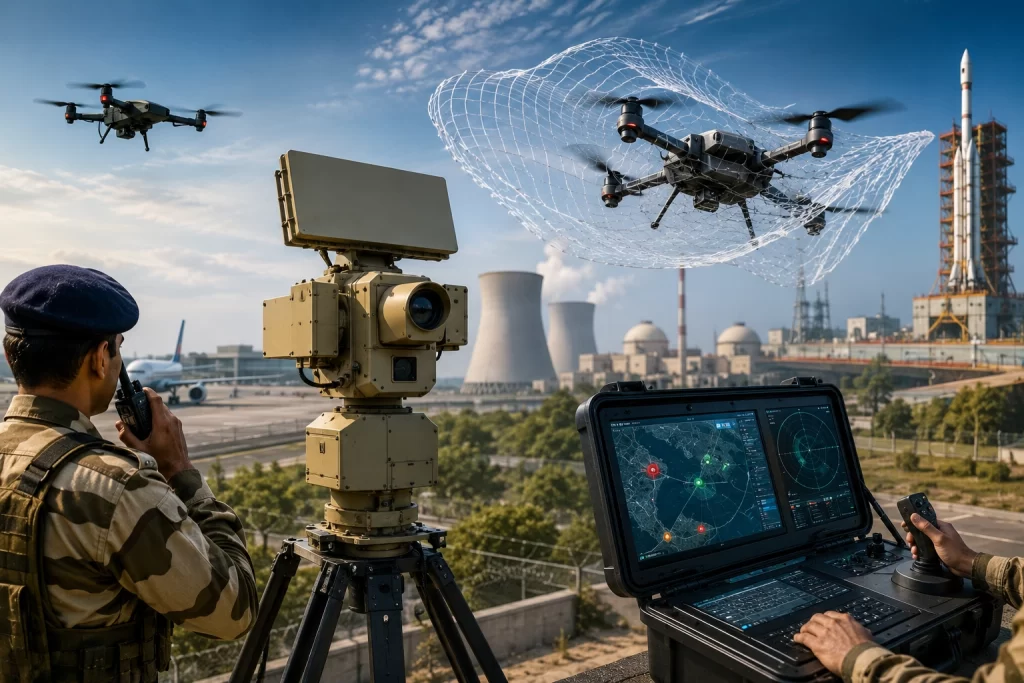
India is strengthening the protection of its most sensitive national infrastructure against emerging unmanned aerial threats, with the Central Industrial Security Force (CISF) entering into a strategic partnership with the Drone Federation of India (DFI) to develop advanced drone and counter-drone capabilities.
The two organisations signed a Memorandum of Understanding on 28 August 2026 at CISF Headquarters in New Delhi. The partnership will connect the security force directly with India’s growing ecosystem of drone startups, technology developers and counter-UAS specialists, creating a structured mechanism for training, applied research, testing and operational deployment.
Protecting Airports, Nuclear Plants and Space Facilities
The initiative has particular strategic significance because CISF provides security to more than 370 installations across India, including airports, nuclear facilities, space centres, oil refineries and other critical infrastructure.
CISF has also been designated as the nodal agency for dealing with rogue-drone threats at critical installations, placing counter-UAS preparedness increasingly at the centre of its technological modernisation.
Small commercial and improvised drones have fundamentally altered the security environment around sensitive facilities. Their relatively low cost, small radar signature and ability to carry cameras or payloads allow them to approach areas that would traditionally be protected against ground intrusion or conventional aircraft.
The challenge is consequently shifting from merely detecting an unidentified flying object to rapidly determining its location, trajectory and potential intent before selecting an appropriate response.
Indian Drone Startups to Work With CISF
One of the most important aspects of the CISF-DFI partnership is the planned involvement of Indian drone and counter-drone companies in operationally relevant development and testing.
DFI will facilitate structured interaction between CISF and domestic technology companies for capacity building, applied research and operational preparedness. This could allow security personnel to communicate real-world requirements directly to developers while giving Indian companies an opportunity to test technologies against realistic operational scenarios.
The approach is important because counter-drone defence is not based on a single technology. Effective systems can involve combinations of radio-frequency detection, radar, electro-optical and infrared sensors, acoustic detection, electronic jamming, navigation interference and other interception mechanisms.
Different installations also present very different requirements. An airport, for example, must detect an unauthorised drone without interfering with normal civil aviation systems. Nuclear and space facilities may have different perimeter, terrain and electromagnetic considerations. Technologies therefore need to be evaluated in the environments where they may ultimately operate.
Behror to Become Centre of Excellence
A central objective of the partnership is to develop the CISF Recruit Training Centre at Behror in Rajasthan into a Centre of Excellence for Drone and Counter-Drone Systems.
The Ministry of Home Affairs had already identified the development of RTC Behror as an important component of CISF’s technology-led security strategy. The new DFI partnership provides an industry-facing mechanism through which the centre can interact with technology developers and the wider Indian drone ecosystem.
The proposed Centre of Excellence is expected to go beyond conventional classroom instruction. It can potentially provide an environment for evaluating new systems, developing operational doctrine, familiarising personnel with emerging aerial threats and testing responses to changing drone technologies.
CISF Director General Praveer Ranjan said the collaboration would help the force test its preparedness against realistic and evolving drone threats while identifying gaps in existing systems, procedures and response mechanisms.
Counter-Drone SOPs and Pilot Deployments
The MoU also envisages development of Standard Operating Procedures and deployment frameworks for counter-drone operations at CISF-protected installations.
Pilot projects are expected to help determine how different counter-UAS systems can be integrated into the existing security architecture at vital facilities.
This is particularly important because detecting a drone represents only one part of the response chain. Security forces must determine how an alert is verified, which authorities are informed, how the drone is tracked, when countermeasures can be activated and how an incident is investigated after the immediate threat has passed.
Developing common operational frameworks can therefore be as important as procuring the detection or neutralisation technology itself.
Drone Forensics to Become an Important Capability
The collaboration will also cover drone forensics and analytical capabilities, an increasingly important area as unmanned systems become more widely available.
When a rogue drone is recovered, investigators may need to examine its flight-control systems, storage devices, communication equipment, navigation records and other electronic components to understand where it originated, how it was operated and what its intended mission may have been.
The CISF-DFI initiative aims to develop best practices and explore indigenous tools for investigating rogue-drone incidents, helping create capabilities that extend beyond simply stopping an aircraft in flight.
Red-Team Exercises to Test Real-World Defences
Another notable component of the agreement is the proposed use of controlled red-team exercises and joint drills.
In such exercises, authorised teams can attempt to challenge a facility’s security system using realistic drone scenarios. Security personnel must then detect, track and respond to the simulated intrusion.
These exercises can reveal weaknesses that may not be obvious during routine equipment demonstrations. They can test the complete response chain — from initial detection and identification to escalation, countermeasure activation and post-incident investigation.
The partnership also envisages dynamic training modules, hackathons and challenge programmes, providing a route for emerging technological solutions to be tested against practical security problems.
More Than 3,000 CISF Personnel Already Trained
CISF has already begun creating a sizeable internal base of personnel familiar with unmanned systems.
More than 3,000 CISF personnel have been trained in drone and anti-drone protocols, while around 80 CISF units currently use drones for monitoring, threat detection and training. The force has also developed a group of domain specialists to guide the adoption of unmanned technologies within its operational structure.
Drones can themselves be valuable security tools. They allow rapid inspection of large perimeters, difficult terrain and inaccessible areas and can provide security control rooms with an aerial perspective during emergencies.
The result is a technological environment in which CISF must develop expertise in both employing friendly drones and defending installations from potentially hostile ones.
Building an Indigenous Security Technology Ecosystem
The involvement of the Drone Federation of India gives the initiative a broader industrial dimension.
DFI represents companies and organisations operating across India’s drone and counter-drone sector and works on technology development, policy, safety standards and industry-academia collaboration. Its role in the CISF partnership could help translate operational requirements from security forces into technical challenges for domestic companies.
DFI President Smit Shah said the partnership seeks to bridge operational requirements with indigenous technological innovation, including the testing of startup capabilities in realistic scenarios and development of specialised forensic and training tools.
This model has parallels with efforts already underway between the armed forces and India’s drone industry. The Indian Army and DFI previously established cooperation covering drone and counter-drone research, field trials, testing and indigenous manufacturing, illustrating the growing role of industry partnerships in accelerating unmanned-system development.
Counter-Drone Defence Becomes a Critical Infrastructure Priority
The rapid evolution of unmanned technology means the drone threat will not remain static. Autonomous navigation, improved communications, swarm operation, increasing payload capacities and resistance to conventional electronic countermeasures are continually altering the challenge faced by security agencies.
For an organisation such as CISF, which protects some of India’s most strategically important civilian and industrial infrastructure, counter-drone capability therefore cannot be treated simply as an equipment purchase. It requires trained personnel, operational doctrine, intelligence, testing infrastructure, forensic expertise and continuous access to technological innovation.
The CISF-DFI partnership attempts to bring these elements together.
By combining the security force’s operational experience with India’s expanding domestic drone industry, the initiative could help create a more responsive counter-UAS ecosystem in which new threats identified at critical installations can be translated into training requirements, operating procedures and indigenous technological solutions.
As drones become increasingly important to both civilian activity and modern security threats, the programme represents a shift towards a more comprehensive model of protection — one designed not only to detect rogue aircraft, but to anticipate, test against, investigate and ultimately neutralise evolving unmanned aerial threats around India’s critical national infrastructu
References:
Central Industrial Security Force (CISF) — Official Website:
https://www.cisf.gov.in/
CISF Official Social Media Post on MoU with Drone Federation of India — 28 August 2026:
https://www.instagram.com/p/DclbOuLD_kG/
Drone Federation of India — Official Website:
https://www.dronefederation.in/
You may also like
-
Rolls-Royce Deepens India Engagement as Reliance Partnership Targets Indigenous AMCA Fighter Engine
-
Larsen & Toubro and Spain’s Navantia Partner to Develop Four Amphibious Assault Ships for Indian Navy
-
Gujarat’s Svaayatt Systems Proposes Nine-Drone Autonomous Swarm for Indian Armed Forces
-
EndureAir and Maraal Aerospace Partner to Develop Indigenous High-Altitude Pseudo-Satellite for India
-
Larsen & Toubro Selects Australian Orbital’s 350HFE Heavy-Fuel Engines for Indian Tactical UAV Programme
