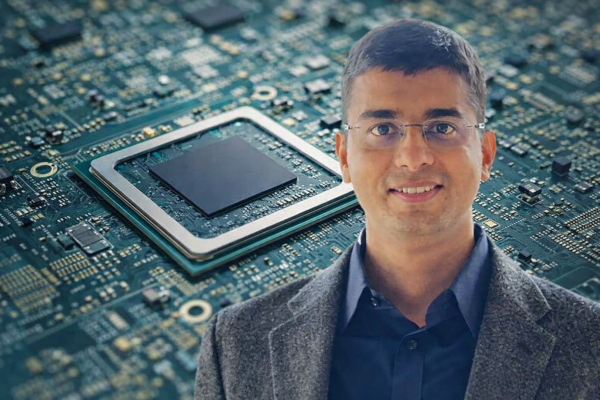
At a time when artificial intelligence systems are demanding ever more compute, memory bandwidth and electricity, an IIIT Hyderabad researcher is working on a hardware design meant to ease that pressure. Prof. Priyesh Shukla of IIIT Hyderabad is developing TVARAK-AI, described as a scalable and heterogeneous accelerator chip for sustainable inference in next-generation AI models. The project targets a central problem in modern AI: large models are becoming increasingly expensive to run on conventional hardware, especially power-hungry GPUs.
Shukla’s work has received a Prime Minister Early Career Research Grant from the Anusandhan National Research Foundation, a competitive programme under which researchers can receive support of up to Rs 60 lakh plus overheads for three years. IIIT Hyderabad said he was selected among roughly 700 researchers from more than 6,000 proposals, giving the project both national visibility and a funding path for early-stage development.
The proposed chip, whose name draws from the Sanskrit word “Tvarak,” meaning “to accelerate,” is intended as an Indian alternative to generic AI compute platforms. According to IIIT Hyderabad and the New Indian Express report, the architecture is being designed to better balance compute intensity, memory access and bandwidth demands, while reducing total energy consumption. The broader aim is to create hardware that is faster and more efficient for AI inference rather than relying solely on expensive, general-purpose accelerators.
What makes the effort notable is that it goes beyond a single chip design. Shukla said the project seeks to build an integrated AI stack combining hardware architecture, software toolchains, machine-learning compilers and deployment frameworks. That matters because AI performance increasingly depends on how tightly chips, memory systems and software are co-designed rather than on raw processing power alone.
The research is currently in the prototyping phase and builds on Shukla’s earlier work in in-memory computing-based accelerators for edge AI, where processing is pushed closer to where data is generated. That approach can cut latency and power use, which is especially valuable for devices and environments where energy, connectivity or onboard compute are limited. IIIT Hyderabad lists his research areas as sustainable computing, efficient AI processing at the edge and cloud, compute-in-memory systems and next-generation computing platforms.
If the design matures successfully, its applications could stretch across rural healthcare, autonomous drones, mobile devices and other low-connectivity or resource-constrained settings. The project also fits into India’s larger push for semiconductor capability and technological self-reliance, as policymakers and institutions try to move the country from being mainly a buyer of advanced AI hardware to becoming a developer of core compute technologies. That said, commercial deployment is still a future step; for now, TVARAK-AI remains a promising research-led prototype rather than a market-ready processor.
Reference:
https://www.newindianexpress.com/cities/hyderabad/2026/Apr/19/iiit-hyderabad-professor-develops-chip-to-ease-strain-on-machines-powering-ai-systems
https://blogs.iiit.ac.in/priyeshshukla-pmecrg/
You may also like
-
Molecular Geometry Tweak Opens New Way for Smart Biomaterials
-
ISRO’s Indo-French TRISHNA Satellite Enters Advanced Development Stage, Launch Expected in 2027–28
-
IISc Scientists Show How Strong Magnetic Fields Could Allow White Dwarfs to Exceed Chandrasekhar Limit
-
IIT Madras to Launch Global Mission to Map 100 Human Brains in 3D
-
3,898 Indian Scientists Feature in 2026 Global Top 2% Research Database; IISc Leads Indian Institutions
