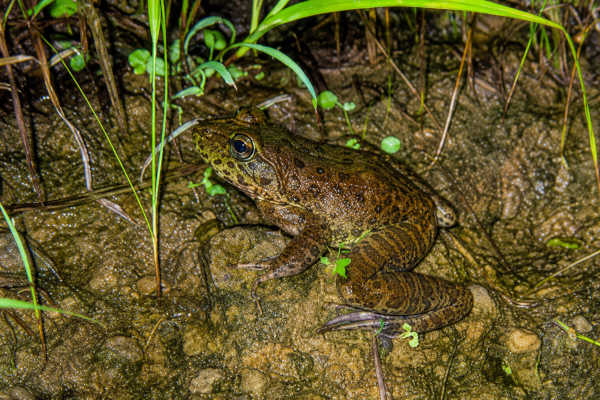
Scientists have discovered a new species of cascade frog from Nagaland, adding another important chapter to the growing record of Northeast India’s amphibian diversity. The newly described frog has been named Amolops kamal, in honour of the late Assam zoologist Dr. Kamal Choudhury, recognising his contribution to zoological research and biodiversity studies in the region.
The discovery was made from Kiphire district in Nagaland, a part of the eastern Himalayan and Indo-Burma biodiversity landscape. This region is known for its forested hills, streams, waterfalls and moist habitats that support a rich variety of amphibians. Cascade frogs usually live around fast-flowing hill streams and waterfalls, where they cling to wet rocks, breed in flowing water and depend on clean aquatic ecosystems for survival.
The new species belongs to the genus Amolops, a group commonly known as cascade frogs. These frogs are specially adapted to life near torrents and mountain streams. Their bodies, limbs and toe structures help them survive in slippery, high-flow environments where ordinary frogs may struggle. Such species are often sensitive to ecological disturbance, making them valuable indicators of stream health, forest quality and local climate stability.
The discovery of Amolops kamal is important because it shows how much of Northeast India’s biodiversity still remains under-documented. Nagaland, with its community forests, remote mountains and stream-rich landscapes, continues to hold species that are yet to be formally recorded by science. Every new discovery helps scientists understand the region’s evolutionary history, habitat diversity and conservation priorities more clearly.
The finding also highlights the importance of detailed field surveys. Amphibians are often small, seasonal and highly habitat-specific. Many species remain hidden in narrow ecological zones, appearing only during particular weather conditions or breeding periods. Scientific documentation therefore requires patience, local knowledge, repeated surveys and careful comparison with known species.
For India, such discoveries carry conservation value beyond taxonomy. Frogs are deeply connected to ecological balance. They control insect populations, serve as prey for birds and reptiles, and respond quickly to pollution, habitat loss and climate shifts. A decline in frog populations often signals stress in the environment. Protecting frogs means protecting streams, forests, wetlands and the communities that depend on them.
The naming of the species after Dr. Kamal Choudhury also gives the discovery a human dimension. Scientific naming often becomes a way of preserving memory, honouring regional scholarship and connecting new knowledge with the people who helped build the foundation of natural history research. In this case, Amolops kamal stands as both a biological discovery and a tribute to a life devoted to zoology.
Northeast India has repeatedly shown itself to be one of the country’s richest zones for new amphibian records. From Arunachal Pradesh and Meghalaya to Nagaland, Mizoram and Assam, scientists continue to find frogs, caecilians and other lesser-known species that expand India’s biodiversity map. These discoveries strengthen the argument for protecting hill streams, forest corridors and community-managed landscapes before ecological pressures erase species that science has only just begun to recognise.
Amolops kamal is therefore more than a new frog species. It is a reminder that India’s natural heritage still holds many hidden forms of life. In the mountain streams of Nagaland, a small cascade frog has opened a larger conversation on biodiversity, conservation, local research and the urgent need to document life before fragile habitats change forever.
Reference:
Records of the Zoological Survey of India — “Description of a new cascade frog of the genus Amolops Cope, 1865 (Anura: Ranidae) from Nagaland, North-East India” — 2026
NovaTaxa — “Amolops kamal: A New Cascade Frog from Nagaland, North-East India” — 2026
Devdiscourse — “Newly Identified Cascade Frog Highlights Nagaland’s Biodiversity” — 30 May 2026
You may also like
-
ISRO Plans Four Operational Launch Pads by 2029 to Expand India’s Space Capabilities
-
Indian Scientists Discover How Rapidly Spinning Black Holes Produce High-Frequency X-Ray Oscillations
-
ISRO Completes Historic SPADEX Mission as Both Satellites Re-enter Earth’s Atmosphere After Successful Space Docking Experiments
-
Indian Scientists Discover Rare Accretion Disk Around Neutron Star 24,000 Light-Years Away
-
BARC Scientists Develop Indigenous Technology to Recover 90% of Lithium from Seawater
