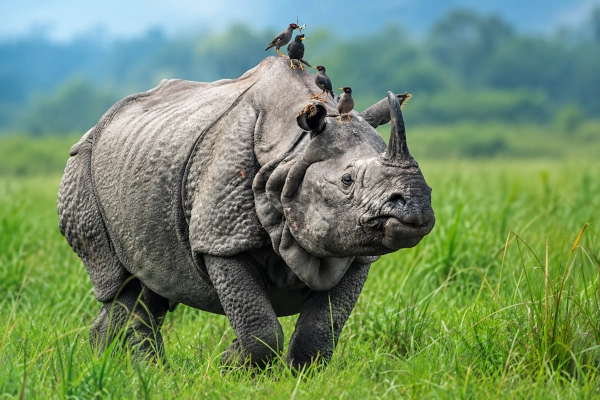
At the beginning of the twentieth century, the Greater One-Horned Rhinoceros had been pushed close to disappearance across much of the Indian subcontinent. Hunting, poaching and the conversion of its riverine grasslands had reduced a species that once ranged across large parts of the Indus-Ganga-Brahmaputra plains to a handful of isolated populations.
Kaziranga represented just how precarious the situation had become. Historical conservation records associated with Indian Rhino Vision 2020 estimate that only around 10 to 20 rhinos survived in Kaziranga in 1905. More than a century later, the same landscape supports the world’s largest concentration of Greater One-Horned Rhinos.
India’s rhino recovery is therefore much more than a story of preventing extinction. It has involved rebuilding populations, protecting floodplain grasslands, strengthening anti-poaching operations, creating new populations through translocation and gradually attempting to spread the species beyond a few vulnerable strongholds.
The conservation effort entered another phase in September 2026 with the initiation of Project Rhino, designed to provide financial and technical support to rhino range states for protection, habitat management, genetic improvement and a better understanding of population dynamics.
From a Few Survivors to More Than 4,000
The scale of the recovery becomes apparent when the historical numbers are compared.
Assam’s rhino population was estimated at around 600 animals during the 1960s. By 1999, official Assam Forest Department records placed the population across Kaziranga, Orang and Pobitora at 1,672.
The population continued to expand over subsequent decades. Assam’s official conservation reporting states that the number has risen to more than 4,000 animals, representing an extraordinary recovery from the low levels recorded during the twentieth century.
The recovery has also made India central to the global survival of the species. Assam alone now holds nearly 80 per cent of the world’s Greater One-Horned Rhino population.
Behind those numbers lies a conservation effort extending across generations of forest guards, wildlife managers, veterinarians, researchers and communities living around rhino landscapes.
Kaziranga Became the Great Rhino Stronghold
No landscape has been more important to the recovery than Kaziranga.
Located along the Brahmaputra floodplain in Assam, Kaziranga contains a mosaic of tall elephant grass, wetlands, river channels, sandbars and woodland. These habitats provide the combination of grazing areas, water and cover required by rhinos and numerous other large mammals.
Kaziranga’s rhino population reached 2,613 in the March 2022 count, according to official Assam records. The park consequently contains a remarkable proportion of the surviving global population of the species.
The recovery did not happen simply because an area was declared protected. Intensive patrolling, anti-poaching operations, intelligence networks, habitat management and long-term investment in frontline forest personnel became fundamental parts of what is sometimes described as the Kaziranga model.
Protection of rhinos also benefited an entire ecological community. Kaziranga today supports elephants, wild water buffalo, swamp deer, tigers and a rich assemblage of birds, reptiles and aquatic species.
Pobitora Became a Conservation Success — and a Warning
Pobitora Wildlife Sanctuary demonstrates another side of India’s rhino recovery.
The relatively small sanctuary developed an exceptionally dense rhino population. Official Assam records counted 74 rhinos there in 1999, increasing to 102 by 2018.
Successful protection created a new problem: too many rhinos concentrated within a relatively restricted habitat.
When animals move beyond protected boundaries into surrounding agricultural landscapes, encounters with people can increase. High population density can also place pressure on available grasslands and other resources.
Pobitora consequently became important not only as a rhino sanctuary but also as a potential source population from which animals could be moved to other suitable habitats.
That idea became central to the next stage of rhino conservation.
Indian Rhino Vision Changed the Strategy
Conservationists recognised that protecting large numbers of rhinos in only one or two places created its own risk.
A catastrophic flood, epidemic, major poaching episode or other localised disaster could affect a disproportionately large share of the species. Concentrating animals within a few protected areas also restricts opportunities for populations to expand.
Indian Rhino Vision 2020, launched in Assam with government agencies and conservation partners, attempted to address this vulnerability.
Its objective was not merely to increase the number of rhinos but to expand their geographical distribution. The programme envisaged moving animals from strong source populations such as Kaziranga and Pobitora into other protected landscapes capable of supporting viable populations.
Among the most important target landscapes was Manas National Park.
Rhinos Return to Manas
Manas demonstrates why increasing numbers alone cannot define conservation success.
The protected landscape once supported rhinos, but the population was eliminated during a period of severe civil disturbance and poaching in the 1990s. Restoring rhinos to Manas therefore required rebuilding security and management before animals could safely return.
Translocations under Indian Rhino Vision moved rhinos from established populations into Manas, where they were monitored after release.
The programme gradually re-established a breeding population.
Official Assam records illustrate the change. Manas recorded essentially no viable rhino population at the end of the 1990s. By 2012, 22 rhinos were recorded, and the number had risen to 36 by 2018.
The return of rhinos to Manas demonstrated that conservation could go beyond defending the species in its remaining refuges. Lost populations could, under suitable conditions, be rebuilt.
Orang Provides Another Crucial Population
Orang National Park is another important piece of Assam’s rhino landscape.
Official figures show 46 rhinos in Orang in 1999, increasing to 68 in 2006 and 100 by 2012. The population subsequently continued to receive intensive protection and habitat management.
Recent habitat expansion has increased the conservation potential of the landscape. Government reporting points to the addition of more than 200 square kilometres associated with Orang as part of efforts to secure more space for rhinos and other wildlife.
Expanding habitat becomes increasingly important as populations recover. Protecting animals without ensuring sufficient grassland, wetlands and connectivity eventually creates ecological pressure inside the protected areas themselves.
Dudhwa Shows That Rhino Restoration Can Work Beyond Assam
India’s rhino story is not confined to the Brahmaputra floodplains.
Dudhwa National Park in Uttar Pradesh provides another important experiment in restoring the species to part of its historical range in the Terai.
Rhinos were reintroduced into Dudhwa beginning in the 1980s. A major management operation in 2018 moved four animals into another range within the national park, expanding the area occupied by the population.
The programme demonstrated that rhino conservation could include active population management rather than simply protecting animals where they happened to survive.
The Government’s September 2026 conservation update specifically highlighted the progress of rhino reintroduction in Dudhwa while also noting protection and recovery efforts in West Bengal and parts of Bihar.
Anti-Poaching Protection Changed the Equation
None of these population gains would have been possible without confronting the trade in rhino horn.
Rhinos have historically been killed because of demand for their horns in illegal international markets. The horn consists primarily of keratin, yet myths surrounding supposed medicinal properties and its use as a status symbol have sustained trafficking networks.
India responded through stronger wildlife law enforcement, armed and better-equipped forest protection forces, intelligence gathering, surveillance and tougher legal measures.
Kaziranga became particularly associated with intensive anti-poaching operations. Assam also publicly destroyed 2,479 stockpiled rhino horns in 2021, signalling that confiscated horns would not be returned to commercial circulation.
The dramatic reduction in poaching has allowed natural reproduction to translate into sustained population growth rather than continually being cancelled out by illegal killing.
Saving Rhinos Means Saving Grasslands and Wetlands
The next challenge is different from the one India faced a century ago.
Simply preventing rhinos from being shot is no longer enough.
Greater One-Horned Rhinos depend heavily on alluvial grasslands, wetlands, riverine forests and associated floodplain ecosystems. These habitats are naturally dynamic. Rivers change course, grasslands undergo succession and annual floods reshape the landscape.
Invasive plants can degrade grazing areas. Grasslands can gradually transform into woodland without appropriate ecological management. Changes in water availability can alter wetlands, while infrastructure and human settlement can restrict movement between habitats.
Climate change adds another layer of uncertainty, particularly in landscapes influenced by increasingly unpredictable rainfall and flooding.
The recovery of the rhino has therefore shifted the conservation challenge from saving individual animals to securing functioning landscapes.
Floods Are Both Threat and Lifeline
Kaziranga illustrates this ecological complexity particularly well.
The annual flooding of the Brahmaputra can kill wildlife, including rhinos, especially during severe flood years. Animals attempting to reach higher ground may also encounter roads, settlements and other hazards.
Yet flooding is also essential to the ecosystem.
Floodwaters replenish wetlands, redistribute nutrients and prevent the landscape from becoming permanently dominated by woodland. The disturbance helps maintain the grasslands upon which rhinos and many other herbivores depend.
Conservation management therefore cannot simply attempt to eliminate flooding. It must maintain natural floodplain processes while ensuring that wildlife has safe access to higher ground and movement corridors during extreme events.
That makes landscape connectivity between Kaziranga and the neighbouring Karbi Anglong hills particularly important.
Project Rhino Opens the Next Phase
The announcement of Project Rhino in September 2026 signals an attempt to build upon the gains made through earlier conservation programmes.
The initiative is intended to provide financial and technical assistance to India’s rhino range states. Its stated areas of attention include protection, habitat management, genetic improvement and understanding population dynamics.
Those priorities reflect how the conservation challenge has evolved.
A population recovering from a tiny number of survivors requires careful monitoring of genetic diversity. Growing populations require more habitat. Isolated populations need connectivity or scientifically managed movement between landscapes. Reintroduced populations require long-term monitoring, while expanding rhino ranges require greater attention to coexistence with surrounding communities.
India has therefore reached a point where the success of rhino conservation itself creates new responsibilities.
From Preventing Extinction to Rebuilding a Landscape
The Greater One-Horned Rhino once ranged across a vast belt of riverine grasslands stretching through much of the northern Indian subcontinent. Today’s population occupies only a fraction of that historical range.
Its recovery is therefore unfinished.
But the transformation already achieved is remarkable. Kaziranga moved from an estimated 10–20 rhinos in 1905 to 2,613 in the 2022 count. Manas regained a species that had disappeared from the landscape. Pobitora became a source population for wider conservation efforts. Orang strengthened another independent population, while Dudhwa demonstrated that rhinos could be restored to other parts of their former range.
The next measure of success will not simply be how many rhinos India can count.
It will be whether those animals can occupy multiple secure populations connected to healthy grasslands, wetlands and river systems, with enough genetic diversity and habitat to remain viable for generations.
India succeeded in preventing the Greater One-Horned Rhinoceros from disappearing. The task now is larger: ensuring that the ecosystems which brought the animal back can survive alongside it.
References
Prime Minister’s Office / Press Information Bureau — Prime Minister shares an article by Union Minister Shri Bhupender Yadav highlighting efforts strengthening the conservation journey of the Greater One-Horned Rhinoceros, 23 September 2026.
Official PIB release
Prime Minister’s Office / Press Information Bureau — Prime Minister celebrates World Rhino Day; PM shares initiation of Project Rhino, 22 September 2026.
Official PIB release on Project Rhino
Government of Assam, Forest Department — Data of Wildlife: Rhino Population in Assam.
Official Assam Forest Department data
Government of Assam — Kaziranga National Park, including the March 2022 rhino population estimate.
Official Kaziranga information
Government of Assam, Environment & Forest Department — Indian Rhino Vision 2020.
Official Assam Rhino Vision resource
WWF-India — Indian Rhino Vision 2020, conservation objectives, population restoration and translocation strategy.
Indian Rhino Vision 2020 document
WWF-India — A Giant Leap for Rhino Conservation, Dudhwa National Park rhino translocation programme.
Dudhwa rhino conservation programme
You may also like
-
India Expands Global Big Cat Conservation as International Big Cat Alliance Opens New Headquarters
-
Satpura Tiger Reserve’s Barasingha Population Crosses 300 as Madhya Pradesh Plans New Wildlife Corridors
-
Karnataka’s Tiger Population Could Cross 700 as New Census Builds on Official Count of 563
-
Project Cheetah Expands as Veerangana Durgavati Tiger Reserve Becomes Madhya Pradesh’s Third Cheetah Habitat
-
Kashmir Markhor Population Rises to 227 as Kazinag Conservation Efforts Show Results
