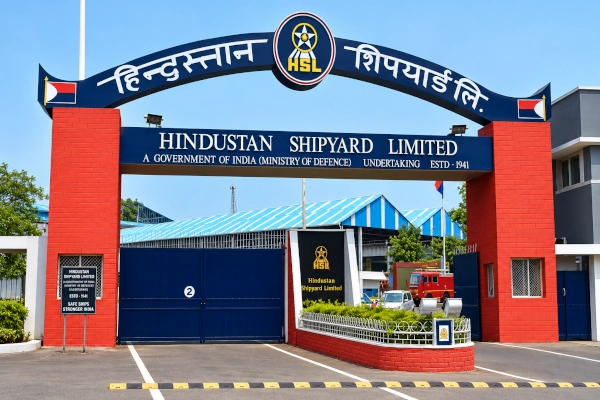
Hindustan Shipyard Limited has simultaneously docked three vessels inside a single dock at its Ship Repair Complex in Visakhapatnam, completing a closely coordinated operation that placed three different ships within the facility under unusually tight clearance conditions.
The operation was completed on 19 September 2026 and involved CG Platform, LGT Navya and Samudra Ratnakar. All three vessels were brought into the dock, aligned with their designated dock blocks and safely positioned before repair work began.
The docking placed considerable demands on the shipyard’s planning and handling teams. Approximately four metres of lateral clearance separated the vessels, while Samudra Ratnakar was positioned with only around 40 centimetres of clearance above the dock floor during the operation.
Three Ships Positioned Within a Single Dock
Docking a vessel requires the underwater hull to be aligned accurately with a predetermined arrangement of keel and supporting blocks on the floor of the dry dock. The task becomes substantially more demanding when several ships occupy the same dock because the available manoeuvring space reduces considerably.
HSL’s operation required the three vessels to be moved into position in a controlled sequence while maintaining clearances between their hulls and ensuring that each vessel settled correctly onto its assigned docking arrangement.
The work involved detailed preparation of the dock blocks, controlled movement using the shipyard’s handling equipment and continuous coordination between the dockmaster, capstan operators, riggers and vessel crews.
The operation was led by P. Syama Sundar, Dock Master and Assistant General Manager at HSL, together with the shipyard personnel responsible for positioning and securing the vessels.
Four Metres Between Vessels
The limited space inside the dock made precise positioning central to the operation. HSL maintained only around four metres of side clearance between the vessels after they were placed in their designated positions.
Samudra Ratnakar presented an additional challenge because its hull was brought to within approximately 40 centimetres of the dock floor during positioning.
Such margins leave little tolerance for errors in movement, trim, alignment or dock-block positioning. The vessels therefore had to be controlled carefully throughout the docking process until each hull was correctly seated.
After the three ships had been positioned, HSL carried out an underwater inspection to verify their seating and confirm that the required clearances had been maintained before repair operations commenced.
HSL’s Dedicated Ship Repair Complex
The operation was carried out at Hindustan Shipyard’s dedicated Ship Repair Complex in Visakhapatnam.
HSL operates shipbuilding, ship repair and submarine activities as separate business units. Its repair infrastructure includes a large dry dock capable of handling commercial, defence and offshore vessels, together with workshops and waterfront facilities supporting major refits and maintenance programmes.
The Department of Defence Production describes HSL as an important ship-repair facility on India’s east coast. The yard has repaired more than 2,000 vessels covering defence ships, commercial ships, offshore platforms and specialised marine assets.
Its customers have included the Indian Navy, Indian Coast Guard, ONGC, Shipping Corporation of India, Dredging Corporation of India and other domestic and international operators.
Experience With Large and Specialised Vessels
HSL’s ship-repair division has handled several technically demanding programmes over the years.
The yard has undertaken repairs to large commercial ships, naval platforms and offshore vessels and has carried out extensive work on ONGC’s drillship Sagar Bhushan. It has also handled underwater repair work on foreign offshore vessels and major repair programmes involving propulsion systems, machinery, hull structures, electrical equipment and specialised marine systems.
According to the Department of Defence Production, HSL has successfully docked large bulk carriers and has developed specialised capabilities covering sonar-dome installation, bow and ramp-door refurbishment, machinery overhaul and damage-restoration work.
The three-vessel operation adds a different dimension to that capability by demonstrating how the existing dry-dock space can be planned and used for concurrent repair work.
Concurrent Docking Can Improve Repair Capacity
Dry-dock availability is one of the main constraints in ship repair. A vessel undergoing underwater hull work occupies the dock until inspections, structural repairs, propulsion maintenance and other below-waterline tasks are completed.
Accommodating several compatible vessels within one dock can allow a shipyard to undertake multiple repair programmes without waiting for one ship to leave before another enters.
Such an arrangement requires careful consideration of vessel dimensions, repair requirements, docking sequences and the space required for workers and equipment around each hull.
HSL’s latest operation demonstrated that three vessels of suitable dimensions could be safely accommodated while preserving the clearances required for inspection and repair activity.
Ship Repair Becomes a Larger Part of HSL Operations
Hindustan Shipyard has been expanding the utilisation of its Ship Repair Complex as demand grows from naval, Coast Guard, public-sector and commercial operators.
The company has previously reported increased activity at the facility, with defence, commercial and specialised vessels undergoing repair simultaneously across its available waterfront infrastructure.
Ship repair differs substantially from new ship construction because projects typically operate on much shorter schedules. Repairs can involve unexpected structural or mechanical work identified only after a vessel enters the dock, placing greater emphasis on rapid engineering decisions, material availability and coordination between trades.
HSL maintains a dedicated ship-repair organisation with its own infrastructure and management structure to handle these shorter turnaround requirements.
Precision Dock Management at Visakhapatnam
The simultaneous docking of CG Platform, LGT Navya and Samudra Ratnakar demonstrates an operational capability that depends as much on dock planning as on the physical dimensions of the facility.
Positioning three vessels with approximately four metres separating their hulls and maintaining the required clearance above the dock floor required accurate calculations before the dock was emptied and continuous control while the vessels settled onto their blocks.
The subsequent underwater inspection confirmed that the ships had reached their intended positions and allowed their respective repair programmes to proceed.
For Hindustan Shipyard, the 19 September operation provides another demonstration of how its Visakhapatnam repair infrastructure can be used to handle several maritime assets concurrently while maintaining the positioning and safety requirements associated with dry docking.
References
Hindustan Shipyard Limited / Ship Repair Complex operational update — 19 September 2026: Simultaneous docking of CG Platform, LGT Navya and Samudra Ratnakar.
Department of Defence Production, Ministry of Defence — Hindustan Shipyard Limited Ship Repairs: Official description of HSL’s ship-repair infrastructure, capabilities and repair experience.
Government of India / Hindustan Shipyard Limited: Official information on HSL’s shipbuilding, ship-repair and submarine business units and Visakhapatnam infrastructure.
You may also like
-
India’s Economic Warfare Challenge: Strategic Autonomy, Energy Security and the Rise of a Global Power
-
India-US Trade Deal Stalemate: Why Washington’s Tariff Pressure Has Failed to Secure an Agreement
-
US Double Standards in Foreign Policy: 16 Recent Cases Involving India, Russia, China and Global Trade
-
India’s Arctic Energy Ambitions: Russian Oil, LNG and a New Sea Route to Indian Ports
-
India and Russia Explore Joint Icebreaker Construction as Maritime Industrial Cooperation Expands
