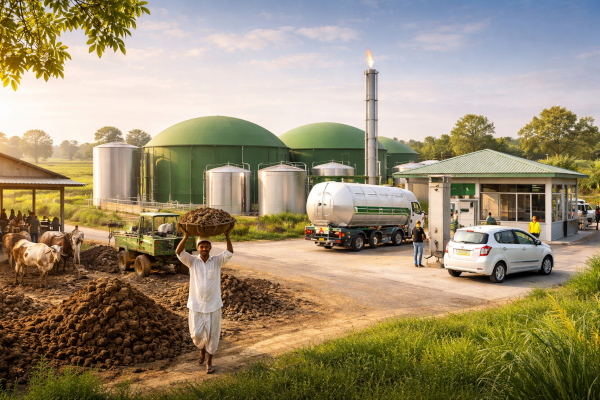
India has begun implementing a major ₹23,731-crore national programme to transform agricultural residue, cattle dung, municipal organic waste and other biomass into compressed biogas, marking one of the country’s largest attempts to build a domestic circular bioenergy industry.
The new GOBARdhan framework came into effect on September 1, 2026, and will operate through FY 2035-36. Administered by the Ministry of Petroleum and Natural Gas, the ten-year programme is intended to increase India’s domestic compressed biogas production nearly tenfold while creating a commercially viable market capable of attracting large-scale private investment.
The Union Cabinet had approved the programme on August 6, bringing several existing compressed-biogas initiatives under a unified national framework. Instead of supporting individual parts of the industry through separate schemes, the new structure addresses the entire CBG value chain—from securing feedstock and financing plants to guaranteeing demand, establishing stable prices, connecting facilities to gas networks and creating markets for the organic manure produced alongside biogas.
The broader objective is to turn India’s enormous quantities of biological waste into an economically valuable domestic energy resource while simultaneously improving waste management, creating rural income and reducing dependence on imported natural gas.
From Waste-Management Programme to National Energy Strategy
GOBARdhan originally emerged in 2018 under the Swachh Bharat Mission-Grameen as an initiative focused largely on managing animal waste, agricultural residue, kitchen waste and other biodegradable material in rural areas. Its purpose was to convert such waste into biogas and nutrient-rich bio-slurry while improving sanitation.
The programme has now evolved considerably beyond that original waste-management role.
Under the new National Circular Bioenergy Scheme, compressed biogas is being treated as part of India’s energy-security strategy. CBG can be produced by processing organic feedstocks such as cattle dung, crop residue, press mud from sugar mills, municipal organic waste and other biodegradable materials through anaerobic digestion and subsequent purification.
Once upgraded to the required methane concentration and compressed, the resulting gas can perform many of the same functions as conventional natural gas. It can be supplied to vehicles through CNG networks, blended into piped natural gas systems and potentially used by industrial and commercial consumers.
The significance for India is substantial because the country continues to depend heavily on imported natural gas. A domestic CBG industry creates an opportunity to replace a portion of those imports with renewable gas produced from resources already available within the country.
Six-Part Framework Designed to Solve Industry Bottlenecks
The new GOBARdhan architecture has been designed around six interconnected components intended to address the problems that have historically constrained India’s compressed-biogas industry.
The first is assured offtake. City Gas Distribution companies will procure CBG in line with India’s mandatory blending trajectory, creating predictable demand for producers. The CBG obligation begins at 3% during FY 2026-27, increases to 4% in FY 2027-28 and reaches 5% from FY 2028-29 onwards for the CNG transport and domestic PNG segments.
This is potentially one of the most important aspects of the scheme. A biogas plant requires substantial upfront investment, but investors have historically faced uncertainty over whether sufficient customers would be available after construction. A mandatory blending trajectory effectively creates a long-term market into which CBG producers can sell their output.
The second element is a stable pricing system designed to give plant developers greater certainty over revenues. The government has fixed the procurement price of CBG at ₹2,110 per MMBtu, providing a long-term benchmark rather than leaving producers entirely exposed to short-term changes in market conditions.
The pricing mechanism has been designed with a minimum ten-year horizon, an unusually important feature for an infrastructure business where developers and lenders need confidence that plant revenues will remain sufficient to repay capital investment over many years.
Government Support Designed to Keep CBG Affordable
The higher producer price is accompanied by a government-funded affordability mechanism intended to prevent the entire increase from being transferred to CNG and household PNG consumers.
Under the latest framework, the government will provide support equivalent to ₹10 per kilogram of CBG, or approximately ₹215 per MMBtu for gas containing 95% methane. This reduces the effective CBG cost to be recovered through the wider gas pool from ₹2,110 to approximately ₹1,895 per MMBtu.
The government has also widened the gas pool across which this cost will be distributed. According to the Ministry of Petroleum and Natural Gas, the applicable domestic gas base will be approximately 2.5 to three times larger than under the earlier arrangement.
The policy is therefore attempting to balance two competing objectives: paying CBG producers enough to make plants financially viable while ensuring that increased procurement costs do not translate into a large increase for individual gas consumers.
Capital Support Could Accelerate New Plant Construction
The third major component is direct capital assistance.
Eligible greenfield compressed-biogas projects can receive support of up to ₹2 crore for every tonne-per-day of installed CBG production capacity. Brownfield projects expanding existing capacity can also become eligible.
Importantly, the assistance is not restricted solely to the central digestion and purification plant. It can also support assets needed to aggregate feedstock and process or add value to the organic manure produced as a by-product.
This matters because the economics of a CBG project extend far beyond the digester itself. Large facilities need reliable supplies of agricultural residue, cattle dung, press mud or municipal waste throughout the year. Collecting, transporting and storing that biomass can become one of the largest operational challenges facing a project.
Reducing the initial capital burden could make projects more viable for private companies, cooperatives, MSMEs and rural entrepreneurs rather than limiting the industry to large energy companies.
New Pipelines to Connect Biogas Plants With Gas Networks
The fourth component addresses another persistent problem: transporting compressed biogas from the production site to customers.
Many of the best locations for CBG plants are close to farms, sugar mills, cattle populations or municipal waste streams rather than close to existing gas consumption centres.
The government will therefore support both standalone and cluster-based pipeline infrastructure capable of connecting CBG facilities with City Gas Distribution networks and larger gas pipelines.
Direct pipeline connectivity can reduce dependence on transporting compressed gas cylinders or cascades over long distances by road. It can also allow larger plants to operate at higher utilisation levels because their output can enter an established gas network continuously.
As India’s natural-gas grid and City Gas Distribution system continue expanding, pipeline-connected CBG plants could eventually function as decentralised renewable-gas production centres feeding into a much larger national network.
Credit Guarantees Target MSMEs and New Developers
Access to finance has been another obstacle facing the sector because lenders can perceive newer bioenergy projects as carrying greater technological, feedstock and market risks than conventional infrastructure.
GOBARdhan therefore introduces a dedicated credit-guarantee mechanism for eligible MSME-based CBG projects.
The mechanism can provide guarantee coverage of up to 85% of eligible loans, reducing the risk faced by lenders and potentially allowing viable projects to obtain financing with lower collateral requirements.
This feature could be particularly important for broadening participation beyond large corporate developers. Cooperatives, rural businesses, women entrepreneurs and first-time bioenergy developers often possess access to biomass resources but may lack the balance sheets required to raise conventional project finance.
Creating a stronger credit framework could therefore turn local feedstock availability into local business opportunities.
District-Level Challenge Fund to Build the Wider Ecosystem
The sixth component is the CBG Ecosystem Challenge Fund, designed to strengthen the supporting infrastructure surrounding biogas plants.
The fund will support activities including mapping local biomass resources, developing feedstock aggregation systems, preparing district-level CBG plans, encouraging technology adoption and improving the processing and commercial use of organic manure.
This reflects an important reality about bioenergy. Building a plant is only one part of creating a functioning industry.
A commercially successful CBG facility needs predictable feedstock supplies, transport operators, storage infrastructure, trained workers, reliable technology, gas buyers and a market for the organic fertiliser produced during digestion.
Building these supporting networks at district level could help create clusters where farmers, municipalities, energy companies, transport operators and fertiliser businesses participate in a common circular economy.
India’s CBG Industry Already Has a Growing Base
The new national programme is not beginning from zero.
Government data released in August 2026 showed that 1,929 CBG and Bio-CNG plants had been registered nationally, with 217 already commissioned and 357 under construction.
These projects have emerged from a combination of earlier initiatives including SATAT, capital-support programmes, biomass-aggregation assistance, pipeline-development support and incentives for marketing fermented organic manure.
The new scheme effectively consolidates this policy architecture under the Ministry of Petroleum and Natural Gas, providing developers with a single national framework rather than requiring coordination across multiple ministries and individual schemes.
This consolidation could prove almost as important as the financial outlay itself because delays in approvals, unclear responsibilities and fragmented incentive systems have historically complicated investment in emerging renewable-energy sectors.
Farmers Could Become Energy-Supply Partners
Agriculture lies at the centre of the GOBARdhan strategy because crop residue and cattle waste represent two of the largest potential CBG feedstocks.
For farmers, the development of a large bioenergy market could create additional income from agricultural material that currently has little economic value.
Crop residue that might otherwise be burned, left to decompose or disposed of could instead be purchased by biomass aggregators supplying CBG plants. Cattle dung can similarly become an energy feedstock rather than simply a waste product.
The economic effect could extend into rural logistics. A sizeable CBG plant requires regular collection and transportation of biomass from surrounding areas, creating demand for collection equipment, transport services, storage facilities and local employment.
If plants are distributed across agricultural regions rather than concentrated around major cities, a significant portion of the economic activity generated by the industry could therefore remain within rural areas.
Potential Role in Reducing Stubble Burning
The programme could also contribute to efforts to manage agricultural residue that is currently burned in fields.
Crop-residue burning remains a major environmental problem in parts of northern India because farmers often have only a short period between harvesting one crop and planting the next. Removing residue manually can be expensive and time-consuming, making burning the fastest disposal method.
Creating a commercial buyer for straw and other agricultural biomass changes the economics of this problem.
If farmers or aggregators can sell crop residue to nearby CBG facilities, what was previously treated as waste can become a feedstock with monetary value.
The government is already supporting biomass-aggregation machinery intended to collect and process such material more efficiently, creating another link between the clean-energy programme and agricultural waste management.
Organic Fertiliser Is the Other Major Product
Compressed biogas is not the only useful output from anaerobic digestion.
After microorganisms break down the organic feedstock and release methane, a nutrient-rich digestate remains. This material can be processed into Fermented Organic Manure and Liquid Fermented Organic Manure, creating another potential revenue stream.
A stronger organic-manure market could improve the commercial viability of CBG plants while returning nutrients from agricultural waste back to farmland.
The government has already supported this sector through market-development assistance for organic fertilisers produced by GOBARdhan plants.
The new national scheme seeks to strengthen processing and value addition further, effectively treating organic manure as a co-product rather than as waste requiring disposal.
This circular model is one of the programme’s most important characteristics. Agricultural or municipal waste becomes energy, while the nutrients remaining after energy production are returned to agriculture.
Potential Savings on Energy Imports
The government’s projections indicate that the programme could have significant macroeconomic effects if the proposed production expansion is achieved.
Official estimates suggest that greater domestic CBG use could save more than ₹40,000 crore in foreign exchange by reducing fossil-fuel imports over the programme period.
The government also expects domestically produced renewable gas to displace approximately 10 million metric tonnes of fossil-fuel consumption.
These figures depend on actual plant construction, production levels and utilisation, and should therefore be regarded as programme projections rather than guaranteed outcomes.
Nevertheless, the strategic logic is clear. Every unit of commercially viable gas produced from Indian biomass represents a unit that potentially does not need to be imported from an overseas supplier.
Government Projects ₹75,000 Crore Addition to GDP
The wider economic expectations are also substantial.
Government projections indicate that the expanding CBG industry could add more than ₹75,000 crore to national GDP over the programme period while generating more than 1.5 lakh jobs across the bioenergy value chain.
Employment could emerge not only inside CBG plants but also through feedstock collection, agricultural machinery, transport, construction, engineering, equipment manufacturing, maintenance and organic-manure distribution.
Unlike some large energy projects that concentrate economic activity in a limited geographical area, biomass-based energy depends upon distributed local supply chains. This means employment and income generation could spread across agricultural districts where plants are established.
Environmental Benefits Extend Beyond Renewable Gas
The programme is also expected to provide environmental benefits that go beyond substituting renewable gas for fossil fuel.
The government estimates that diverting organic waste away from landfills and putting it to productive use could reduce greenhouse-gas emissions by more than 40 million tonnes of carbon dioxide equivalent over the programme horizon.
This is particularly relevant because untreated organic waste can generate methane while decomposing. Methane is a powerful greenhouse gas, and capturing it for productive energy use can therefore provide climate benefits in addition to replacing fossil fuels.
The government also expects the programme to support production of approximately 250 million metric tonnes of organic fertiliser, potentially strengthening India’s organic-input economy.
Municipalities could benefit as well if greater quantities of food waste and other biodegradable material are diverted from dumps and landfills into productive energy systems.
India Wants a Circular Bioeconomy, Not Simply More Biogas Plants
The scale of GOBARdhan’s latest redesign reveals that the government is attempting to create an industry rather than simply subsidise individual renewable-energy projects.
Assured demand gives producers a market. Stable pricing provides revenue visibility. Capital assistance reduces construction costs. Pipeline support improves access to customers. Credit guarantees make financing easier, while the Challenge Fund addresses the local supply chains required to keep plants functioning.
Taken together, these measures attempt to solve several problems simultaneously rather than expecting investment to follow from a single subsidy.
The result could be an increasingly integrated ecosystem linking farmers, municipalities, sugar mills, dairies, City Gas Distribution companies, fertiliser businesses, technology providers and financial institutions.
Ten Years Will Determine Whether CBG Reaches National Scale
The ₹23,731-crore programme represents a major policy commitment, but its eventual success will depend on implementation.
Bioenergy plants must secure reliable feedstock supplies throughout the year, maintain consistent gas quality and operate at sufficiently high capacity utilisation to remain commercially viable. Biomass transportation costs also need to remain manageable because moving large quantities of low-density agricultural material over long distances can quickly undermine project economics.
Developers will therefore need to locate plants carefully and build strong relationships with farmers, municipalities and industrial feedstock suppliers.
At the same time, City Gas Distribution networks will need to absorb progressively larger quantities of CBG as mandatory blending rises from 3% to 5%.
The significance of GOBARdhan ultimately lies in the fact that it addresses three national challenges through the same industrial system: energy dependence, organic-waste management and rural income generation.
By creating commercial value from materials such as crop residue, cattle dung, press mud and municipal organic waste, India is attempting to convert a waste-management burden into a domestically produced energy resource.
The ten-year scheme that began on September 1 therefore represents much more than an expansion of biogas production. It is an attempt to create a nationwide circular bioeconomy in which India’s farms, villages and cities become direct contributors to the country’s future energy security.
You may also like
-
India’s Merchandise Exports Surge 23% to $44.40 Billion in September 2026
-
Segritech Develops AI-Powered Fruit Grading Machines to Improve Farmers’ Income and Reduce Post-Harvest Losses
-
Bharat Small Reactors Take Centre Stage at ICC India Energy Summit as India Advances 100 GW Nuclear Power Mission
-
OSTO Launches AI-Native Cybersecurity Platform for Indian Startups and SMEs
-
Cosmochute Develops Reusable Lunar Robotics Platform, Raises $1.5 Million to Advance Moon Exploration
