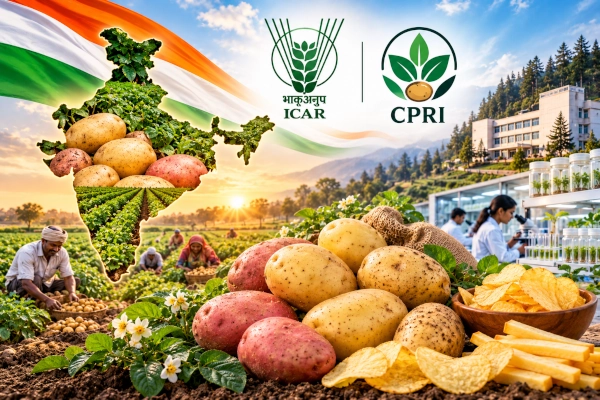
India’s agricultural research system has played a major role in transforming potato cultivation, with four varieties developed by the ICAR–Central Potato Research Institute (ICAR-CPRI) accounting for nearly 75% of the country’s potato-growing area in a landmark assessment of their adoption. The varieties—Kufri Jyoti, Kufri Bahar, Kufri Pukhraj and Kufri Chipsona-1—demonstrate the lasting contribution of indigenous crop breeding to agricultural productivity and the development of India’s potato industry.
According to an assessment published by the Indian Council of Agricultural Research (ICAR), these four varieties became widely cultivated because of their adaptability, productivity and suitability for different agricultural and commercial requirements. Their adoption helped farmers access improved planting material while supporting the expanding market for fresh potatoes and processed potato products.
ICAR-CPRI’s Contribution to India’s Potato Cultivation
Established in 1949, the Central Potato Research Institute, headquartered in Shimla, Himachal Pradesh, has been central to the development of potato varieties suited to India’s diverse agricultural conditions.
Potatoes originated in the Andean region of South America and are naturally associated with cooler growing environments. Developing varieties suitable for India’s subtropical plains required substantial research into crop adaptation, maturity periods, disease resistance and cultivation practices.
ICAR-CPRI addressed these challenges through systematic breeding programmes and research on potato production technologies. Its work enabled potato cultivation to expand across major agricultural regions, particularly the northern plains, where farmers grow the crop during the cooler months.
In its publication Indian Agriculture After Independence, ICAR reported that the institute had released 66 potato varieties for different states and regions. These varieties accounted for approximately 80–85% of India’s potato production at the time of the assessment.
The research also documented substantial improvements in the yield potential of newly developed potato varieties, demonstrating the progress achieved through decades of scientific crop improvement.
Kufri Jyoti: A Widely Adapted Indian Potato Variety
Kufri Jyoti is among the best-known potato varieties developed by ICAR-CPRI. Released during the 1960s, it became widely cultivated because of its adaptability to different potato-growing environments.
The variety has been used in several agricultural regions and has played an important role in extending improved potato cultivation beyond traditional production areas.
Its significance lies in the ability to provide farmers with a dependable variety suited to established cultivation practices. Broad adaptability is particularly important in India, where soil conditions, temperatures and growing seasons differ considerably between regions.
Kufri Jyoti also became an important reference point for subsequent potato breeding programmes. ICAR’s historical assessment indicates that the yield potential of varieties developed during the 1960s, including Kufri Jyoti, generally ranged from 20 to 25 tonnes per hectare.
Later breeding programmes built upon these earlier achievements to develop varieties with greater productivity and additional desirable characteristics.
Kufri Bahar: Supporting Potato Productivity in the Northern Plains
Kufri Bahar is another important variety developed through India’s public agricultural research system. It became particularly popular in the northern plains, where potato production forms a significant part of winter-season agriculture.
The variety gained recognition for its productivity and suitability for cultivation under favourable growing conditions.
For farmers, dependable performance is an important consideration when selecting a potato variety. Crop yield depends on several factors, including planting material, temperature, irrigation, soil fertility and the management of pests and diseases.
A productive variety provides the genetic foundation for a successful crop, while appropriate cultivation practices help farmers realise its potential.
Kufri Bahar’s widespread adoption contributed to the expansion of commercial potato farming and the availability of potatoes for domestic markets.
Its success also demonstrates the importance of developing varieties suited to specific agricultural environments rather than relying on a single potato type for every region.
Kufri Pukhraj: Early Maturity and High Yield Potential
Kufri Pukhraj became popular among Indian farmers because of its relatively early maturity and high yield potential.
Early-maturing potato varieties offer an important advantage in agricultural regions where the growing season is limited or farmers need to coordinate potato production with other crops.
Harvesting potatoes earlier can allow cultivators to prepare their fields for subsequent agricultural activities. The ability to complete a crop within a shorter period can be particularly valuable in intensive farming systems.
Kufri Pukhraj has gained substantial adoption in major potato-producing regions because its characteristics match the requirements of farmers cultivating potatoes during the winter season.
Its popularity reflects the economic importance of crop duration alongside overall productivity.
By developing varieties that combine desirable maturity periods with commercial yield potential, ICAR-CPRI has helped farmers make more efficient use of agricultural land and seasonal growing conditions.
Kufri Chipsona-1: A Potato Variety Developed for Food Processing
Unlike varieties cultivated primarily for fresh consumption, Kufri Chipsona-1 was developed to meet the requirements of the potato-processing industry.
Potatoes intended for manufacturing chips must possess characteristics that differ from those required for ordinary table consumption.
Processing varieties generally need suitable dry-matter content and relatively low levels of reducing sugars. These characteristics influence the texture, oil absorption and colour of potato chips during frying.
Excessive reducing sugars can produce undesirable darkening during high-temperature processing, affecting the appearance and commercial acceptance of finished products.
ICAR-CPRI developed Kufri Chipsona-1 to provide an appropriate raw material for potato chip manufacturing. Its adoption helped strengthen the connection between scientific crop breeding and the requirements of India’s food-processing industry.
In April 2013, ICAR documented the use of Kufri Chipsona-1 and Kufri Chipsona-3 for manufacturing potato chips at the institute’s processing facility in Kufri.
The development of specialised processing varieties has supported the growth of potato-based food manufacturing by improving the suitability and consistency of agricultural raw materials.
ICAR Potato Varieties Contributed ₹54,636 Crore Annually
The economic contribution of ICAR-CPRI’s potato breeding programme was examined in an assessment published in the November–December 2019 edition of Indian Horticulture, an ICAR publication.
The assessment covered the three-year period from 2014 to 2017, when India produced approximately 45.87 million tonnes of potatoes annually.
During this period, potato cultivation contributed an estimated ₹57,512 crore annually in Gross Value Added (GVA) at current prices.
Of this amount, potato varieties developed by ICAR-CPRI accounted for approximately ₹54,636 crore, representing about 95% of the estimated economic contribution of India’s potato crop.
The assessment demonstrates how improved crop varieties developed through public agricultural research became central to commercial potato production.
Importantly, the ₹54,636 crore figure represents the estimated annual economic contribution associated with ICAR-developed potato varieties during the historical assessment period. It is not a measure of the institute’s revenue, nor does it represent a newly calculated figure for 2026.
The findings nevertheless provide evidence of the substantial economic reach of agricultural research beyond laboratories and experimental farms.
Improved Potato Varieties Increase Agricultural Productivity
ICAR’s research documents show that India’s potato breeding programmes have progressively improved crop yield potential while introducing additional characteristics.
Earlier varieties developed during the 1960s generally offered potential yields of approximately 20–25 tonnes per hectare. More recent varieties have demonstrated potential yields of around 35–40 tonnes per hectare under suitable growing conditions.
These improvements reflect advances in plant breeding, disease resistance and the selection of varieties suited to different agricultural environments.
Modern potato breeding also focuses on resistance to important diseases and pests, including late blight and potato cyst nematodes.
Other breeding objectives include tolerance to environmental stresses, improved processing characteristics and enhanced nutritional qualities.
ICAR has documented varieties such as Kufri Thar-3, developed for drought tolerance, and Kufri Manik, bred for improved micronutrient characteristics.
Such developments demonstrate how potato breeding has expanded beyond increasing production to addressing water availability, crop protection, nutritional quality and commercial requirements.
High-Quality Seed Production Remains Essential
The success of an improved potato variety depends not only on its genetic characteristics but also on the quality of planting material available to farmers.
Potatoes are commonly propagated through seed tubers rather than botanical seeds. This method allows farmers to reproduce established varieties, but it also creates challenges because diseases can accumulate through successive generations of planting material.
Viral infections are particularly important because they can reduce crop vigour and productivity.
ICAR-CPRI has therefore invested in technologies for producing healthy potato planting material, including tissue culture, micropropagation and aeroponic seed production.
Aeroponic technology allows potato plants to grow with their roots suspended in a controlled environment, where nutrients are supplied through a mist. The system can be used to produce seed minitubers under carefully managed conditions.
These technologies support the multiplication of high-quality planting material and help improve the availability of improved potato varieties.
The institute’s continued work on seed production is essential for transferring advances in crop breeding from research facilities to farmers’ fields.
New ICAR Potato Varieties Strengthen Future Cultivation
ICAR-CPRI continues to develop potato varieties for different cultivation environments and market requirements.
In a more recent development, the Ministry of Agriculture and Farmers Welfare notified four additional varieties developed by the institute: Kufri Ratan, Kufri Chipbharat-1, Kufri Chipbharat-2 and Kufri Tejas.
Kufri Ratan is a medium-maturing, red-skinned table potato variety with a reported yield potential of 37–39 tonnes per hectare. It is suited to several northern plains and plateau regions.
Kufri Tejas has been developed for heat tolerance, with a reported yield potential of 37–40 tonnes per hectare. Its characteristics make it relevant to potato cultivation in regions where higher temperatures can limit productivity.
For the processing industry, Kufri Chipbharat-1 and Kufri Chipbharat-2 offer high dry-matter content and low reducing sugar levels, making them suitable for chip manufacturing.
The development of these varieties reflects changing agricultural requirements, including climate resilience, processing quality and the need for improved crop productivity.
Their notification for seed production and multiplication creates opportunities for wider adoption through India’s agricultural extension and seed distribution systems.
Indian Potato Research Connects Farmers with Food Industries
Potato production supports an extensive value chain involving farmers, seed producers, agricultural input suppliers, traders, cold-storage operators, transporters and food-processing companies.
The requirements of these participants differ considerably. Farmers prioritise productivity, disease resistance and crop duration, while processors require consistency in tuber size, composition and processing performance.
Consumers also influence variety development through demand for potatoes suited to different culinary applications.
By developing varieties for both table consumption and industrial processing, ICAR-CPRI has helped connect agricultural research with the requirements of different market segments.
The continued expansion of India’s potato-processing industry increases the importance of varieties developed specifically for chips, frozen products and other value-added applications.
Improved storage technologies, efficient supply chains and the availability of suitable planting material can further strengthen the benefits of scientific potato cultivation.
Indigenous Potato Breeding Strengthens India’s Agricultural Future
The widespread adoption of Kufri Jyoti, Kufri Bahar, Kufri Pukhraj and Kufri Chipsona-1 demonstrates the long-term influence of indigenous agricultural research on India’s potato industry.
Their contribution extends beyond higher yields to include regional adaptability, appropriate crop maturity and the development of varieties suited to commercial processing.
The historical finding that four ICAR-developed varieties occupied nearly 75% of India’s potato cultivation area illustrates the scale at which scientific breeding achievements can reach farmers.
Continued research into disease resistance, climate tolerance, seed production and processing quality will help prepare India’s potato sector for changing agricultural and market conditions.
ICAR-CPRI’s achievements demonstrate how sustained investment in indigenous crop research can strengthen agricultural productivity, support farmer livelihoods and build a competitive food-processing industry. With newer varieties entering seed multiplication programmes, India’s potato breeding system continues to create opportunities for more productive and resilient cultivation.
References
- Indian Council of Agricultural Research — Indian Agriculture After Independence. Official ICAR publication, Section 3.2.2: Improved Varieties of Potato. Documents the development of 66 potato varieties and the historical contribution of Kufri Jyoti, Kufri Bahar, Kufri Pukhraj and Kufri Chipsona-1 to approximately 75% of India’s potato cultivation area.
https://www.icar.gov.in/sites/default/files/2023-02/Indian-Agriculture-after-Independence.pdf - Indian Council of Agricultural Research — Indian Horticulture, November–December 2019. Official assessment of ICAR-CPRI’s contribution to potato production and agricultural Gross Value Added during 2014–17, including the estimated annual contribution of ₹54,636 crore.
https://www.icar.gov.in/sites/default/files/2022-06/IH-November-December-2019.pdf - ICAR — Ministry of Agriculture Notifies Four New Potato Varieties of ICAR-CPRI for Nationwide Cultivation and Processing. Official information on Kufri Ratan, Kufri Tejas, Kufri Chipbharat-1 and Kufri Chipbharat-2.
https://www.icar.gov.in/en/ministry-agriculture-notifies-four-new-potato-varieties-icar-cpri-nationwide-cultivation-and - ICAR — Potato Processing Plant and Potato Park Inaugurated. 8 April 2013. Official documentation of the use of Kufri Chipsona-1 and other processing varieties for potato chips and French fries.
https://icar.gov.in/en/node/8498 - ICAR — Aeroponic Facility Inaugurated at CPRI, Shimla. 16 November 2013. Official information on disease-free seed potato production and aeroponic technology.
https://icar.gov.in/node/8949
You may also like
-
JSW Steel’s Crude Steel Production Rises 5% to 7.27 Million Tonnes in Q2 FY2027
-
Jubilant Pharmova Announces CAD 94.5 Million Expansion of Canadian Radiopharmaceutical Facility
-
Kabra Extrusiontechnik’s GEON Commissions 20 MWh Battery Storage Project in Rajasthan
-
India’s Wind Energy Capacity Reaches 59.20 GW as Government Targets 100 GW by 2030
-
GST Council Recommends Major Compliance Reforms, Raises Prosecution Threshold to ₹5 Crore
