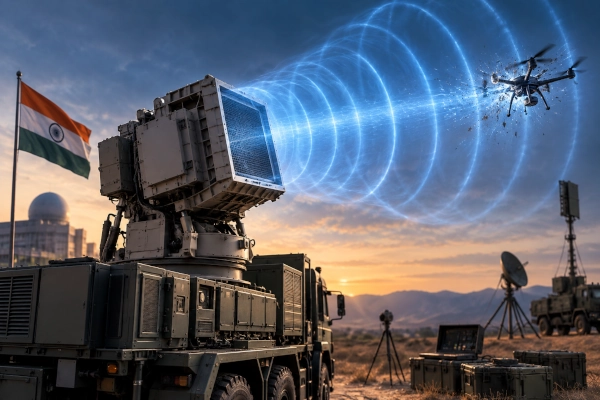
India’s Defence Research and Development Organisation has initiated a new programme to develop an indigenous S-band High-Power Microwave Integrated Evaluation System for Lethality and Damage, expanding the country’s capabilities in advanced electromagnetic and directed-energy technologies.
The Ministry of Defence’s official eProcurement portal lists the project under tender . The tender was published on September 3, 2026, with bids scheduled to close on October 7 and technical bids to be opened on October 8. The project is commonly referred to as SHIELD, derived from its objective of creating an S-band HPM Integrated Evaluation System for Lethality and Damage.
SHIELD is intended primarily as an evaluation and technology-development platform, rather than an immediately deployable battlefield weapon. Its purpose is to generate controlled high-power microwave emissions and study how electronic systems respond when exposed to intense electromagnetic energy.
The proposed system is expected to use a modular and scalable architecture built around Gallium Nitride-based solid-state power amplifier technology. Available RFP details indicate a target peak electric-field strength of at least 3 kV per metre in the far field, with pulsed operation and adjustable duty cycles. These characteristics would allow engineers to reproduce different electromagnetic exposure conditions and measure their effects on electronic equipment.
Such testing can help researchers establish the vulnerability thresholds of communications equipment, sensors, processors, control electronics and other systems exposed to high-intensity microwave radiation. The resulting data can support both the development of future high-power microwave systems and efforts to harden Indian military electronics against similar electromagnetic threats.
One of the more notable requirements associated with the programme is its planned drone-mountable configuration. An airborne evaluation platform could allow HPM effects to be studied from different distances, angles and operational geometries instead of limiting testing to fixed ground installations.
The programme is being pursued through DRDO’s Technology Development Fund, a Ministry of Defence initiative executed by DRDO to promote indigenous development of defence and dual-use technologies that are not yet available within Indian industry. The scheme places particular emphasis on participation by private companies, MSMEs and start-ups and can support projects undertaken in collaboration with academic and research institutions.
High-power microwave technology belongs to the broader directed-energy domain. Rather than relying on kinetic impact or explosives, an HPM system produces intense electromagnetic energy capable of interacting directly with electronic circuits. Depending on power, distance, waveform and target characteristics, such exposure can cause temporary disruption, interference or physical damage to vulnerable electronics.
This makes HPM technology increasingly relevant in an environment where military operations depend heavily on drones, radars, communication networks, sensors and computer-controlled systems. An indigenous facility capable of accurately measuring HPM effects would therefore give Indian researchers a valuable tool for studying both offensive technologies and defensive electromagnetic resilience.
SHIELD should not yet be regarded as an operational microwave weapon. At its current stage, it represents an enabling technology programme intended to create the indigenous test, measurement and evaluation capability required before more mature directed-energy systems can be developed and validated.
By building this capability within India and involving domestic industry through the TDF mechanism, DRDO is laying another part of the technological foundation required for future high-power microwave and electromagnetic-warfare systems.
You may also like
-
EON Space Labs and Dhruva Space Advance Indian Space Hardware on Transporter-18 Mission
-
SatLeo Labs’ TAPAS-1 Reaches Orbit, Advancing India’s Private Thermal-Imaging Capability
-
TakeMe2Space’s MOI-1A Reaches Space on Falcon 9 Transporter-18 Mission
-
PRAHAAR: India’s First National Counter-Terrorism Policy and Strategy
-
SCI and India’s Push for a Larger Indigenous Maritime Fleet
