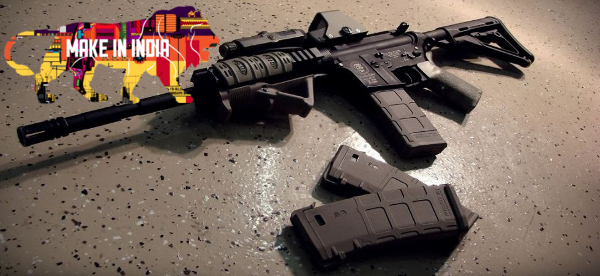
India’s AK-203 assault-rifle programme is set to gain a deeper domestic supply chain after Adani Defence & Aerospace entered into a five-year agreement with Indo-Russian Rifles Private Limited to supply indigenously manufactured 7.62×39 mm ammunition for the rifles being produced in Uttar Pradesh.
Adani Defence announced the agreement on September 5, 2026. Under the arrangement, the company will provide the small-calibre ammunition required for the AK-203 programme for a period of five years, creating an Indian source of ammunition supply alongside the domestic production of the rifles themselves. The value of the agreement, annual ammunition quantities and detailed delivery schedule have not been publicly disclosed.
The agreement brings together two important parts of India’s small-arms manufacturing ecosystem. Indo-Russian Rifles Private Limited, or IRRPL, manufactures the AK-203 assault rifle at Korwa in the Amethi district of Uttar Pradesh, while Adani Defence has established large-scale ammunition-manufacturing capacity at Kanpur. Connecting these two production centres means that both the weapon and an important part of its continuing ammunition requirement can increasingly be sourced from within India.
The AK-203 fires the 7.62×39 mm cartridge, and Adani Defence said the new agreement would provide an indigenous source of this ammunition while supporting continuity of supply over the five-year contract period. For a rifle intended to enter service in very large numbers, assured access to ammunition is as important as the ability to manufacture the weapon itself.
The AK-203 programme is one of India’s largest ongoing small-arms localisation projects. The Ministry of Defence signed a contract with IRRPL on December 6, 2021 for 6,01,427 AK-203 assault rifles. The rifles are to be produced at Korwa under an India-Russia joint venture established specifically for indigenous manufacturing.
IRRPL combines Indian and Russian defence-industrial participation. On the Indian side, the shareholders are defence public-sector companies Advanced Weapons and Equipment India Limited and Munitions India Limited. The Russian participants are Rosoboronexport and Concern Kalashnikov. The Ministry of Defence has stated that the Indian side holds 50.5 per cent of the joint venture while the Russian side holds 49.5 per cent.
The Ministry subsequently confirmed that IRRPL had established the facilities required for indigenous production of the AK-203 at Korwa. The objective of the programme is to progressively develop domestic capability for a rifle that will serve as an important infantry weapon for the Indian Armed Forces.
Adani Defence’s role adds another layer to this localisation effort by moving ammunition production into the same domestic industrial ecosystem. The company has built a major ammunition and missile manufacturing complex at Kanpur, which was inaugurated in February 2024.
Spread across approximately 500 acres, the Kanpur complex was established to manufacture small-, medium- and large-calibre ammunition for the armed forces, paramilitary organisations and police. At the time of its inauguration, Adani said the facility had begun producing small-calibre ammunition with an initial capacity of 150 million rounds annually, which the company estimated was equivalent to roughly one-quarter of India’s annual requirement at that time.
The Kanpur development was significant because ammunition availability can become a critical constraint during sustained military operations. Large stocks may be consumed rapidly during prolonged training, mobilisation or conflict, making domestic production capacity strategically important. The expansion of private-sector ammunition manufacturing is therefore intended not only to substitute imports but also to create additional industrial capacity alongside the established public-sector production base.
The five-year AK-203 agreement provides Adani Defence with a direct role in one of India’s largest infantry modernisation programmes. Instead of functioning only as an independent ammunition producer serving a broad customer base, the Kanpur facility will now be linked to a specific domestically manufactured weapon programme through a longer-term supply arrangement.
For the AK-203 programme, the agreement also represents a move toward a more complete national supply chain. Localisation of a weapon does not end with manufacturing its receiver, barrel and other mechanical components. Ammunition, spare parts, maintenance infrastructure, testing capabilities and logistics must also be available domestically if the system is to achieve a high level of supply-chain independence.
Producing the rifle at Korwa and its ammunition within India reduces exposure to overseas supply disruptions and creates greater control over production planning. This becomes particularly important for ammunition because it is a consumable item required continuously throughout a weapon’s operational life.
The development also reflects the wider transformation underway in India’s defence manufacturing sector, where public-sector companies, private manufacturers and international technology partners are increasingly being integrated into common production ecosystems. In the AK-203 programme itself, two Indian defence PSUs participate in the rifle-manufacturing joint venture while a major Indian private-sector company will now contribute ammunition.
Adani Defence has steadily expanded its presence across ammunition, missiles, unmanned systems, counter-drone technologies and small arms. Its Kanpur complex is intended to serve both domestic and international markets and forms part of the company’s effort to establish large-scale manufacturing capacity for strategic military supplies.
As AK-203 production continues at Korwa, the Adani-IRRPL agreement adds another domestic component to the programme’s supply chain. The combination of Indian rifle manufacturing and Indian-made 7.62×39 mm ammunition marks another step toward building a more self-contained small-arms ecosystem in which weapons, ammunition and supporting industrial capabilities can increasingly be sourced within the country.
You may also like
-
EON Space Labs and Dhruva Space Advance Indian Space Hardware on Transporter-18 Mission
-
SatLeo Labs’ TAPAS-1 Reaches Orbit, Advancing India’s Private Thermal-Imaging Capability
-
TakeMe2Space’s MOI-1A Reaches Space on Falcon 9 Transporter-18 Mission
-
PRAHAAR: India’s First National Counter-Terrorism Policy and Strategy
-
SCI and India’s Push for a Larger Indigenous Maritime Fleet
