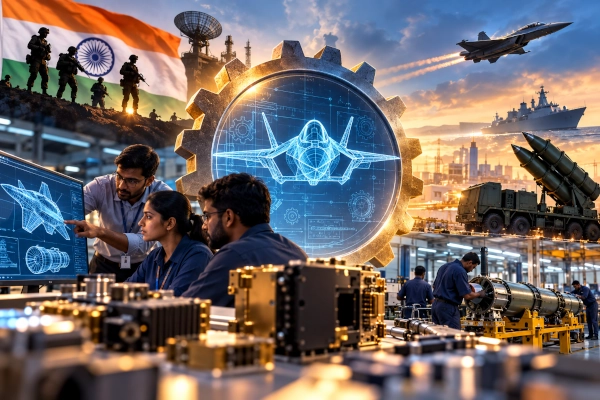
India’s proposed Defence Acquisition Procedure 2026 seeks to move the country’s military procurement system beyond domestic manufacturing towards deeper ownership of defence technology, with indigenous design, intellectual property rights and domestic development becoming more prominent elements of future acquisitions.
The Ministry of Defence released the draft DAP 2026 in February to replace the existing Defence Acquisition Procedure 2020. The proposed framework has been designed around four interconnected objectives: faster acquisition, greater self-reliance, stronger integration of Indian industry into defence development and a procurement system capable of responding more quickly to rapidly changing military technology.
The significance of the new procedure lies in the distinction between manufacturing equipment in India and actually controlling the technology behind that equipment. The draft specifically places greater emphasis on indigenous designing and retention of intellectual property rights, creating a pathway for Indian companies to develop defence systems whose underlying designs and technologies are increasingly owned within the country rather than merely manufactured under external licences.
Indigenous Design Moves Higher in the Procurement Structure
The Ministry of Defence has described the Buy (Indian-IDDM) category — covering equipment that is indigenously designed, developed and manufactured — as a central component of India’s self-reliance strategy.
Draft DAP 2026 proposes to strengthen this approach by explicitly defining indigenous design and by increasing the indigenous-content requirement under the Buy Indian-IDDM category from 50 per cent to 60 per cent.
This distinction matters because indigenous content and indigenous design measure different aspects of self-reliance. A system may contain a high percentage of components manufactured in India while still depending upon intellectual property, critical technologies or designs controlled outside the country.
By placing greater emphasis on indigenous design, the proposed acquisition system seeks to encourage Indian defence companies to become technology creators rather than remaining predominantly production partners for externally developed systems.
Intellectual Property Becomes a Strategic Asset
One of the clearest statements in the official DAP 2026 announcement is the emphasis on indigenous designing and retention of intellectual property rights.
For Indian industry, ownership of IPR can determine whether a company can independently improve a system, develop future variants, integrate new technologies and potentially offer derivatives to additional customers without remaining permanently dependent upon an external technology owner.
This has particular importance for private defence companies, startups and smaller technology firms. Many such companies are developing specialised technologies in areas including artificial intelligence, autonomous systems, electronic warfare, sensors, communications, robotics, propulsion and unmanned platforms.
A procurement framework that recognises indigenous intellectual property alongside domestic manufacturing can provide these companies with a stronger incentive to invest in long-term research and product development.
The wider defence ecosystem is already moving in this direction. According to official government data, more than 2,780 DRDO intellectual property rights had been opened for industry use by March 2026, while 2,180 technology-transfer agreements had been signed with Indian industry.
Procurement Categories Are Being Simplified
Draft DAP 2026 proposes reducing the number of major procurement categories from five to four as part of a broader attempt to simplify the acquisition system.
The Ministry of Defence has repeatedly identified lengthy procurement timelines as a problem because modern military technology can evolve more quickly than traditional acquisition processes. A system conceived at the beginning of a lengthy procurement cycle can face significant technological changes before it eventually enters service.
The proposed procedure therefore seeks to align procurement categories more closely with technological availability and manufacturing readiness. This allows acquisitions to be structured according to whether a technology already exists, requires further development or is moving rapidly through successive generations.
The intention is to make the procurement mechanism more responsive without abandoning the technical evaluation and financial safeguards required for major military acquisitions.
Prototype Testing Could Become More Flexible
Trials represent one of the most important areas of proposed reform.
The official draft provides for greater involvement of subject specialists in finalising Service Qualitative Requirements and specifications and in overseeing trials. It also introduces provisions for two-stage trials and gives the Services greater flexibility in determining the appropriate mode of quality-assurance testing.
The changes are intended to reduce situations in which promising indigenous systems encounter delays because procurement requirements or testing procedures do not adequately reflect the maturity of emerging technologies.
Technology Readiness Level-based categorisation is another important proposal. Using TRLs allows procurement authorities to distinguish between early-stage technology, mature prototypes and systems already approaching production readiness.
For equipment at Technology Readiness Levels six to nine under the Indian indigenous design, development and manufacturing category, the proposed procedure also provides for ab-initio single-vendor procurement under specified circumstances.
Together, these changes could be particularly relevant for Indian companies developing technologies that have already passed major prototype stages but have not yet accumulated the operating history normally available to established foreign systems.
Spiral Development Recognises That Technology Does Not Stand Still
DAP 2026 also formally incorporates the idea of spiral development into defence acquisition.
Traditional procurement frequently attempts to define a complete final requirement before development begins. That model becomes increasingly difficult when technologies such as drones, artificial intelligence, electronic warfare and software-defined systems can change substantially within only a few years.
Spiral development instead allows capability to evolve through successive versions. An initial operational system can be developed and acquired while improved capabilities are incorporated in later iterations.
The draft applies this concept both to major platforms and to Make and iDEX projects. The approach could allow the Armed Forces to gain access to useful technology earlier while providing Indian developers with opportunities to progressively improve systems based on operational experience.
The official framework also proposes five years of assured orders for eligible Make and iDEX projects, potentially providing greater production visibility for companies that successfully move indigenous technologies through development and trials.
New Route for Fast-Moving Technologies
The proposed DAP introduces a Low-Cost Capital Acquisition procedure specifically intended for rapidly evolving and relatively inexpensive technologies.
This is particularly relevant to areas in which traditional procurement cycles can become an obstacle. Small drones, counter-drone technologies, communications equipment, software-based systems, sensors and other emerging technologies may undergo several generations of development during the acquisition period of a conventional military platform.
The Fast Track Procedure is also proposed to be refined, with greater delegation of decision-making authority for technologies characterised by shorter development cycles.
These reforms reflect an increasingly important procurement problem. Military equipment such as warships, aircraft and armoured vehicles may remain in service for several decades, while their electronic, software and unmanned-system components can evolve within a fraction of that period.
The procurement system must therefore accommodate both long-life platforms and rapidly changing technologies without applying exactly the same acquisition model to both.
Greater Opportunity for Private Industry, MSMEs and Startups
The Ministry of Defence has explicitly linked DAP 2026 with the growth of India’s private defence industry.
The draft proposes easing financial and experience requirements to allow more inclusive participation. This could reduce barriers faced by smaller companies possessing specialised technology but lacking the turnover, balance sheet or previous defence contracts normally associated with established manufacturers.
That approach complements the expansion of iDEX, the Technology Development Fund and other government innovation programmes. Official figures show that iDEX had engaged 676 startups, MSMEs and innovators and generated 551 design and development contracts by March 2026.
The Technology Development Fund was supporting 80 projects valued at ₹334 crore by June, while an additional ₹500 crore corpus has been approved for deep-tech and emerging technologies.
The objective increasingly appears to be the creation of a layered industrial ecosystem rather than reliance on a small number of major platform manufacturers. Large companies can integrate complete systems while startups and specialised firms develop sensors, electronics, software, materials, autonomous technologies and other subsystems.
Long-Term Orders Could Give Industry Greater Visibility
Another proposed change is the introduction of a Long Term Bulk Acquisition mechanism.
Defence companies frequently need to invest heavily in specialised production lines, tooling, testing equipment and supply chains before significant quantities of equipment can be manufactured. Uncertainty over future orders can discourage such investment, particularly when production runs are small or procurement is divided into numerous short contracts.
Long-term acquisition planning can provide manufacturers with greater visibility over expected demand, allowing companies and their suppliers to plan capacity, workforce requirements and capital investment more effectively.
This is particularly important as India attempts to build domestic supply chains extending beyond major defence companies into MSMEs producing specialised components and materials.
Stable orders can also help suppliers move from prototype-level manufacturing towards repeatable industrial production, which remains one of the most difficult transitions for emerging defence technologies.
Imports Would Increasingly Become the Exception
The official DAP 2026 announcement also states that imports are intended to be restricted primarily to critical equipment that is not available domestically.
This does not mean India will cease acquiring foreign defence technology. Certain capabilities may continue to require overseas procurement, international collaboration or technology partnerships because domestic alternatives are unavailable or because immediate operational requirements cannot wait for indigenous development.
The direction of procurement policy, however, is increasingly clear. Indigenous acquisition is intended to become the normal route wherever domestic technological and manufacturing capabilities can satisfy military requirements.
That policy is reinforced by the Positive Indigenisation Lists, the SRIJAN portal and programmes intended to transfer technologies previously sourced from abroad to Indian manufacturers.
Official figures released in August showed that more than 15,700 defence items had already been successfully indigenised, producing estimated import substitution of approximately ₹9,000 crore over the preceding five years.
From Manufacturing Equipment to Controlling Technology
The most important element of DAP 2026 may ultimately be the connection it attempts to create between military procurement and technological ownership.
India has already expanded domestic defence manufacturing substantially, with defence production reaching a record ₹1.78 lakh crore in 2025-26. Private industry accounted for approximately 24 per cent of that production, while its role in defence exports was considerably larger.
The next stage involves increasing the proportion of systems whose design, intellectual property, critical technologies and development capabilities reside within India.
That requires a procurement system capable of rewarding research and development rather than simply manufacturing capacity. It also requires the Armed Forces to accept appropriately mature indigenous technologies, provide predictable orders and work with developers through successive generations of a system.
Draft DAP 2026 attempts to create that framework by combining stronger indigenous-design requirements, retention of intellectual property, higher domestic content, more flexible testing, spiral development and procurement mechanisms tailored to emerging technologies.
If implemented effectively, the resulting change would extend beyond the familiar concept of making defence equipment in India. The deeper objective would be to ensure that an increasing share of the technology inside those systems is also conceived, developed, controlled and improved within India.
References
Press Information Bureau, Ministry of Defence — “DAP 2026 Proposes Transformative Leap in India’s Defence Procurement Framework,” 13 February 2026.
Official PIB release
Press Information Bureau, Ministry of Defence — “Inviting Comments on the Draft Defence Acquisition Procedure (DAP)-2026,” 10 February 2026.
Official PIB release
Press Information Bureau, Government of India — “India’s Defence Strength: Powering National Security Through Self-Reliance,” 14 August 2026.
Official PIB backgrounder
You may also like
-
Biocon Secures Global Patent Settlement with Genentech for Pebrilzo Biosimilar, Targets European Launch in 2027
-
Segritech Develops AI-Powered Fruit Grading Machines to Improve Farmers’ Income and Reduce Post-Harvest Losses
-
Bharat Small Reactors Take Centre Stage at ICC India Energy Summit as India Advances 100 GW Nuclear Power Mission
-
OSTO Launches AI-Native Cybersecurity Platform for Indian Startups and SMEs
-
Cosmochute Develops Reusable Lunar Robotics Platform, Raises $1.5 Million to Advance Moon Exploration
