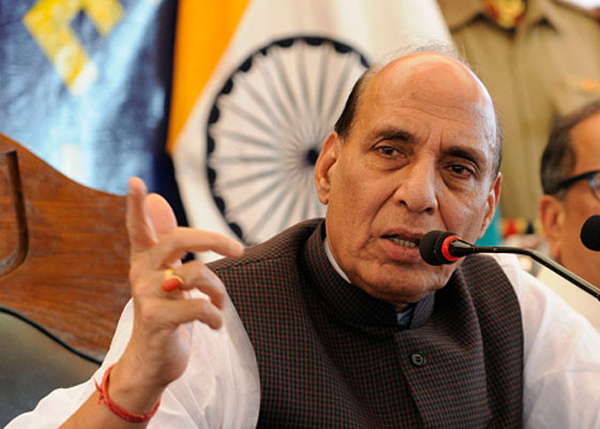
New Delhi: Connectivity has been achieved on 59 roads with a total length 3,205 km along the India-China border, Defence Minister Rajnath Singh said in Rajya Sabha on Monday.
In a written response to a question, Singh said 61 India-China Border Roads (ICBRs) with a length of 3,323.57 km were identified as strategically important and the work was entrusted to the Border Roads Organisation (BRO).
The defence minister said the construction of 42 roads with a length 1,530.38 km has been completed.
“Connectivity has been achieved on 59 roads of length 3,205.16 km and on the remaining 02 roads of length 118.41 km, the unconnected portion is 29 km,” he said.
In view of the face-off between Indian and Chinese militaries in eastern Ladakh as well as China’s aggressive infrastructure development along the border, India has redoubled efforts to improve connectivity along the frontier.
Singh said 10 ICBR roads are targeted to be completed by this month while work on seven roads is expected to be over by March next year and another two roads by March 2023.
The defence minister said the financial and administrative powers of BRO executives have been enhanced to expedite the implementation of the road projects.
Out of 61 roads, 27 with a length of 1,725.46 km are in Arunachal Pradesh, 12 with a length of 1,064.14 km are in Ladakh and 14 roads of length 355 km are in Uttarakhand. Himachal Pradesh too has five ICBR roads of length 116.99 km, while Sikkim has three roads of the length of 61.98 km, Singh said.
Replying to a separate question, Minister of State for Defence Shripad Naik said substantial changes have been introduced in training to generate increased operational orientation for all aircrew.
He said the learning curve has been made steeper to weed out weaker pilots before they are posted to operational units.
“Substantial changes have been introduced in training pattern to generate increased operational orientation and reduce the timelines to achieve ”Operational Status” for all aircrew,” Naik said.
He said all aircrew are exposed to simulators which have become an integral part of the flying training syllabus enabling the trainer pilot to be adequately prepared for flying aircraft and handle modern on-board cockpit systems with greater proficiency.
“As a matter of policy, simulators are being procured for all new aircraft inductions,” he said.
Source: DTNext
You may also like
-
India’s First Fleet Support Ship Set for Launch as Hindustan Shipyard Expands Capacity for 45,000-Tonne Vessels
-
HAL Koraput to Add ₹218-Crore Shakti Engine Production Line as India Marks 2,000th Aero-Engine Milestone
-
Indian Defence Production Delegation Visits Saab in Sweden as Defence Co-Manufacturing Talks Deepen
-
DRDO Expands Space-Based ELINT and RF Geolocation Technologies for Future Defence Surveillance
-
Indian Army Tests Apache 30 mm Cannon Against Aerial Target in Counter-Drone Validation
