Heritage

News, articles and Essays on Sanatana Dharma, Hinduism and Indian way of life.

Kulasekhara Alvar / Kulasekhara Varman: The Chera King Who Turned Royal Power into Bhakti

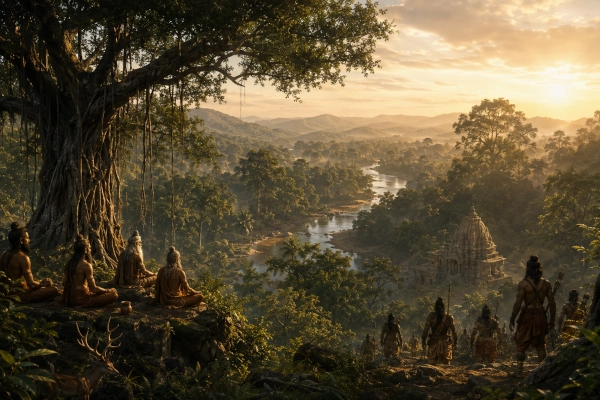
Tradition places Kulasekhara in Chera Nadu, the western land of mountains, rivers, ports and temples that corresponds broadly with Kerala. Sri Vaishnava tradition says he was born in the Chera country, came to the throne after his father, and became deeply devoted to Sri Rama. The Koyil Divya Prabandham tradition associates him with Thiruvanjikkalam, presents him as a Chera king, and remembers him as a ruler whose mind moved constantly towards Rama, Srirangam and the service of Vishnu. The traditional biography even says that when he heard the Ramayana narrated, he reacted as if the events were happening before his eyes. This is the key to understanding him: for Kulasekhara, sacred memory was not literature alone; it was living presence.

Weapons, Astras and Warrior-Systems in the Mahabharata: An Ancient Indian Defence Study

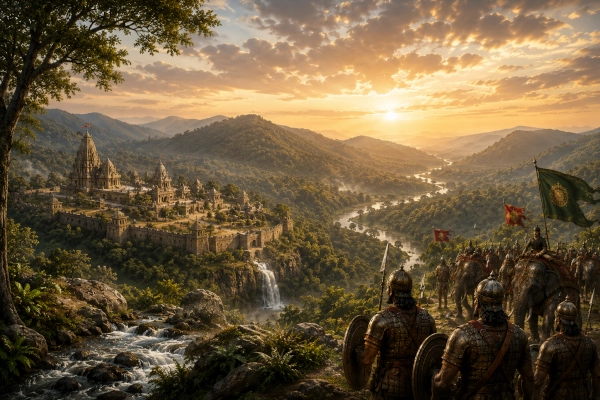
The ordinary weapons of the epic represent different combat functions. The bow gave reach, precision and speed. The mace gave crushing power in close combat. The sword served as a secondary weapon when distance collapsed. The spear or lance gave thrusting and anti-cavalry value. The chariot served as a mobile fighting platform. The elephant acted as a shock platform, while cavalry enabled movement, pursuit and screening. Together, these weapons formed the ancient equivalent of combined arms.

Mullakkal Rajarajeswari Temple, Alappuzha: The Bhagavathy Shrine at the Heart of Alleppey

The presiding deity of the temple is Goddess Rajarajeswari, worshipped here as a powerful form of Bhagavathy/Durga. Kerala Tourism describes the temple as a grand Kerala-style shrine where Goddess Durga is the main deity, with other deities including Hanuman, Ganesha, Krishna, Ayyappa, Nagaraja and the Navagrahas also worshipped within the temple complex. The temple is believed to be around 500 years old, making it one of the important historic temples associated with Alappuzha’s religious landscape.

Command Under Dharma: Bhishma, Drona, Karna, Arjuna and Krishna as a Defence Study in Mahabharata Leadership

Krishna’s strategic brilliance begins before Kurukshetra. He reads personalities clearly: Duryodhana’s ambition, Yudhishthira’s moral hesitation, Arjuna’s sensitivity, Bhima’s force, Karna’s pride, Bhishma’s restraint and Drona’s emotional weakness. This is advanced strategic intelligence. Modern defence planning values the same ability through political assessment, adversary profiling, intelligence fusion and red-team analysis. A war is shaped by weapons, terrain and logistics, but also by temperament, ego, fear, legitimacy and morale.

Kanaikkal Irumporai: The Chera King Whose Defeat Became a Legend of Honour

The title “Irumporai” itself carried the weight of a Chera lineage known from Sangam poems. In that old Tamil world, dynastic legitimacy was expressed not only through ancestry but also through conduct. A king had to be brave in battle, generous to poets, fierce to enemies and dignified in hardship. Kanaikkal Irumporai’s story fits this ideal perfectly. He is remembered not for palaces, temples or inscriptions, but for war, captivity and a final act of royal self-respect.

From Akshauhini to Integrated Battle Groups: Army Organisation and Battlefield Structure in the Mahabharata

The Mahabharata repeatedly presents armies as mixed forces, and Adi Parva gives a precise mathematical structure for the Akshauhini, beginning with one chariot, one elephant, three horses and five foot soldiers as one Patti. This creates a battlefield system where mobility, shock power, speed and ground-holding capacity move together as one fighting organism.

Chengannur Mahadeva Temple: The Sacred Abode Where Shiva and Parvati Are Worshipped as One Living Presence

Thriputharattu is the temple’s defining ritual and one of the rarest Goddess festivals in India. During this observance, the Devi’s presence is treated with the tenderness and ritual seriousness given to a living mother. The temple’s special-festival page says that on the fourth day, the Devi’s idol is taken to the nearby river for Arattu, or ritual bathing, after which she is brought back to the temple in procession. When the procession returns to the nalambalam near the main entrance, Bhagavan Mahadeva is believed to be waiting there, and the divine pair together circumambulate the temple in procession.

Netherlands Returns Chola-Era Anaimangalam Copper Plates, Restoring a Priceless Chapter of Tamil Maritime History

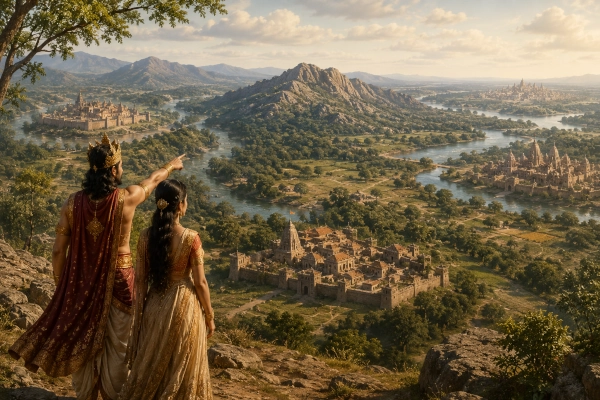
The plates belong to the world of Rajaraja Chola I and Rajendra Chola I, two rulers who transformed the Chola kingdom into one of Asia’s most influential maritime powers. Rajaraja Chola I, who ruled from 985 CE to 1014 CE, is remembered not only for military expansion and monumental temple-building, but also for creating a disciplined administrative state that recorded land, revenue and religious grants with remarkable precision.