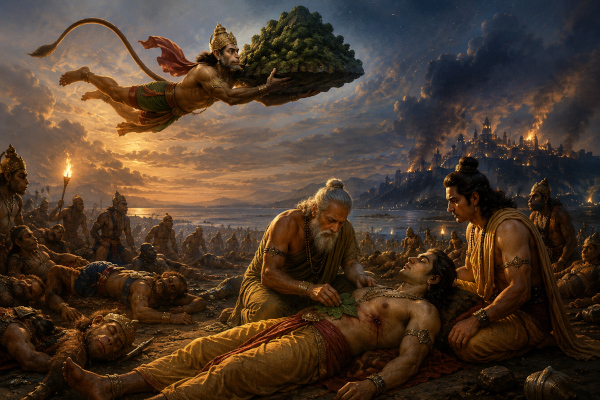
In the Lanka war, the battlefield reaches a point where courage alone can no longer hold the line. Rama, Lakshmana and many Vanara warriors are wounded. The army that crossed the ocean with confidence suddenly faces a darker reality: even the strongest formation can weaken when its commanders fall and its fighters lie injured across the field. At this moment, the Ramayana shows one of the most important but often overlooked dimensions of warfare — battlefield medicine, casualty recovery and the urgent need to save fighting strength before defeat spreads through the ranks.
The episode of Hanuman bringing the healing herbs is usually remembered as an act of devotion. It is that, but it is also much more. It is a battlefield rescue mission under extreme pressure. It shows a wounded army, a medical requirement, a time-sensitive operation, a special responder, and the restoration of combat power. In simple military terms, the Sanjivani mission is a casualty recovery operation that saves key commanders and revives the army’s morale at the same time.
When Lakshmana is struck down, Rama is shaken deeply. The fall of Lakshmana is not only the injury of a brother. It is the possible collapse of command continuity. Lakshmana is Rama’s closest battlefield companion, a warrior of enormous skill, and one of the central pillars of the campaign. His condition affects the emotional strength of Rama, the confidence of the Vanara army and the direction of the war itself. This is exactly how modern armies view the wounding of key commanders. A commander is not just one soldier among many. He carries decision-making, morale, coordination and the will of the formation. Saving such a person becomes a matter of operational survival.
Sushena, the healer in Rama’s camp, plays a crucial role here. He does not panic with the rest of the army. He studies the condition of the wounded, understands that Lakshmana can still be saved, and identifies the medicine needed. This is the battlefield medic’s role in its ancient form. In war, the healer must stay calm when warriors are emotional. He must read signs, judge survival, decide the treatment and direct action quickly. The Ramayana gives Sushena this responsibility with remarkable clarity. He becomes the medical mind of the army at the exact moment when the army needs discipline more than grief.
Hanuman is then sent to bring the life-saving herbs from the mountain. This is where the episode becomes a model of emergency military logistics. The medicine is far away. The casualty needs urgent care. The army has very little time. Hanuman is selected because he has the speed, strength and determination required for a mission beyond the reach of ordinary fighters. In modern military language, he becomes the rapid response asset, the emergency evacuation-and-supply platform, and the special operations responder rolled into one. The army uses the right person for the right mission at the right moment.
The most powerful part of the story is Hanuman’s decision when he cannot identify the exact herb. He does not waste time in hesitation. He lifts the entire mountain and brings it back. This is a profound lesson in battlefield decision-making. In a crisis, perfect information may take too long. A commander or responder must sometimes bring the entire capability rather than risk delay. Modern militaries follow the same logic when they send full medical teams, mobile surgical units, blood supplies, evacuation helicopters, trauma kits and emergency equipment forward instead of waiting to identify every requirement one by one. When lives are measured in minutes, speed becomes part of the treatment.
The return of Hanuman with the mountain is the turning point. The herbs revive Lakshmana and restore the fallen Vanaras. The army breathes again. Rama regains strength. The warriors regain confidence. The field that had become silent with fear becomes alive with renewed determination. This shows that casualty recovery has two effects in war. It saves bodies, and it saves morale. A soldier who knows that his side will rescue the wounded fights with greater trust. An army that sees its fallen comrades revived gains psychological strength. Medical support is therefore not a secondary service behind the battlefield. It is a combat multiplier.
Modern military doctrine treats battlefield medicine in the same serious way. Today, soldiers are trained in combat lifesaving, first response, bleeding control, airway support, evacuation drills and casualty movement. Armies create casualty collection points, where wounded personnel are gathered, sorted, stabilised and prepared for evacuation. Medical teams work in layers — from the first responder near the point of injury to field medics, forward surgical teams, evacuation platforms and higher military hospitals. The purpose is the same as in the Ramayana episode: keep the wounded alive, preserve the fighting strength of the force and prevent battlefield chaos from turning into collapse.
The modern idea of the “golden hour” in trauma care also fits naturally into this episode. The first hour after a severe injury is often decisive. Fast bleeding control, quick evacuation and early surgical care can change survival outcomes. Hanuman’s flight to the mountain represents this same race against time. The story does not treat delay lightly. Every moment matters. The entire mission moves with urgency because a warrior’s life and an army’s future are tied to time. This is why modern forces invest heavily in medical evacuation helicopters, battlefield ambulances, forward medical posts and trained combat medics. The faster care reaches the casualty, the stronger the chance of survival.
A powerful modern Indian parallel comes from the Kargil War of 1999, where battlefield medicine became a matter of survival in the icy heights of Drass and Kargil. Soldiers were climbing near-vertical ridgelines under artillery, machine-gun fire and freezing wind, and every wounded man had to be stabilised, carried down and moved through the evacuation chain. In 13 Jammu and Kashmir Rifles, Regimental Medical Officer Colonel Rajesh W. Adhau became a living example of this principle. He stayed close behind the assaulting troops, treated wounded soldiers under fire and helped keep the fighting strength of the unit alive during some of the fiercest actions of the war. This mirrors the Sanjivani episode with striking clarity. In the Ramayana, Sushena gives the medical direction and Hanuman brings the life-saving remedy with speed. In Kargil, the doctor, stretcher-bearers, comrades, pilots and evacuation teams formed the same chain of recovery. The lesson is timeless: an army wins by advancing against the enemy, and it also wins by refusing to abandon its wounded.
There is also a deeper command lesson in this episode. Rama’s army does not abandon the wounded. It organises a response. Jambavan identifies Hanuman’s importance. Sushena gives medical direction. Hanuman executes the mission. Rama holds the emotional centre of the army. Every role matters. This is exactly how a mature military system works. The commander, medic, logistics team, evacuation unit and fighting troops all contribute to casualty recovery. Battlefield medicine is therefore a chain, not a single act. A break in that chain can cost lives. A strong chain can restore an army after a devastating blow.
The Sanjivani mission also shows that medical logistics must be planned like combat logistics. Food, weapons and ammunition keep an army fighting, but medicine keeps an army alive. A force that enters battle without casualty recovery planning is vulnerable after the first serious strike. Modern militaries know this well. They plan evacuation routes, medical posts, blood supply, stretcher teams, ambulance access, helicopter landing zones and communication channels before major operations. The Ramayana expresses the same principle through story. The wounded army needs the right medicine, the right carrier and the right speed. The mission succeeds because all three come together.
This episode also carries a strong psychological dimension. The enemy’s aim in wounding Rama, Lakshmana and the Vanaras is physical damage as well as emotional disruption. A wounded commander can spread fear across the ranks. A fallen army can invite panic. The recovery of Lakshmana reverses that pressure. It tells the Vanaras that their leadership still stands. It tells the enemy that Rama’s side can absorb heavy blows and return to battle. In modern warfare, casualty recovery has the same psychological power. Quick evacuation, visible care for the wounded and the return of injured soldiers to safety strengthen trust within the ranks. Soldiers fight harder when they believe their lives matter to the system they serve.
For India’s modern military thinking, this principle has direct relevance. Indian soldiers operate across mountains, deserts, forests, high-altitude posts and difficult border terrain. In such conditions, casualty recovery becomes as important as firepower. A wounded soldier in the Himalayas, a patrol casualty near the Line of Control, or an injured commando in a counter-terror operation needs rapid response, trained first aid, evacuation coordination and medical reach. The lesson from Hanuman’s Sanjivani mission fits this reality perfectly. The army that can reach its wounded quickly protects both life and operational confidence.
The Ramayana therefore gives battlefield medicine a heroic form. Hanuman’s flight is divine and dramatic, but the military principle behind it is practical. A wounded army must be restored before it breaks. A fallen commander must be saved before command confidence collapses. A medic’s judgment must guide action. A rapid responder must move without delay. A force must treat casualty recovery as part of victory itself.
In the Lanka war, Hanuman does not merely bring herbs. He brings back time, morale, command strength and the army’s will to continue. That is the real defence lesson of this episode. Wars are won by striking the enemy, but they are also won by saving one’s own. The side that protects its wounded protects its courage. The side that restores its commanders restores its direction. The side that treats battlefield medicine as a combat duty turns survival into strategy.
You may also like
-
Indian Navy’s First Training Squadron Arrives in Colombo to Strengthen Maritime Cooperation
-
Indian Navy Launches First Indigenous Sullage Barge, Begins Construction of Two More Vessels in Thane
-
Indian Navy’s Next Generation Offshore Patrol Vessel Srishti Launched at Goa Shipyard
-
India and France Sign Agreement to Preserve and Digitise Ancient Indian Manuscripts
-
Huna in the Mahabharata: Nakula’s Western Campaign, the Harahunas and Central Asia’s Changing Frontiers
