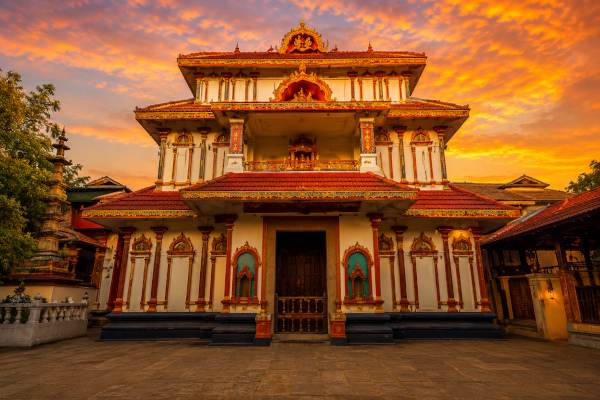
Thiruvairanikulam Mahadeva Temple is one of the most revered Shiva-Parvathy temples in Kerala. Situated at Vellarappilly near Kalady in Ernakulam district, the temple carries the atmosphere of an ancient Kerala kshetram where legend, ritual, architecture and devotion come together with quiet power. Kalady, the birthplace of Adi Shankaracharya, gives the region a deep spiritual identity, and Thiruvairanikulam stands as one of its most important sacred landmarks.
The temple is dedicated to Lord Shiva and Goddess Parvathy. The main deity, Mahadeva, faces the east, while Goddess Parvathy faces the west. This arrangement gives the temple a distinctive identity among Kerala temples. Shiva and Shakti are worshipped here as separate divine presences within a single sacred world, creating a powerful image of balance, union and grace.
The temple is especially famous for the rare opening of the Goddess Parvathy Sreekovil. The sanctum of Parvathy Devi is opened to devotees only for twelve days in a year. This annual opening is known as Nadathurappu Mahotsavam. It begins on the Thiruvathira day of the Malayalam month of Dhanu, which usually falls between mid-December and mid-January. During these twelve days, thousands of devotees visit the temple to receive darshan of the Goddess.
The legend behind this ritual is one of the most moving stories associated with the temple. Tradition says Goddess Parvathy once prepared food for Lord Mahadeva in the temple kitchen, the Thidappilli. This was a divine act meant to remain unseen. One day, a Brahmin connected with the temple saw the Goddess in her full presence and called out to her. The Goddess declared that her visible presence would thereafter be available only for twelve days beginning from the Thiruvathira star in Dhanu. This belief forms the heart of the Nadathurappu tradition.
The temple’s origin is also connected with Akavoor Mana and the legendary figure Akavoor Chathan. According to temple tradition, an old Brahmin of Akavoor Mana used to visit Airanikulathappan and Sree Parvathy. Akavoor Chathan is believed to have helped him cross the waters in a miraculous granite boat. In time, Lord Mahadeva is believed to have manifested at the present site, giving rise to the sacred identity of Thiruvairanikulathappan. The story gives the temple a strong connection with faith, service and divine compassion.
One of the striking legends tells of a stone from which blood began to flow when a woman sharpened her sickle upon it. This event revealed the presence of Mahadeva in the form of a Swayambhoo, a self-manifested divine presence. The temple was then established and the deity was installed. The memory of this sacred discovery continues to shape the temple’s ritual geography and spiritual imagination.
The temple well also has deep importance. Temple tradition links the well with the path through which Mahadeva is believed to have appeared. A cave near the well is also associated with this sacred movement. These elements give the temple a sense of living mythology, where the landscape itself becomes part of the deity’s story.
Thiruvairanikulam Mahadeva Temple is also known for its classical Kerala temple architecture. The Sreekovil carries wood carvings, including the figure of a vyali. The Namaskara Mandapam has ceiling art connected with Deva-Asura battles, divine festivals and the Navagrahas. These artistic details show the temple as a centre of devotion as well as a repository of Kerala’s sacred visual culture.
The rituals of the temple are marked by discipline and uniqueness. On regular days, Lord Mahadeva receives daily worship, and the temple follows the rhythm of Kerala temple pooja traditions. Pradosham and Shivaratri are especially important for Shiva worship. Goddess Parvathy receives daily worship and naivedyam, even though her Sreekovil is opened for public darshan only during the annual twelve-day period.
Another distinctive feature is the worship of Parvathy Devi. The idol of the Goddess is made of wood, so water abhishekam is not performed in the usual way. Turmeric powder is used instead. This gives the Devi worship at Thiruvairanikulam a special ritual character. Turmeric, purity, auspiciousness and feminine grace become central to the devotional experience.
The temple also has important associated deities. Lord Nandikeshwara stands in front of the sanctum, and Lord Vigneshwara is worshipped nearby. The presence of Sathidevi, Kali, Dharmasastha and Mahavishnu adds to the temple’s sacred completeness. The temple is not only a Shiva shrine; it is a wider spiritual mandala where Shaiva, Shakta and Vaishnava elements coexist in the traditional Kerala manner.
Devotees especially approach this temple for blessings related to marriage, family harmony and auspicious life. The presence of Shiva and Parvathy gives the temple a strong association with divine partnership. Offerings such as Swayamvara Pushpanjali, Uma Maheswara Pooja, Manjal Abhishekam, Thaali, Pudava and Manjal Para reflect this devotional mood. For many families, a visit to Thiruvairanikulam is an act of prayer for stability, union and grace.
The Nadathurappu Mahotsavam is the emotional centre of the temple year. The opening of Parvathy Devi’s Sreekovil creates a rare sacred moment. Devotees gather with lamps, prayers and offerings, carrying the hope of receiving the Goddess’s blessing during the brief annual darshan. The twelve days are filled with devotion, discipline and the feeling that the divine mother has opened her door to the world.
Thiruvairanikulam Mahadeva Temple represents the beauty of Kerala’s temple culture. It has ancient legends, rare rituals, sacred architecture and a living devotional tradition. Its power lies in its restraint. The Goddess appears only for a short period, and that brief darshan becomes precious. Mahadeva remains the eternal presence, and Parvathy becomes the hidden grace that reveals herself at the chosen time.
This temple teaches a deep spiritual idea. Divinity is always present, even when hidden. The door opens when time, devotion and grace come together. Thiruvairanikulam Mahadeva Temple is therefore not only a shrine of Shiva and Parvathy. It is a temple of waiting, faith and sacred revelation, where Kerala’s ancient ritual wisdom continues to breathe through stone, wood, lamp, mantra and silence.
You may also like
-
Sindhu: The Indus Kingdom of Jayadratha in the Mahabharata
-
Kuninda or Kulinda: The Himalayan Realm of the Mahabharata in Uttarakhand and Himachal Pradesh
-
Durga versus Mahishasura: Weapons, Battlefield Tactics and the Triumph of Shakti
-
Kuluta: The Kullu Valley Kingdom of the Mahabharata
-
Trigarta: The Kangra–Jalandhar Kingdom of the Mahabharata
