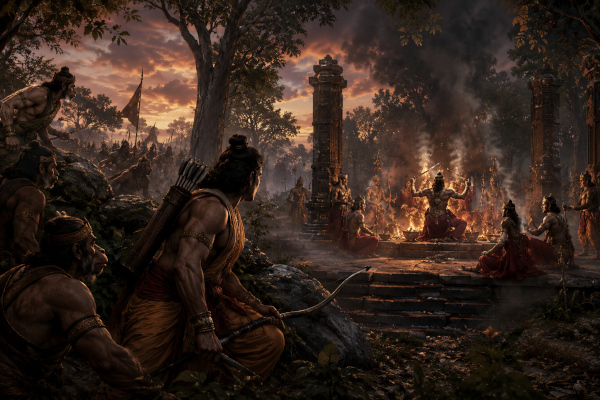
The war in the Ramayana reaches one of its sharpest military moments when Vibhishana reveals the secret of Indrajit’s Nikumbhila ritual. Indrajit is already one of Lanka’s most dangerous warriors. He has mastery over illusion, concealment, astras and psychological warfare. His presence on the battlefield creates fear because he can strike from hidden positions, confuse the enemy and break formations through supernatural force. Yet his greatest strength is linked to preparation. If he completes the ritual at Nikumbhila, he becomes almost impossible to defeat in battle. Rama’s side understands the danger immediately. The objective becomes clear: interrupt the ritual before it transforms Indrajit into an unstoppable battlefield force.
This episode is a classic lesson in pre-activation disruption. Every powerful military system has a preparation cycle. A missile battery must be positioned and armed. An airbase must prepare aircraft, fuel, weapons and pilots. A cyber unit must build access before launching an attack. A terrorist group must assemble men, explosives, vehicles and communication channels before execution. A ritual in the Ramayana becomes the ancient equivalent of a force-multiplier reaching operational status. Once activated, it gives the enemy a decisive advantage. The smartest response is to strike during preparation, while the enemy is still vulnerable.
Vibhishana’s intelligence changes the rhythm of the campaign. He does not merely describe Indrajit’s strength. He identifies the exact condition under which Indrajit becomes stronger. This is the difference between ordinary information and actionable intelligence. Ordinary information says the enemy is dangerous. Actionable intelligence says when, where and how the enemy’s danger will multiply. Vibhishana gives Rama’s side the most valuable battlefield insight: the window of opportunity exists before the ritual is completed.
This moment shows the value of defectors, insiders and human intelligence. Vibhishana knows Lanka’s internal systems, sacred geography, command culture and warrior traditions. He understands Indrajit’s ritual power because he belongs to the same strategic environment. His knowledge cannot be easily obtained through distant observation. This is why insider intelligence has always carried immense military value. A radar image can show movement. A scout can report location. An insider can explain intention, timing and hidden dependency. Vibhishana gives the Vanara command the missing link between enemy preparation and future battlefield consequence.
The Nikumbhila ritual is also a lesson in targeting the enemy’s force-multiplier. Indrajit himself is a warrior. The ritual is his enhancer. It gives him greater power, confidence and battlefield protection. In modern military language, a force-multiplier is anything that increases combat effectiveness beyond ordinary strength. It may be surveillance, electronic warfare, air defence, logistics, satellites, communication networks, drones, fuel reserves, command centres or long-range fires. A smaller force with strong multipliers can become more dangerous than a larger force with weak coordination. Rama’s side recognises that Indrajit’s ritual is the multiplier behind his future dominance.
The decision to interrupt the ritual shows strategic economy. Rama’s army avoids waiting for Indrajit to emerge at full strength. Waiting would allow the enemy to choose the moment, location and tempo of combat. By moving toward Nikumbhila, Rama’s side seizes initiative. Initiative is the pulse of warfare. The side that controls timing forces the enemy to react. The side that acts early shapes the battlefield before the main clash begins. At Nikumbhila, the Vanara side transforms a defensive concern into an offensive opportunity.
Lakshmana’s role in this operation is central. He is chosen to confront Indrajit because the mission requires discipline, courage and precision. This is a focused strike, not a mass assault. The aim is to break the ritual cycle, force Indrajit into combat and remove him before his enhanced power becomes complete. Lakshmana moves under guidance, supported by Vibhishana and the Vanara warriors. The composition of the mission matters. It combines royal authority, insider intelligence, combat skill and battlefield support. This is a task force built for a specific objective.
The terrain of Nikumbhila adds another layer to the operation. Ritual spaces carry symbolic and operational value in the Ramayana. They are protected, chosen and prepared. Indrajit depends on the sanctity and completion of the site. Once Rama’s side moves into that space, the enemy’s preparation is shattered. The strike therefore has physical and psychological effects. It interrupts the ritual process, forces premature combat and attacks Indrajit’s confidence. A warrior who expects to enter battle with enhanced power is pulled into combat during transition. That transition becomes his weak point.
Modern warfare follows the same principle. The most effective strike often lands before the enemy’s system reaches launch condition. Air forces target enemy air assets before take-off. Armies strike logistics nodes before ammunition reaches the front. Navies monitor hostile vessels before they enter firing positions. Counter-terror forces disrupt cells during planning, movement or assembly. Cyber defenders cut hostile access before a digital attack matures. The goal is to prevent the enemy’s strength from becoming usable. The best battlefield result is achieved when the adversary’s plan collapses before full execution.
India’s modern security experience offers many parallels to this principle. Terror launch pads, infiltration routes, drone staging points, communication nodes and ammunition dumps are dangerous because they prepare violence before it crosses into active combat. A mature security doctrine tracks hostile preparation, identifies patterns and acts before the threat reaches civilians or soldiers. The logic is the same as Nikumbhila. The enemy’s strength grows during preparation. Disrupting that preparation protects the larger battlefield.
The 2016 Surgical Strikes offer a strong modern Indian parallel. After the Uri terror attack, Indian Army special forces crossed the Line of Control during the night of 28–29 September 2016 and struck terrorist launch pads. These launch pads were staging zones where terrorists were positioned before infiltration. The operation targeted the preparation layer of proxy warfare. The launch pad was the modern equivalent of a hostile ritual space: a place where violence was assembled, equipped and readied for release. By striking before infiltration, India attacked the threat before it entered its operational phase.
The same logic appears in air warfare. A hostile aircraft on the ground, a missile system during deployment, or a radar network during activation represents a time-sensitive target. Once the system becomes fully active, the cost of engagement increases. Early disruption saves lives, reduces escalation pressure and denies the enemy a prepared advantage. The Nikumbhila episode captures this timeless truth with remarkable clarity. Power is most vulnerable while it is being assembled.
Indrajit’s reaction also reveals the psychological impact of interrupted preparation. He is forced to leave the ritual and enter combat before reaching the intended state of power. This breaks the mental architecture of his plan. Warriors build confidence through preparation. Commanders build operations around timing. When the opponent disrupts that sequence, the mind is shaken before the body is struck. Indrajit loses the advantage of controlled emergence. He is pulled from ritual certainty into battlefield pressure.
India’s offensive defence approach follows the same logic seen in the Nikumbhila strike. The aim is to enter the enemy’s preparation cycle and destroy the threat before it becomes active on the battlefield. When terror launch pads, training camps, drone staging areas, ammunition dumps, command nodes or infiltration routes are allowed to mature, they become force-multipliers for the adversary. India’s Surgical Strikes in 2016 and the Balakot air strike in 2019 reflected this principle by targeting hostile infrastructure before fresh attacks could be launched from prepared bases. The Nikumbhila episode shows the same timeless military wisdom: the strongest enemy must be struck during preparation, because that is the moment when his future power is still forming. Vibhishana’s intelligence gave Rama’s side the exact window, Lakshmana’s strike seized that window, and Indrajit was forced into battle before his advantage became complete. In modern terms, this is offensive defence at its sharpest: protect the nation by carrying the fight to the enemy’s launch point.
The role of Vibhishana during this phase also shows the importance of trust in intelligence-led operations. Rama trusts Vibhishana’s assessment because his previous conduct has established credibility. Intelligence becomes useful when leadership can judge its reliability and act with speed. Doubt, delay and excessive hesitation can allow the enemy’s window of vulnerability to close. Rama’s command structure shows clarity. The information arrives, the threat is understood, the strike force moves, and the enemy’s preparation is disrupted.
This episode also reflects the relationship between time and power. Indrajit’s strength is tied to completion. Rama’s advantage is tied to interruption. The battle is therefore decided by timing before weapons decide the final outcome. Every commander understands this principle. A bridge destroyed after enemy crossing has limited value. A supply convoy struck after delivery has reduced effect. A missile launcher hit after firing has already served its purpose. Timing turns ordinary action into decisive action.
The Nikumbhila strike also teaches that a commander must identify the enemy’s dependency. Indrajit depends on the ritual. A modern army may depend on satellite guidance, fuel, secure communications, spare parts, bridges, ports or electronic networks. Once the dependency is identified, the enemy’s strength becomes a map of vulnerabilities. The goal is to locate the point that supports the larger force. When that point is disrupted, the whole structure weakens.
Rama’s side succeeds because it combines moral clarity with battlefield intelligence. The war is fought to rescue Sita and restore dharma, yet the method is highly strategic. The army does not rely on courage alone. It studies the enemy, listens to insiders, chooses timing and strikes the force-multiplier. This balance between righteousness and operational sharpness is one of the deepest strengths of the Ramayana’s war narrative. Dharma gives purpose. Strategy gives victory.
The fall of Indrajit after the disruption of Nikumbhila changes the war’s momentum. Lanka loses its most sophisticated battlefield operator. Ravana loses the warrior who combined invisibility, astras, ritual power and psychological warfare. The Vanara army gains confidence because the most feared prince of Lanka has been defeated through intelligence, timing and focused combat. The death of Indrajit is therefore more than a personal defeat. It is the collapse of Lanka’s most advanced combat system.
The defence lesson is direct. The enemy’s greatest strength should be studied before it appears in full form. A commander must ask where that strength is prepared, what supports it, when it becomes active and which window offers the cleanest disruption. War rewards the side that understands the enemy’s preparation cycle. Victory often begins before the visible battle begins.
The Nikumbhila episode is one of the Ramayana’s finest examples of pre-emptive operational thinking. Vibhishana identifies the danger. Rama’s command accepts the intelligence. Lakshmana leads the strike. The ritual is interrupted. Indrajit is forced into battle before his force-multiplier matures. The result is a decisive shift in the war. In modern terms, this is the destruction of an enemy capability before deployment. In civilisational terms, it is dharma acting with speed, intelligence and precision against a rising threat.
You may also like
-
Rajnath Singh to Lead Indian Delegation at ASEAN Defence Summit in Philippines, Strengthening Indo-Pacific Security Cooperation
-
Bengaluru Startup Paar Autonomy Develops AI-Powered Drone Systems for GPS-Denied Environments
-
Sigma Advanced Systems Secures Fresh ₹973 Crore NATO Artillery Ammunition Order
-
India Advances Indigenous Defence and Space Technologies Through Naval Innovation, Drones and Advanced Electronics
-
Thales Seeks Indian Partnerships for Next-Generation Missiles, Radars and Electronic Warfare Systems
