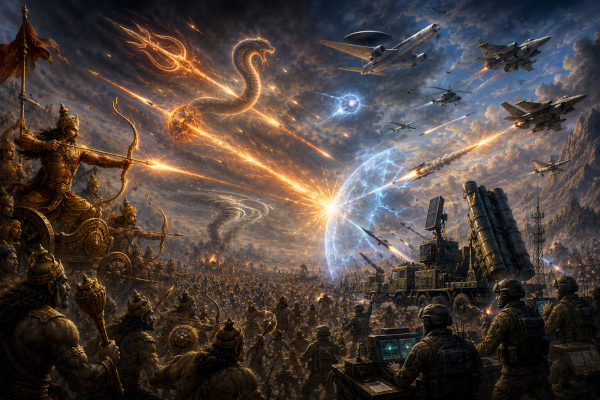
The war in the Ramayana is fought with courage, formations, reconnaissance, siege craft, diplomacy and command discipline. Yet the battlefield reaches its highest level when warriors deploy astras. These are specialised weapons charged with divine force, mantra, training and authority. They are used with purpose, timing and restraint. In strategic reading, astras represent advanced battlefield systems brought into action for decisive effect. They are the epic equivalent of precision missiles, air-defence interceptors, electronic warfare weapons, area-denial systems and strategic strike capabilities.
Ordinary weapons fill the daily rhythm of war. Bows, arrows, maces, swords, spears and stones create close combat pressure. Astras change the character of the battle. They bring fire, serpents, wind, water, darkness, shock, paralysis and overwhelming destruction into the field. A warrior who commands an astra controls an effect greater than his physical strength. The weapon becomes a system. It carries range, payload, guidance, psychological power and escalation value. Its deployment signals that the battle has moved from personal combat to specialised warfare.
The astra is never presented as a casual weapon. It requires knowledge, discipline and correct invocation. This is a major defence lesson. Advanced weapons demand authorised handling. A missile, air-defence battery, strategic bomber, cyber weapon or electronic warfare suite carries consequences beyond the soldier pressing the trigger. The person using it must understand the target, the effect, the timing and the aftermath. In the Ramayana, mastery of an astra is therefore a mark of training as much as power.
The serpent weapons used in the war show the logic of immobilisation. When Indrajit uses serpent-like weapons against Rama and Lakshmana, the battlefield effect is clear. The enemy commanders are bound, movement is stopped and morale is shaken. In modern warfare, this resembles systems designed to freeze the opponent’s operational rhythm. Area-denial weapons, mines, anti-armour missile belts, drone swarms, electronic jamming, runway denial munitions and precision strikes on bridges or logistics routes can immobilise formations. The aim is to trap the enemy, slow movement and create a temporary battlefield cage.
The serpent astra also has a psychological dimension. A bound commander becomes a visible sign of crisis. Troops watching their leaders struck by a strange weapon feel the pressure of uncertainty. Modern warfare creates similar effects when command posts are hit, communications are jammed or armoured columns are halted by precision weapons. The enemy feels physically blocked and mentally compressed. A specialised weapon therefore attacks the body of the force and the confidence of the force at the same time.
Fire weapons represent the doctrine of shock and destruction. Agneyastra-type imagery carries the force of flame, heat and sweeping devastation. Fire has always been a weapon of fear because it changes terrain, destroys supplies, breaks formations and spreads panic. Modern parallels appear in precision air strikes, thermobaric effects, fuel-air explosive concepts, incendiary systems and high-explosive munitions used against hardened or concentrated targets. The military value lies in concentrated destructive energy delivered at the right moment.
A fire weapon also changes the battlefield environment. Smoke reduces vision. Heat drives troops away from positions. Burning supplies weaken endurance. Fires inside a defended zone force movement and expose soldiers to follow-up attacks. In siege warfare, this becomes especially powerful. A commander uses fire-based systems to disturb the defender’s comfort, exhaust his reserves and open gaps in resistance. The Ramayana’s fire imagery therefore carries a clear tactical meaning: the attacker can reshape the battlefield through controlled destructive force.
Wind and storm-like weapons represent disruption. A violent atmospheric force can scatter troops, break formations, disturb projectiles and create confusion. Modern warfare uses similar disruption through electronic warfare, cyber attacks, smoke screens, decoys, radar jamming, communication interference and blast effects. These systems do not always seek direct destruction as their first purpose. They create confusion, delay, blindness and disorder. A force that loses coordination becomes easier to strike.
Water weapons and counter-fire imagery show the doctrine of neutralisation. A weapon that can answer fire with water represents battlefield balance. Every advanced system creates the need for a counter-system. Fire draws suppression. Missiles draw interceptors. Drones draw jammers. Radar draws anti-radiation missiles. Armour draws anti-tank guided weapons. Air power draws integrated air defence. The Ramayana understands this logic through the pairing of astras and counter-astras. The highest warrior must know how to attack and how to neutralise the attack of another.
This pairing is one of the most sophisticated military ideas in the epic. An astra is powerful because it creates a decisive effect. A counter-astra is powerful because it prevents that effect from becoming final. Modern battlefields are built around this contest. A missile battery launches. Air defence tracks and intercepts. A drone swarm approaches. Electronic warfare disrupts its link. A radar illuminates the sky. Anti-radiation weapons search for the radar. A tank column advances. Precision top-attack weapons strike from above. Every weapon invites a counter-weapon. Every advantage creates a response.
The Brahmastra represents the idea of extreme escalation. It stands above ordinary battlefield weapons because its use carries enormous consequence. In modern defence language, it resembles the category of strategic weapons that demand the highest level of political and military control. Such weapons shape deterrence because their existence influences enemy decisions even before use. The value lies in restraint, credibility and command authority. A weapon of great power is strongest when its controlled presence prevents reckless action.
This is where the Ramayana gives a deep lesson on ethics and escalation control. Astras are not merely symbols of destruction. They are bound to dharma, discipline and judgement. A warrior with access to higher weapons carries a heavier burden. Modern militaries follow the same principle through rules of engagement, authorisation chains, target verification, escalation ladders and legal review. A battlefield system with wide effects must be governed by command responsibility. Power without judgement becomes instability. Power under discipline becomes deterrence.
Indrajit’s use of special weapons shows the offensive side of advanced warfare. He combines concealment, timing and specialised effects. His serpent weapons bind. His invisible attacks shock. His illusionary methods disturb morale. He uses astras to create moments where the enemy feels surrounded by forces beyond normal combat. Modern commanders use precision weapons in the same way. They aim to strike critical nodes, paralyse leadership, break movement, disrupt communications and shape enemy perception before the main assault reaches full force.
Rama’s side shows the defensive and restorative side of advanced warfare. When special weapons create crisis, the response comes through knowledge, calm leadership and the right countermeasure. This is the heart of modern defence. A country cannot rely on courage alone against missiles, drones, stealth aircraft and electronic warfare. It needs sensors, intelligence, countermeasures, hardened infrastructure, trained crews, redundant command systems and integrated response. The answer to a special weapon is a prepared ecosystem.
A powerful modern Indian parallel appears in Operation Safed Sagar during the 1999 Kargil War. When Pakistani intruders occupied fortified heights in the Kargil sector, Indian forces faced a difficult mountain battlefield where ordinary firepower had limited effect against well-entrenched positions. The Indian Air Force brought in Mirage-2000 aircraft and used laser-guided bombs against critical enemy positions on Tiger Hill. This was the modern battlefield version of an astra: a specialised weapon released with precision, guided to a decisive target and used to change the tempo of the battle. The strike on command-and-control bunkers weakened the enemy’s hold over the heights and gave advancing Indian troops a major morale lift. In Ramayana terms, this resembles the use of a powerful astra at the exact moment when ordinary weapons have prepared the field but a decisive effect is required. The lesson is clear: advanced weapons become truly powerful when intelligence, timing, platform, guidance and command intent come together in one concentrated strike.
The modern battlefield has many astras. A surface-to-air missile battery is an astra against the sky. A BrahMos-type supersonic cruise missile is an astra against high-value land or naval targets. A Pinaka rocket system is an astra of massed fire across distance. An Astra air-to-air missile is an astra of fighter combat. A Rudram-type anti-radiation missile is an astra against enemy radar. A Pralay-type conventional missile is an astra for precision battlefield strike. A loitering munition is an astra that waits. A cyber weapon is an invisible astra against networks. An electronic warfare system is an astra against communication and detection.
India’s modern defence thinking reflects this layered reality. The country needs weapons for every domain: land, air, sea, space, cyber and the electromagnetic spectrum. Each domain demands specialised systems with specific battlefield effects. Air defence protects cities, bases and formations. Precision missiles hold enemy targets at risk. Naval missiles guard sea lanes. Drones watch and strike. Anti-drone systems protect troops and borders. Electronic warfare controls signatures and communication. The ancient idea of different astras for different effects appears today as a full spectrum of specialised military capabilities.
The doctrine of timing is central to the use of astras. A powerful weapon used too early loses surprise. A powerful weapon used too late loses relevance. The commander must understand the battle’s rhythm. He must know when the enemy is concentrated, when morale is fragile, when a formation is exposed and when a command node is vulnerable. Modern precision warfare follows the same rule. Intelligence finds the target, sensors confirm it, commanders approve the strike and the weapon delivers the effect at the decisive moment.
The doctrine of target selection is equally important. Astras are used against meaningful objectives. A serpent weapon against a commander changes the morale of the army. A fire weapon against a dense formation creates shock. A counter-astra against an incoming weapon preserves the force. Modern warfare follows target value. A missile used against a radar can open the airspace. A strike against a bridge can delay an army. A drone attack on an ammunition dump can reduce firepower. A cyber attack on a command network can disturb decision-making. Special weapons create strategic value when they hit the right node.
The Ramayana also shows that advanced weapons require specialised training. A warrior must know the mantra, the discipline, the method of release and the method of withdrawal. Modern soldiers and operators need the same professional depth. Missile crews, pilots, radar operators, drone teams, cyber specialists and electronic warfare units require long training cycles. Their work depends on precision, calmness and technical mastery. The battlefield may appear dramatic, yet the actual success of advanced weapons comes from disciplined preparation.
Another lesson lies in logistics. Astras in the epic are rare and precious. Modern specialised weapons are also high-value assets. They require production capacity, storage, maintenance, testing, secure transport and trained personnel. A nation that fields advanced weapons must also build the industrial system behind them. Missiles need seekers, propulsion, control surfaces, warheads, datalinks, software, launchers and quality assurance. The battlefield effect begins in laboratories, factories and test ranges long before the weapon is fired.
The special weapons of the Ramayana also demonstrate psychological dominance. The arrival of an astra changes the mood of the field. Soldiers understand that a new level of force has entered the battle. Modern missiles and precision weapons create the same psychological pressure. A unit under drone surveillance behaves differently. A fleet within missile range changes its movement. An air force facing layered air defence adjusts its routes. A command centre under threat disperses its operations. The weapon shapes behaviour even before impact.
This is the essence of deterrence. A known capability influences enemy planning. A commander may choose a slower route, avoid concentration, disperse assets or delay an operation because he fears a specialised strike. In the Ramayana, the reputation of great warriors and their astras affects the confidence of armies. In modern war, the known range and accuracy of missile systems shape enemy choices. The strongest weapon is sometimes the one that forces the enemy to act cautiously.
The astra doctrine also carries an important lesson on integration. A special weapon becomes more effective when combined with intelligence, mobility, deception and command. A missile needs target data. A drone needs communication. An air-defence system needs radar. An artillery rocket needs observation. A cyber strike needs network knowledge. In the epic, astras are connected to the warrior’s awareness, mantra and timing. In modern warfare, they are connected to sensors, satellites, radars, operators and command networks. The weapon is only one part of the system.
The Ramayana’s battlefield therefore offers a complete theory of advanced weapons. Special weapons create decisive effects. Counter-weapons restore balance. Restraint prevents uncontrolled escalation. Training gives power its accuracy. Intelligence gives power its target. Logistics gives power its endurance. Command gives power its purpose. This is the same structure that governs modern military doctrine.
When we read the divine astras of the Ramayana through a defence lens, we see more than mythic spectacle. We see the ancient imagination of specialised warfare. We see area denial in serpent weapons, shock action in fire weapons, disruption in storm weapons, neutralisation in counter-astras and deterrence in the highest weapons. The epic understood that every battlefield has ordinary tools and decisive tools. Ordinary tools sustain the fight. Decisive tools shape the outcome.
The great lesson is clear. A military force wins through courage, numbers and weapons, yet it dominates through specialised systems used with discipline. Astras in the Ramayana are the weapons of decision. Modern missiles, drones, air-defence networks, electronic warfare systems and precision munitions play the same role today. The form has changed from mantra-charged arrows to sensor-guided systems. The principle remains constant: the side that understands specialised weapons, controls escalation and deploys decisive effects at the right moment gains command over the battlefield.
You may also like
-
Thales Seeks Indian Partnerships for Next-Generation Missiles, Radars and Electronic Warfare Systems
-
Indian and Australian Armies Conduct Jungle and Coastal Warfare Drills in AUSTRAHIND 2026
-
Sagar Defence Unveils Autonomous Vessel at SWAVLAMBAN 2026, Expands Manufacturing
-
Rajnath Singh Calls for Aatmanirbharta 2.0 in Defence at SWAVLAMBAN 2026
-
Defence Acquisition Council Clears ₹2.12 Lakh Crore Proposals, 82% Earmarked for Indian Industry
