Flydubai FZ1073 Attack: Captain Smit Machchhar’s Calls With Modi and Netanyahu as UAE Probe Names Terror Plot
New official disclosures have significantly clarified what happened aboard flydubai flight FZ1073 on September 30,
News, articles and Essays on Sanatana Dharma, Hinduism and Indian way of life.
New official disclosures have significantly clarified what happened aboard flydubai flight FZ1073 on September 30,
Kamarupa, by contrast, appears securely as a political name in historical inscriptions from around the fourth century CE. Banglapedia notes that the Mahabharata mentions Pragjyotisha but not Kamarupa and identifies the Allahabad Pillar inscription of Samudragupta as one of the earliest firm historical references to Kamarupa as a northeastern frontier kingdom.
Bharat Vandana Park covers approximately 200 acres in southwest Delhi and has been planned as a large self-contained public destination rather than a conventional neighbourhood park.
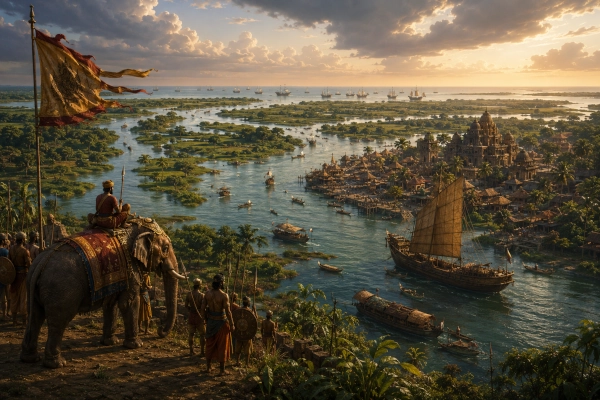
This landscape is fundamentally shaped by the Brahmaputra and its many tributaries. Broad floodplains, river islands, wetlands, forests and surrounding hills created an environment very different from the drier plains of the upper Ganga-Yamuna region. Communication naturally followed the great river and the corridors formed between the valley and the surrounding mountains.
The sixth-century Brihat Samhita, for example, refers to Samatata and Vanga separately. In broad geographical terms, Vanga was associated more strongly with the central and southern Bengal delta, while Samatata became identified particularly with the eastern or trans-Meghna delta.
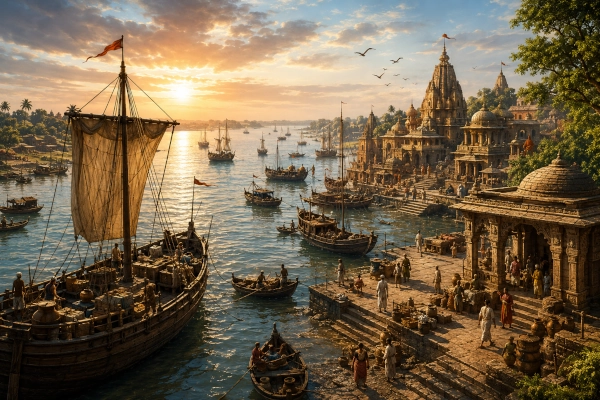
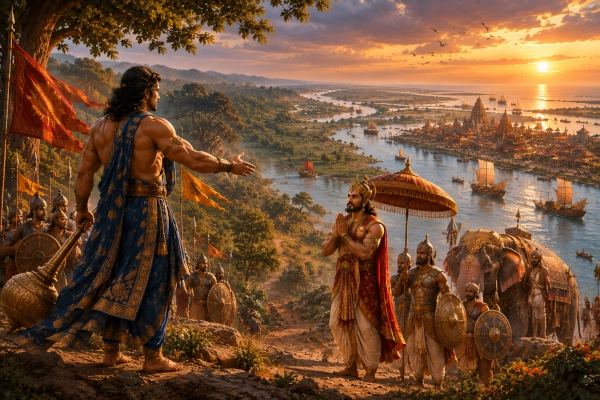
Tamralipta appears prominently during Bhimasena’s eastern campaign in the Sabha Parva. Before Yudhishthira could perform the Rajasuya sacrifice, his brothers were sent in different directions to establish his political supremacy and obtain tribute from surrounding rulers. Bhima was entrusted with the conquest of the east.
The Adi Parva preserves one of the most important genealogical traditions for the ancient east. In the account of the sage Dirghatamas and Queen Sudeshna, five sons are named Anga, Vanga, Kalinga, Pundra and Suhma, and the text explains that five countries subsequently came to bear their names.
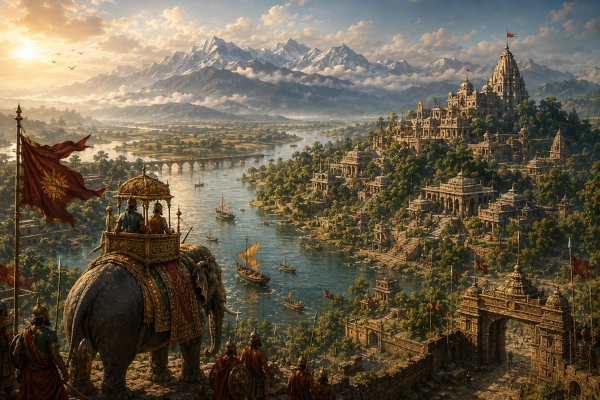
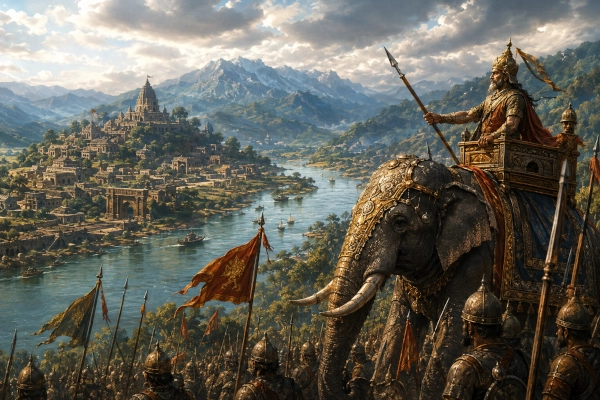
The Mahabharata possesses an extraordinarily detailed knowledge of eastern India. Bhima’s eastern campaign moves through Videha, Magadha, Pundra, Vanga, Suhma and coastal territories, while the Kurukshetra narratives repeatedly mention warriors from Anga, Vanga, Pundra, Kalinga and Tamralipta. The epic also preserves the legendary genealogy in which Anga, Vanga, Kalinga, Pundra and Suhma become the names of five great eastern countries.
The Mahabharata places Pundra firmly within the political geography of eastern India. Pundra repeatedly appears beside kingdoms such as Vanga, Anga, Kalinga, Suhma and Tamralipta, indicating that the epic tradition regarded it as part of a recognisable eastern political and cultural zone rather than as an isolated or vaguely located people.
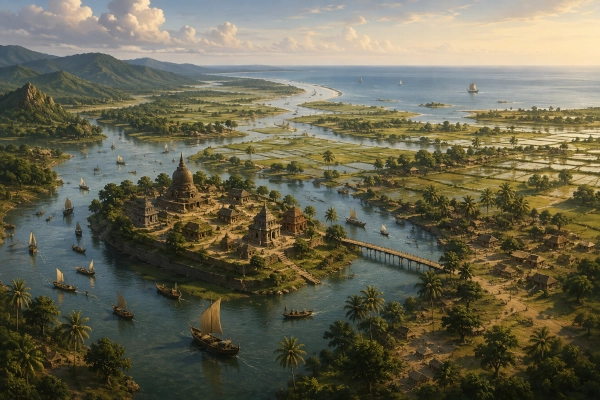
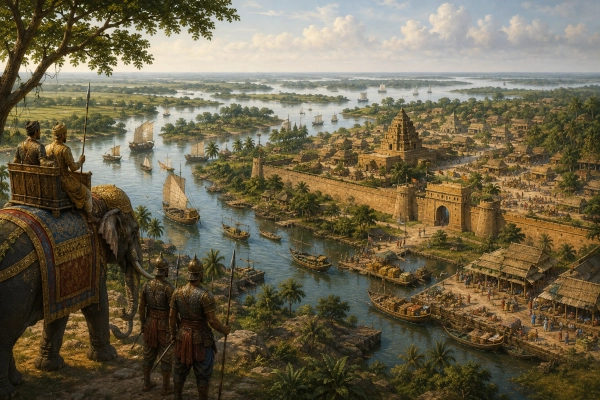
Vanga can be located broadly within central and southern Bengal, spanning territory in modern Bangladesh and adjoining southern West Bengal. Its boundaries changed greatly through time, and it should not be equated with the whole of Bengal. Historical geography places its strongest core broadly between the Bhagirathi system in the west and the Padma-Meghna system in the east, with particularly strong associations with southern and southeastern parts of present Bangladesh and, in earlier periods, portions of southern West Bengal.