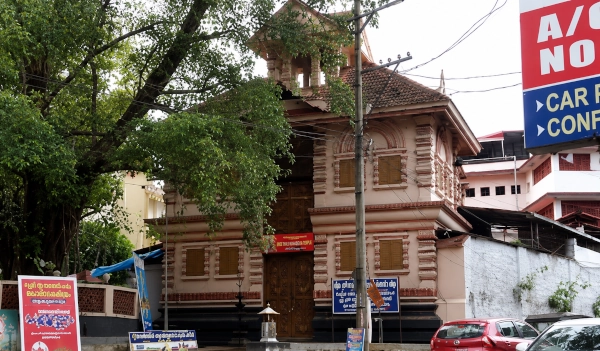
The Tali Sree Mahadeva Temple at Angadipuram is one of the important old Shiva temples of northern Kerala. Situated close to Perinthalmanna in Malappuram district, the shrine forms part of Angadipuram’s ancient sacred landscape, where temples, royal traditions and the historical memory of Valluvanad continue to meet. The temple stands close to the celebrated Thirumandhamkunnu Bhagavathy Temple and can be reached within a few kilometres from central Perinthalmanna. Kerala Tourism describes it as a revered Shiva shrine distinguished by its peaceful atmosphere and spiritual importance.
A Sacred Centre in Historic Angadipuram
Angadipuram occupies a special position in the history of Malabar. It served as the political centre of medieval Valluvanad, whose rulers were known as the Valluvakonathiris or Vellattiris. The town developed around a network of shrines, sacred groves, traditional households and routes connecting the interior of Kerala with the Bharathapuzha region. The Tali Mahadeva Temple belongs to this older religious geography and represents the deep Shaiva tradition that once shaped the spiritual life of Valluvanad.
The word Tali in Kerala’s historical setting commonly refers to an important Shiva temple associated with an established settlement or regional centre. Such temples often became focal points for worship, community gatherings, learning, land administration and cultural activity. The presence of a Tali temple therefore indicates the former importance of Angadipuram as a well-organised religious and social centre.
The Malappuram district administration identifies the Angadipuram shrine as one of the ancient Tali temples traditionally associated with Parashurama. Temple lists vary in the total number they preserve, while the official district account places it among a group of eighteen Tali Shiva temples. This association belongs to Kerala’s sacred geography, in which Parashurama is remembered as the consecrator of numerous ancient Shiva, Bhagavathy and Sastha temples across the land.
The Tradition of the Shiva Linga
Local temple history relates that the sacred place originally centred on a Shiva Linga standing among kanjiram trees. Devotees gradually recognised the site as a powerful place of worship, and ritual activity developed around the Linga. The image of Mahadeva arising within a wooded landscape reflects an ancient pattern of Kerala worship in which sacred trees, natural stones and forest clearings often preceded the construction of formal temple buildings.
The presiding deity is Lord Shiva, worshipped in the form of the Shiva Linga. The shrine presents Mahadeva as the timeless source of creation, preservation and dissolution. For devotees, the Linga represents consciousness beyond physical form, while the surrounding sanctum provides a concentrated space for meditation, prayer and ritual offering.
Lord Ganesha is also worshipped within the temple tradition. His presence is closely connected with the commencement of rituals, removal of obstacles and the successful completion of sacred undertakings.
Traditional Kerala Temple Architecture
The present temple reflects the restrained elegance associated with Kerala’s temple-building tradition. Its sloping tiled roofs are suited to the region’s heavy monsoon rainfall, while the raised base, protected inner spaces and enclosed worship areas create a calm transition from the outer world towards the sanctum.
Wood, laterite, stone, lime and clay tiles traditionally formed the principal materials of temple construction in this part of Kerala. The architectural emphasis rests on proportion, ritual movement and harmony with the surrounding landscape. Instead of monumental height, the structure creates sacred depth through gateways, courtyards, roofed halls and the inward journey towards the Sreekovil.
The atmosphere of the temple remains intimate and contemplative. Lamps, bells, sacred ash, flowers and the fragrance of ritual offerings shape the sensory experience of worship. During the early morning and evening pujas, the sound of mantras and temple bells gives the compound a character rooted in centuries of living devotion.
Worship and Offerings
Daily worship at the temple follows Kerala’s established Tantric and Shaiva traditions. Among the important offerings associated with the shrine are Dhara, Mrityunjaya Archana and Ganapathy Homam.
Dhara involves the continuous ceremonial pouring of sacred water or other prescribed substances over the Shiva Linga. The flowing offering represents purity, serenity and the cooling of worldly agitation. Devotees commonly perform it while praying for peace of mind, health and relief from personal difficulties.
Mrityunjaya Archana invokes Shiva through the sacred Mrityunjaya tradition. The prayer honours Mahadeva as the conqueror of death and the giver of inner strength. Families frequently seek this worship during periods of illness, uncertainty or anxiety.
Ganapathy Homam is performed in honour of Lord Ganesha. It is associated with auspicious beginnings, clarity and the removal of obstacles. The ritual may be offered before important family ceremonies, journeys, educational pursuits or new ventures.
These forms of worship keep the temple connected with the everyday lives of devotees. Mahadeva is approached here as the lord of cosmic time and also as the compassionate presence who receives the personal prayers of individuals and families.
Festivals and Sacred Days
Mahashivaratri is one of the principal observances at the Angadipuram Tali Temple. Devotees gather for special pujas, abhishekas, chanting and night-long worship dedicated to Shiva. The festival encourages fasting, wakefulness and contemplation of Mahadeva as the light of consciousness within all beings.
The temple also observes its annual Pratishta festival during the Malayalam month of Medam, associated with Vishu. Special rituals mark the consecrated presence of the deity and renew the spiritual bond between the temple, its devotees and the surrounding community.
Vishu carries particular importance in Kerala as a time of auspicious beginnings. Its association with the temple’s Pratishta observance brings together the themes of renewal, divine vision and the continuity of sacred tradition.
The Twentieth-Century Restoration Movement
The modern history of the temple is closely connected with a restoration movement led by the Gandhian leader K. Kelappan in 1968. The campaign focused on the revival and renovation of the ancient shrine. Temple-history records place a major phase of the movement on November 16, 1968, and connect it with the formation of the Malabar Kshetra Samrakshana Samithi on November 25 of that year.
The episode gave the temple an importance extending beyond Angadipuram. It became associated with the wider effort to identify, restore and sustain neglected temples throughout northern Kerala. The movement also demonstrated how local devotees, social workers and cultural organisations could participate in preserving sacred heritage.
November 25 is observed in the temple tradition as Aradhana Swathanthryam Day, commemorating the restoration movement and the determination of devotees to continue worship at the ancient site.
Relationship with Thirumandhamkunnu
The proximity of Tali Mahadeva Temple to Thirumandhamkunnu Bhagavathy Temple gives Angadipuram an especially rich sacred character. The district administration places the Tali shrine only a short distance from Thirumandhamkunnu. Together, the two temples embody the complementary worship of Shiva and Shakti.
Thirumandhamkunnu is closely connected with the Valluvanad rulers and their tutelary goddess, while the Tali temple represents the region’s ancient Shaiva foundation. A pilgrimage to Angadipuram therefore provides an opportunity to experience two distinct yet closely related strands of Kerala’s temple tradition.
A Living Monument of Malabar
The significance of Angadipuram Tali Sree Mahadeva Temple rests in its continuity. It preserves an ancient place of Shiva worship, the sacred geography of the Tali tradition, the historical world of Valluvanad and the memory of a major twentieth-century restoration movement.
Its importance emerges through the daily flame of the temple lamp, the water flowing over the Shiva Linga during Dhara, the chanting of the Mrityunjaya mantra and the arrival of devotees during Mahashivaratri and Vishu. These practices transform the temple from a surviving historical structure into a living centre of faith.
Within the busy surroundings of modern Angadipuram and Perinthalmanna, the temple offers a quieter vision of Malabar—one shaped by sacred trees, tiled roofs, ancient ritual, community memory and enduring devotion to Mahadeva.
References
Kerala Tourism. “Thali Temple at Angadipuram, Perinthalmanna, Malappuram.” Department of Tourism, Government of Kerala.
https://www.keralatourism.org/destination/thali-temple-malappuram/518/
Malappuram District Administration. “Places of Interest.” Government of Kerala.
https://malappuram.nic.in/en/places-of-interest/
Kerala Temples. “Tali Sree Mahadeva Temple, Angadipuram.” Details on the temple’s principal deity, local traditions, festivals, offerings and the 1968 restoration movement.
https://keralatemples.info/temple-details/tali-sree-mahadeva-temple
Kerala Tourism. “Thirumandhamkunnu Temple at Angadipuram.” Department of Tourism, Government of Kerala.
https://www.keralatourism.org/destination/thirumandhamkunnu-temple-angadipuram/28/
“Angadipuram.” Background information on the historic Valluvanad centre and the sacred geography of Angadipuram.
https://en.wikipedia.org/wiki/Angadipuram
Last Updated: 16 July 2026.
You may also like
-
Kishkindha — The Boulder Kingdom of Pampa, Rishyamukha and the Tungabhadra
-
Setu — The Sacred Southern Crossing Between Rameswaram and Lanka
-
One Voice – One Resolve – One India: Namami Bharatam Marks 150 Years of Vande Mataram Across the Nation
-
Dravida — The Ancient Tamil Country of Rivers, Temples and the Southern Ocean
-
Pandya — The Southern Kingdom of the Vaigai, Tamiraparani and the Pearl-Rich Sea
