Covid Vaccine Doses Administered in India Surpass 1.5 Billion-Mark
India hit a critical milestone in its COVID-19 vaccination programme, when the total number of vaccine doses provided in the country surpassed 150 million.
News and Articles on Ayurveda, Yoga, Kundalini and other Indian way of health and medicines.
India hit a critical milestone in its COVID-19 vaccination programme, when the total number of vaccine doses provided in the country surpassed 150 million.
In the new study, a team of researchers led by Prof. Sunit K. Singh, Professor of Molecular Immunology & Virology at the Molecular Biology Unit at BHU’s Institute of Medical Sciences, has found that the virus interacts with a set of cells called microglial cells, which protect the brain from infections and that a protein in the virus called ZIKV-NS1 plays an important role in its replication and immune evasion.
According to provisional statistics, India’s COVID-19 vaccination coverage has crossed 146.70 Cr (146,70,18,464) in the previous 24 hours, with close to 1 Cr Doses (99,27,797) vaccine doses administered. This was accomplished after 1,57,38,732 sessions.
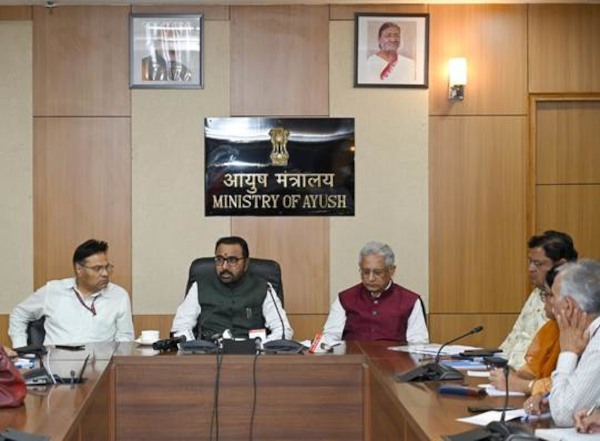
Promoting nutritional diet and a healthy living, the Ministry of Ayush made a new beginning on Monday by making ‘Ayush Aahaar’ available at its canteen at Ayush Bhawan.
The world’s first DNA vaccine will be administered using a needle-free applicator called “PharmaJet”, as opposed to the traditional syringes. A needle-free applicator ensures painless intradermal vaccine delivery, which also leads to a significant reduction in any kind of major side effects.
The Prime Minister announced that from 3rd January 2022, Monday, vaccination will start for the children in the age group of 15-18 years. The move is likely to aid in education normalization in schools and will reduce the worry of the parents with school going children. He also announced precaution dose for healthcare and frontline workers from 10th January 2022, Monday.
In a significant development, India has been able to isolate and grow highly transmissible Omicron variant of the Covid-19 virus in a laboratory setting.
Sickle cell anaemia (SCA) is a common genetic disorder among Indians affecting the red blood cells. It is transmitted by parents who carry a defective beta globin gene without suffering themselves. Close to 0.4 per cent of the population suffers from the disease while 10 per cent people are carriers who lead to birth of new SCA patients.
A new study has paved the way to help brain- and neuro-specialists plan patient-specific restorative neuro-rehabilitation activities for stroke, post-traumatic brain injury, mild cognitive impairment, dementia, and other neuropsychiatric disorders.
In the new study, researchers at IIT-Indore have synthesised a nanocomposite that was found to be quite effective in reaching inaccessible sites, overcoming physiological barriers, maintaining the concentration of drugs, and reducing cellular toxicity. The composite was formulated by loading bioactive compound Piperine onto a co-polymer called PLGA. Piperine, which is derived from the commonly used Black Pepper, has several therapeutic properties such as anti-inflammatory, anti-oxidant, anti-microbial, anti-fungal, anti-depressant, anti-angiogenic & anti-apoptotic, besides imparting a distinctive aroma and taste to cuisines.