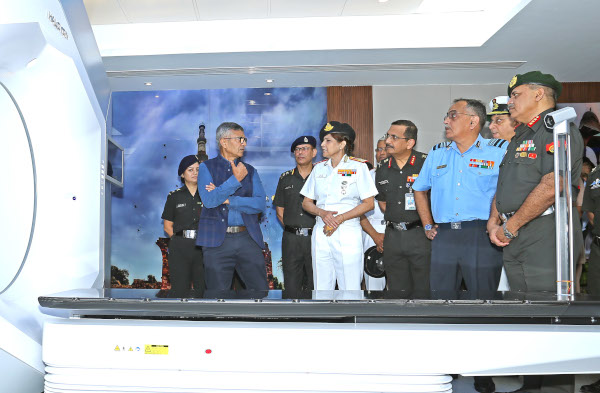
Army Hospital (Research & Referral), Delhi has added a major new capability to its cancer treatment infrastructure with the commissioning of a Ring Gantry-based Linear Accelerator in its Department of Radiation Oncology. The system was inaugurated on 25 May 2026 in the presence of Defence Secretary Shri Rajesh Kumar Singh, marking an important upgrade in advanced radiotherapy services under the Armed Forces Medical Services.
The new equipment is designed to improve access to modern cancer treatment for serving personnel, veterans and their dependents. Army Hospital R&R handles a significant patient load, and the induction of this technology is expected to expand in-house treatment capacity, reduce dependence on external facilities, and provide more advanced care within the military medical system itself.
A linear accelerator, commonly called a LINAC, is one of the most important machines used in external beam radiation therapy. It delivers high-energy radiation to cancerous tissue with the aim of destroying tumour cells while protecting nearby healthy tissue as much as possible. Modern LINAC systems allow doctors, physicists and radiation therapy teams to shape and control the radiation beam according to the patient’s tumour location, size and treatment plan.
The Ring Gantry-based Linear Accelerator commissioned at Army Hospital R&R can deliver several advanced radiotherapy techniques, including Volumetric Modulated Arc Therapy, Intensity-Modulated Radiation Therapy, Image-Guided Radiation Therapy, Stereotactic Body Radiation Therapy and Stereotactic Radiosurgery. These techniques help radiation oncologists target tumours with greater precision while reducing exposure to surrounding normal tissues.
This precision matters deeply in cancer care. Many tumours are located close to critical organs, nerves, blood vessels or sensitive structures. Advanced radiotherapy systems allow clinicians to deliver the required dose more accurately to the tumour region, while carefully managing the dose received by healthy tissue. Intensity-modulated radiation therapy, for example, adjusts radiation intensity across treatment areas, helping doctors shape dose delivery around complex tumour sites.
The availability of stereotactic techniques also gives the hospital a stronger platform for treating selected cases that require highly focused radiation. Stereotactic body radiation therapy is used for small, isolated tumours outside the brain and spinal cord, while stereotactic radiosurgery is used for certain brain and nervous system conditions through highly precise radiation delivery. These methods represent a more refined approach to radiation oncology, especially where accuracy is central to patient safety and treatment outcome.
For the Armed Forces Medical Services, the commissioning of this LINAC is also a modernisation step. PIB stated that the new procurement represents a substantial upgrade over the earlier equipment, which has since been decommissioned. The development also fits into a wider phased effort to upgrade other oncology centres under AFMS, indicating that cancer care modernisation is being pursued as a system-wide priority rather than a single-hospital improvement.
The significance of this induction goes beyond the machine itself. Military hospitals serve a distinct community that includes active-duty personnel, retired soldiers, families and dependents spread across the country. For many such patients, timely access to advanced treatment within the trusted military healthcare network can make the cancer care journey more organised, less fragmented and more reassuring.
Army Hospital R&R has long been one of India’s premier military medical institutions, and the addition of advanced radiotherapy technology strengthens its role as a high-end referral centre. Cancer treatment demands coordination between multiple specialists, including radiation oncologists, medical physicists, dosimetrists, technologists, surgeons, medical oncologists and nursing teams. A modern LINAC improves the technical backbone available to this entire clinical ecosystem.
The commissioning ceremony was attended by DG AFMS Surgeon Vice Admiral Arti Sarin, Commandant Army Hospital R&R Lieutenant General Avinash Das, and other senior officials. Their presence underlined the institutional importance attached to oncology modernisation within the defence medical framework.
With this induction, Army Hospital R&R has taken a meaningful step towards more precise, technology-enabled cancer care. The new Ring Gantry-based Linear Accelerator will help the hospital deliver advanced radiotherapy services to a larger number of eligible patients, while supporting the broader goal of strengthening specialised healthcare for India’s armed forces community.
You may also like
-
PRAHAAR: India’s First National Counter-Terrorism Policy and Strategy
-
Takshak Heavyweight Torpedo: How India’s Indigenous Submarine Weapon Compares With the World’s Leading Torpedoes
-
Embraer Builds Dual Aerospace Strategy in India Through C-390 Military and E175 Regional Aircraft Programmes
-
NextLeap Tests Indigenous Jet Engine for Long-Range Stryker Kamikaze UAV
-
Côte d’Ivoire Military Delegation Visits HAL, Shows Interest in India’s Indigenous Aerospace Platforms
