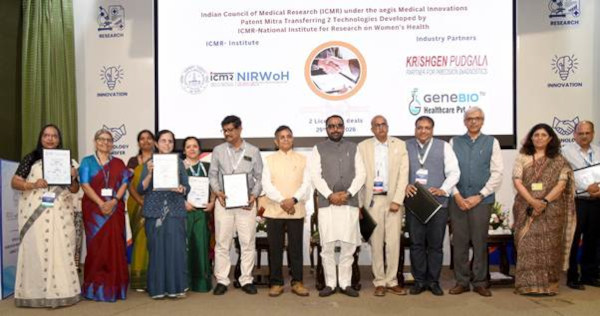
India’s biomedical research ecosystem received a major push with the Indian Council of Medical Research organising “Medical Innovations Patent Mitra: Innovators-to-Industry Connect” in New Delhi. The event, held at the Manekshaw Centre, was described by PIB as India’s largest biomedical innovation and technology transfer facilitation event. It brought together researchers, innovators, startups and industry partners with the aim of moving Indian medical technologies from laboratories into real-world healthcare use.
The initiative is important because India has often produced strong scientific research, but the journey from invention to commercial product has usually required deeper industry participation, intellectual property support and manufacturing scale. The ICMR Medical Innovation Patent Mitra platform has been designed to address this exact gap. Its purpose is to help promising biomedical ideas move through patent protection, technology transfer, industrial development and eventual deployment for public health.
The event was inaugurated by Shri Prataprao Ganpatrao Jadhav, Union Minister of State with Independent Charge of the Ministry of Ayush and Minister of State in the Ministry of Health and Family Welfare. Speaking at the event, he said the initiative connects Indian science with industry and supports the larger goal of Viksit Bharat by turning laboratory innovations into technologies that strengthen public health.
A major highlight was the transfer of 41 public health technologies from ICMR institutes and innovators to industry partners for further development, manufacturing and commercialisation. These technologies cover key areas such as diagnostics, vaccines, medical devices and biomedical solutions linked to major public health needs. This makes the initiative more than a conference; it becomes a practical bridge between publicly funded research and industrial production.
Among the technologies transferred were glycoconjugate and recombinant vaccines for Typhoid and Paratyphoid, along with diagnostic technologies for diseases such as Japanese Encephalitis, Tuberculosis and Mpox. These areas are especially significant for a country like India, where affordable diagnostics and vaccines can directly influence disease surveillance, outbreak control and access to timely treatment.
Another important development was the first-ever transfer of well-characterised biomaterials, including inactivated Kyasanur Forest Disease and Chandipura virus biomaterials, to industry partners. This step can support vaccine research, diagnostic development and biomedical manufacturing capacity. By giving industry access to validated research materials through a structured route, India can strengthen its preparedness for infectious diseases and reduce dependence on external technology pipelines.
The event also saw the release of the Indian Biomedical Patent Landscape Report and a Technology Compendium. These documents are expected to support a more organised innovation ecosystem by mapping intellectual property, identifying technology opportunities and giving industry a clearer view of available biomedical solutions. For startups and manufacturers, such a compendium can act as a catalogue of research-ready opportunities.
More than 100 technologies in diagnostics, therapeutics and medical devices were showcased during the event. These innovations came from ICMR institutes, researchers and startups, showing that India’s biomedical ecosystem is expanding across multiple layers: public institutions, young enterprises, scientific teams and private manufacturers. The direct engagement between innovators and industry stakeholders was central to the programme’s design.
Dr. Gobardhan Das, Member, NITI Aayog, said India has the scientific capability and innovation ecosystem to become a global leader in health technologies. His remarks underline a broader national ambition: India wants to move beyond being a large healthcare market and become a source of affordable, scalable and exportable medical technologies.
Dr. Rajiv Bahl, Director General of ICMR and Secretary, Department of Health Research, described Medical Innovations Patent Mitra as a mechanism to ensure that advanced research reaches people through strong industry partnerships and meaningful technology transfer. This is the heart of the initiative. Biomedical research has maximum public value when it leads to accessible tests, reliable devices, effective vaccines and practical treatment solutions.
The Innovators-to-Industry Connect platform can therefore become a key instrument in India’s health technology strategy. It supports public-private partnership, strengthens intellectual property use, encourages domestic manufacturing and gives Indian medical science a clearer commercial pathway. For Viksit Bharat 2047, this kind of platform can help create a healthcare innovation system where Indian research serves Indian patients first and then reaches global markets.
You may also like
-
EON Space Labs and Dhruva Space Advance Indian Space Hardware on Transporter-18 Mission
-
SatLeo Labs’ TAPAS-1 Reaches Orbit, Advancing India’s Private Thermal-Imaging Capability
-
TakeMe2Space’s MOI-1A Reaches Space on Falcon 9 Transporter-18 Mission
-
Bank of Baroda Enters Pension Fund Management After PFRDA Appointment
-
SCI and India’s Push for a Larger Indigenous Maritime Fleet
