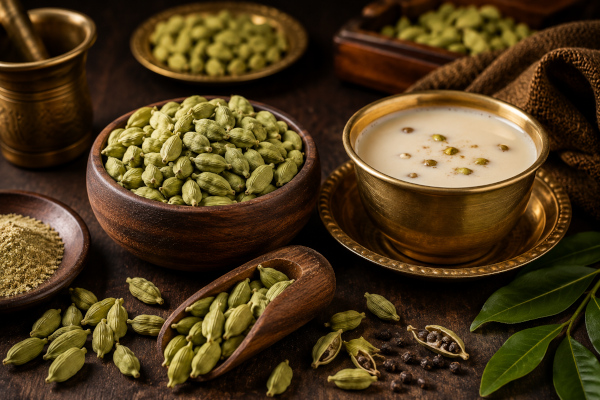
Cardamom, or elaichi, is one of those tiny Indian kitchen treasures that proves Ayurveda’s deepest food wisdom: medicine does not always arrive as a bitter decoction or a complicated prescription. Sometimes it enters the body through a cup of chai, a spoon of payasam, a bowl of biryani, a festive laddu, or warm milk after dinner. In Ayurveda, small cardamom is known as Ela or Sukshmaila, and the official Ayurvedic Pharmacopoeia identifies it as the seeds of the dried fruits of Elettaria cardamomum, a plant of the ginger family, Zingiberaceae.
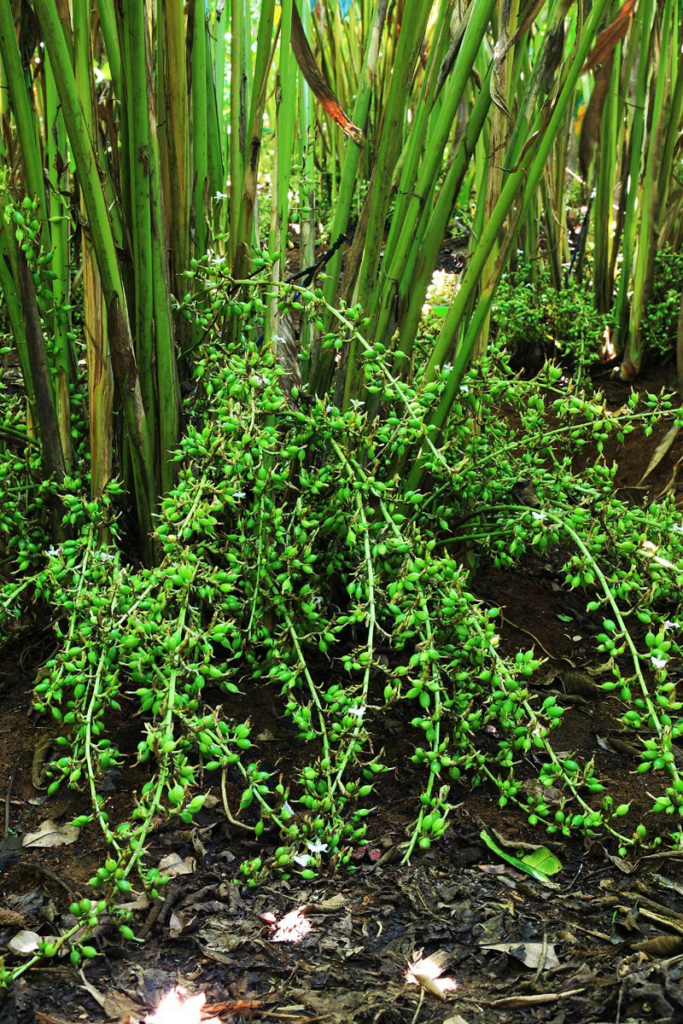
Cardamom is rightly called the Queen of Spices. The Spices Board of India describes small cardamom as the dried ripe fruit capsule of the cardamom plant, valued for its pleasant aroma and taste, and widely used in food, beverages, perfumery, health foods and Ayurvedic medicines. Its cultivation is strongly associated with the evergreen forests of the Western Ghats in South India, making it one of India’s most elegant contributions to global spice culture.
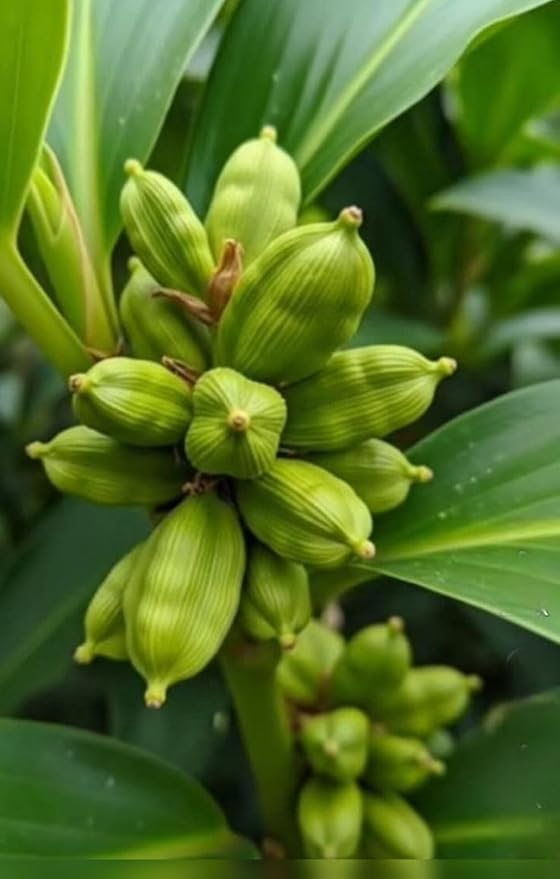
The first lesson of cardamom is identification. True small cardamom comes as a greenish, pale-buff or yellowish capsule, usually around 1–2 cm long, three-sided and lightly striated. Inside the pod are rows of dark brown to black aromatic seeds.
These seeds carry the real strength of elaichi — the fragrance, the oil, the digestive warmth and the cooling sweetness that make it so special in Ayurveda.
In Ayurvedic language, cardamom has Katu and Madhura Rasa — pungent and sweet taste. Its Guna is Laghu, meaning light. Its Virya is Shita, meaning cooling in potency, and its Vipaka is Madhura, meaning sweet in post-digestive effect. This makes cardamom very different from many other sharp spices. It awakens digestion while retaining a soothing, pleasant and cooling personality. It can brighten food without making the body feel harshly heated.
Ayurveda describes cardamom’s actions as Rochana, Dipana, Anulomana, Hrdya and Mutrala. In simple language, it improves taste and appetite, supports digestive fire, helps the proper downward movement of vata, pleases the heart and supports urinary function. That is why elaichi occupies a special place in Indian cooking: it is aromatic enough for royal sweets, gentle enough for daily chai, and medicinal enough to appear in classical Ayurvedic formulations.
Its most familiar role is in digestion. Cardamom is the spice that brings lightness after richness. A few crushed pods in milk, kheer, halwa, tea or rice dishes help balance heaviness and give the meal a clean aromatic finish. In Ayurveda, this is the meaning of Rochana and Dipana in everyday life. Elaichi wakes up the tongue, invites appetite, freshens the mouth and helps the stomach receive food with more comfort.
This is why Indian homes often use cardamom after meals. Chewing one pod after lunch or dinner is more than a breath-freshening habit. The aromatic seeds stimulate salivation, refresh the palate and gently support digestion. In a culture where food is layered with ghee, milk, grains, lentils and spices, cardamom acts like a fragrant finishing note — it closes the meal gracefully and helps the body move from eating to digesting.
Cardamom is also one of Ayurveda’s most elegant respiratory spices. The Ayurvedic Pharmacopoeia lists Kasa and Shvasa among the therapeutic uses of Sukshmaila, terms associated with cough and breathing difficulty in Ayurvedic clinical language. This explains why elaichi appears in many traditional home combinations for throat comfort, especially when paired with warming companions such as ginger, long pepper, cinnamon or honey in lukewarm preparations.
Its inclusion in classical formulations confirms its medicinal importance. The Ayurvedic Pharmacopoeia lists Eladi Modaka, Eladi Churna and Sitopaladi Churna among important formulations containing cardamom. Sitopaladi Churna, one of the best-known Ayurvedic powders for respiratory and digestive support, traditionally includes ingredients such as sugar candy, bamboo manna, long pepper, cardamom and cinnamon in a structured formulation.
The genius of cardamom lies in its dual nature. It is a spice, but it does not behave aggressively. It is pungent, yet cooling. It is aromatic, yet gentle. It lifts kapha-like heaviness from food, helps vata move more comfortably through the gut, and remains pleasant for pitta when used in moderate culinary quantities. This is why elaichi works beautifully in milk sweets, spiced teas, fruit preparations, rice dishes and festive foods.
In the Indian “food is medicine” tradition, elaichi milk is one of the simplest uses. One or two lightly crushed pods can be simmered in a cup of milk, preferably with a little turmeric or a pinch of nutmeg depending on the season and constitution. This drink becomes especially suitable after a heavy dinner or during cool evenings, when the body wants comfort without excess heaviness. The milk nourishes; cardamom makes it fragrant, lighter and easier to enjoy.
For digestive freshness, a simple household mix can be made with cardamom seeds, fennel and a little mishri. This can be kept in a small jar and used after meals. Fennel cools and sweetens the mouth, cardamom adds aromatic sharpness, and mishri gives a gentle traditional sweetness. This is the kind of kitchen medicine Ayurveda celebrates — small, practical, pleasant and woven into daily life.
For cooking, whole pods are usually better than pre-ground powder. Cardamom loses aroma quickly once powdered, because its strength lives in volatile oil. The Ayurvedic Pharmacopoeia specifies essential oil as one of the constituents of Sukshmaila and sets a standard of volatile oil content for the drug. The Spices Board also notes cardamom oil and oleoresin as important ingredients in processed foods, beverages, perfumery and Ayurvedic medicines.
Modern research has also begun exploring cardamom through scientific frameworks. Reviews have examined its possible effects in areas such as metabolic health, inflammation, lipid profile, blood sugar regulation and antioxidant activity, while laboratory studies have investigated antimicrobial and other bioactive properties of Elettaria cardamomum. These findings are best understood as supportive research directions rather than a replacement for clinical treatment.
Cardamom also has a strong cultural personality. It moves easily between temple prasadam, household remedies, royal kitchens and global beverages. In India, it perfumes payasam, laddu, kesari, biryani, pulao, masala chai and paan. In the Middle East, it famously enters cardamom coffee or gahwa, and the Spices Board notes that Indian cardamom has long enjoyed preference in Middle Eastern markets for this use.
A good home should treat elaichi with respect. Choose pods that are green, fragrant and heavy for their size. Store them whole in an airtight container away from heat, sunlight and moisture. Crush only when needed. The moment the pod opens, its fragrance begins to escape; the best cardamom is the one that releases its perfume just before it enters the food.
In daily use, a little is enough. One or two pods can flavour a cup of tea or milk. A few pods can perfume a pot of rice or kheer. A pinch of fresh powder can lift sweets, fruit bowls or herbal drinks. Ayurveda gives a formal powder dose of 250–500 mg for Sukshmaila, which shows how concentrated this spice is in medicinal form. Therapeutic use, especially in higher doses or as part of classical formulations, belongs under the guidance of a qualified Ayurvedic physician.
Cardamom’s beauty is that it makes wellness feel graceful. It does not demand attention like chilli, dominate like clove, or burn like strong pepper. It works through fragrance, subtle sweetness and digestive intelligence. It reminds us that Indian cuisine was never built only for taste; it was built for balance. Every spice had a job, every aroma had a purpose, and every meal carried a hidden medical grammar.
In that sense, elaichi is one of the finest symbols of India’s food-as-medicine civilisation. It turns milk into comfort, sweets into digestible joy, tea into therapy, and festive food into something lighter on the body. Small in size and royal in fragrance, cardamom shows the Ayurvedic kitchen at its best — where healing does not stand outside food, but quietly blooms inside it.
You may also like
-
Ayurveda on Fresh Food Versus Reheated Food: Why Freshly Prepared Meals Are Preferred for Healthy Digestion
-
Ayurveda on Cold Foods and Iced Drinks: Why Food Temperature Matters for Digestion
-
Serum Institute of India-Manufactured Ebola Vaccine Enters Clinical Trial in Uganda
-
Ayurveda and Hydration: How Much Water Should We Really Drink?
-
Warm Water in Ayurveda: When and Why It Is Recommended
