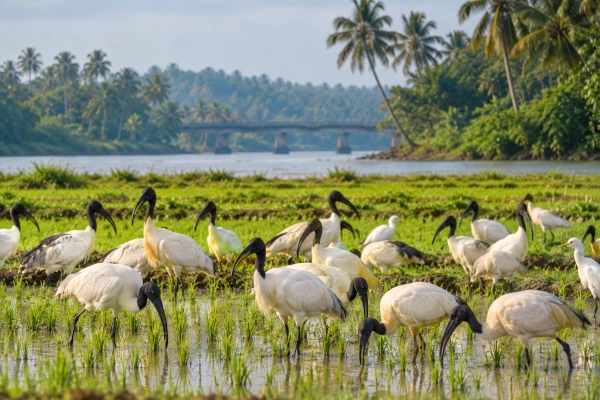
The Pallar paddy fields at Tirunavaya in Kerala’s Malappuram district have turned into a striking gathering place for black-headed ibises, with large numbers of the distinctive white-and-black waterbirds descending on the agricultural wetlands as farmers prepare the fields for the coming paddy season.
The congregation is more than a seasonal spectacle. Tirunavaya has emerged over recent years as an important feeding and breeding landscape for several waterbird species, demonstrating how Kerala’s traditional paddy fields and associated wetlands can function simultaneously as productive agricultural land and valuable wildlife habitat.
The black-headed ibis (Threskiornis melanocephalus) is particularly conspicuous. Standing on long dark legs, the bird has predominantly white plumage contrasted by a bare black head and neck and a long, downward-curving black bill adapted for probing shallow water and soft mud for food.
Large numbers are now feeding across the Pallar fields, creating an unusual sight against the green and waterlogged agricultural landscape of Tirunavaya.
Ploughing Paddy Fields Creates a Feeding Ground
The timing of the congregation is closely connected with farming activity.
Fields in the area are being ploughed and prepared for the coming paddy cultivation season. Turning the wet soil exposes small aquatic animals and other organisms that would otherwise remain hidden beneath the mud.
Black-headed ibises take advantage of precisely these conditions.
The birds normally forage in shallow wetlands, marshes, flooded agricultural fields and other waterlogged environments. They walk slowly through the water or mud, probing below the surface with their long curved bills in search of prey.
Their diet can include insects and their larvae, worms, molluscs, crustaceans, frogs and other small aquatic organisms.
A freshly disturbed paddy field can therefore temporarily become an abundant feeding area. Agricultural activity that prepares the land for cultivation simultaneously creates opportunities for waterbirds searching for food.
At Tirunavaya, this relationship between farming and birdlife is now visible on a particularly impressive scale.
Black-Headed Ibis Has Become More Familiar in Kerala
The presence of the species in Kerala also has an interesting recent history.
Wetland researcher Binu Chullakkattil has noted that black-headed ibis sightings were relatively uncommon in Kerala until the early years of this century. Records subsequently became more frequent, particularly from around 2012 onwards.
The birds are now observed more regularly in suitable wetland landscapes in the state.
Tirunavaya has become particularly noteworthy because the birds are not merely visiting the area to feed.
Nesting by black-headed ibises was documented at Tirunavaya in 2022. Continued observations subsequently showed that the birds were establishing a more substantial breeding presence in the landscape.
By 2024, researchers had recorded more than 50 nests in the area.
The progression from occasional sightings to feeding congregations and documented nesting makes Tirunavaya important for understanding the species’ developing presence in Kerala.
Tirunavaya Is Also a Breeding Landscape
Scientific observations support the importance of the Tirunavaya wetlands for the species.
Research published in the Journal of Threatened Taxa has identified Thirunavaya among documented breeding locations of the black-headed ibis in Kerala.
Breeding sites are particularly significant because they indicate that a wetland is providing more than temporary feeding opportunities. Birds establishing nests require suitable nesting trees or vegetation, access to dependable feeding areas and environmental conditions that allow them to raise their young.
The surrounding agricultural wetlands can become an important part of that system.
Adult birds may nest at one location while travelling into nearby paddy fields, marshes, ponds and shallow wetlands to obtain food. A landscape containing several interconnected habitats can therefore support considerably more birdlife than any individual field or pond viewed in isolation.
This makes the wider Tirunavaya wetland-agricultural mosaic particularly interesting.
Paddy Fields Can Be Wildlife Habitat
Paddy cultivation is often considered purely in terms of agriculture, but traditional rice-growing landscapes can also function as seasonal wetlands.
When fields are flooded, they create shallow aquatic habitats capable of supporting insects, molluscs, amphibians, small fish and other organisms. These in turn attract waterbirds.
The habitat changes repeatedly during the agricultural cycle. Ploughing exposes organisms in the soil, flooding creates shallow-water feeding grounds, growing rice provides vegetation and cover, and post-harvest fields can offer another set of feeding opportunities.
Birds have adapted to exploit these changing conditions.
The black-headed ibis congregation at Pallar therefore illustrates an ecological relationship that occurs across many traditional agricultural landscapes: farmland and wildlife habitat do not necessarily exist as completely separate spaces.
Where hydrology and traditional land-use patterns remain favourable, cultivated wetlands can become important components of larger ecosystems.
Tirunavaya Supports a Much Wider Bird Community
The black-headed ibis is only one member of the waterbird community using the Tirunavaya landscape.
Painted storks, glossy ibises, Asian openbills, spoonbills, herons, egrets, cormorants, moorhens and jacanas are among the birds reported from the area’s wetlands and agricultural fields.
The diversity reflects the range of feeding opportunities available across shallow water, exposed mud, vegetation and flooded fields.
Different species exploit different parts of this environment. Long-legged waders search through shallow water, jacanas move across floating vegetation, cormorants pursue aquatic prey, while storks and ibises forage across wet fields and marshes.
Tirunavaya has also attracted attention for its breeding waterbirds. Researchers have reported a substantial spoonbill nesting colony in the wider area, adding another dimension to its ecological importance.
The landscape therefore functions as much more than a temporary stopping point for a single species.
A Bird With an Extensive Asian Range
The black-headed ibis occurs across parts of South and Southeast Asia.
India supports an important portion of its range, and the species can be encountered in freshwater marshes, lakes, riversides, flooded fields, reservoirs, coastal wetlands and other shallow-water habitats.
Unlike many familiar birds, the black-headed ibis does not have feathers covering its head and upper neck. The exposed dark skin gives the species its characteristic appearance and provides the contrast responsible for its common name.
Its long decurved bill is another adaptation to its feeding strategy. Rather than depending entirely on eyesight to locate prey, the bird can probe through mud and shallow water while searching for organisms below the surface.
The International Union for Conservation of Nature currently classifies the species as Least Concern. This means the black-headed ibis is not presently considered globally threatened with extinction.
That classification does not make individual wetland habitats unimportant. Local populations still depend on suitable feeding and breeding areas, and changes in wetland conditions can alter where birds are able to congregate or reproduce successfully.
Why Agricultural Wetlands Matter
The scenes at Pallar also draw attention to the ecological importance of wet agricultural landscapes at a time when many traditional wetlands face pressure from changes in land use.
A paddy field that appears empty during one part of the year may become a feeding ground for hundreds of birds when it is flooded or ploughed. A nearby cluster of trees can provide nesting habitat, while ponds, marshes and canals create additional feeding areas.
Remove enough of these individual components and the ecological value of the wider landscape can diminish.
Maintaining wetland hydrology, avoiding unnecessary disturbance around active nesting colonies and reducing contamination of agricultural water systems can therefore benefit wildlife without necessarily removing the land from productive agricultural use.
Tirunavaya provides a particularly visible example of this coexistence.
Farmers preparing the Pallar fields are continuing an agricultural cycle that has shaped the landscape for generations. Black-headed ibises are responding to the ecological opportunities created by that same cycle.
A Seasonal Spectacle With a Larger Story
For visitors, the immediate attraction is the sight of large numbers of black-headed ibises scattered across Tirunavaya’s fields.
Behind that spectacle, however, is a larger ecological story.
The birds are using an actively cultivated landscape. Their food is being made accessible partly through agricultural activity. The species has become increasingly visible in Kerala over recent years, and Tirunavaya has progressed from a feeding area to a documented breeding location.
Alongside the ibis are storks, spoonbills, herons, cormorants and numerous other wetland birds that depend on the same interconnected landscape.
The congregation at Pallar consequently demonstrates something easily overlooked in discussions about wildlife conservation. Important habitats are not always remote forests or formally protected sanctuaries.
Sometimes they are working landscapes where people and wildlife have found ways to use the same environment.
At Tirunavaya, the ordinary rhythm of preparing Kerala’s paddy fields has once again transformed the landscape into a spectacular seasonal gathering place for waterbirds.
References
Mirror Now — Black-Headed Ibis Flocks Arrive in Tirunavaya Pallar Fields
https://www.mirrornow.in/kerala-news/rare-black-headed-ibis-flocks-arrive-in-tirunavaya-pallar-fields-article-156171890
Journal of Threatened Taxa — Research on Black-Headed Ibis Breeding in Kerala
https://threatenedtaxa.org/index.php/JoTT/article/download/10458/10840/75490?inline=1
BirdLife International / IUCN — Threskiornis melanocephalus
https://www.iucnredlist.org
You may also like
-
Karnataka’s Tiger Population Could Cross 700 as New Census Builds on Official Count of 563
-
Project Cheetah Expands as Veerangana Durgavati Tiger Reserve Becomes Madhya Pradesh’s Third Cheetah Habitat
-
Kashmir Markhor Population Rises to 227 as Kazinag Conservation Efforts Show Results
-
ICAR-CIFRI Pushes Conservation of Indigenous Himalayan Fish for Biodiversity and Livelihood Security
-
Indian-Born Cheetah KJP21 Gives Birth to Five Cubs at Kuno, India’s Cheetah Population Reaches 60
