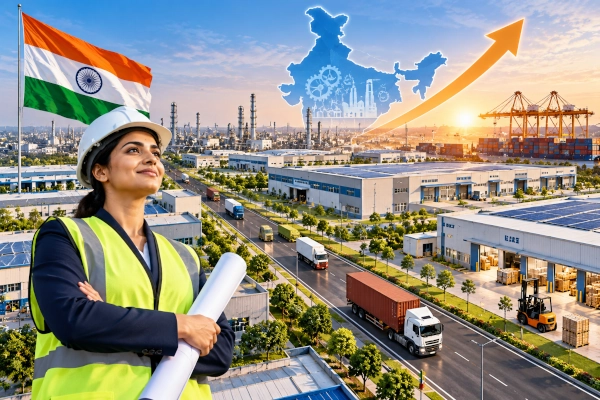
India is taking a major step towards strengthening its manufacturing ecosystem through the Bharat Audyogik Vikas Yojna (BHAVYA), an ambitious industrial infrastructure development scheme that aims to establish 100 plug-and-play industrial parks across the country. With an approved financial outlay of ₹33,660 crore, the initiative seeks to provide manufacturers with ready-to-use industrial infrastructure, reliable utilities, modern logistics facilities and streamlined regulatory processes.
The Union Cabinet approved the BHAVYA scheme in March 2026, followed by its notification on April 10, 2026. The programme will be implemented over six years, from financial year 2026–27 to 2031–32, in partnership with state governments and private developers.
The scheme is designed to address one of the persistent challenges confronting industrial investors: the time and expenditure required to acquire suitable land, develop infrastructure, obtain necessary approvals and establish manufacturing operations.
By creating integrated industrial parks equipped with essential facilities, BHAVYA aims to reduce the initial burden on manufacturers and accelerate the establishment of new production units.
The initiative forms part of India’s wider strategy to expand domestic manufacturing, attract investment, strengthen industrial supply chains and improve the country’s competitiveness as a global manufacturing destination.
BHAVYA to Establish 100 Modern Industrial Parks Across India
The BHAVYA scheme envisages the development of 100 industrial parks designed around the concept of plug-and-play manufacturing infrastructure.
Under this approach, industrial enterprises will be able to establish production facilities within designated industrial areas where essential infrastructure has already been developed.
Conventional industrial development often requires individual companies to arrange access roads, electricity connections, water supplies, drainage systems and other facilities before manufacturing can begin. These activities involve substantial investment and can delay the commencement of commercial operations.Plug-and-play industrial parks aim to overcome these challenges by providing common infrastructure and shared facilities within a planned industrial environment.
Manufacturers can concentrate a greater proportion of their resources on machinery, production equipment, technology and workforce development rather than undertaking basic infrastructure construction independently.
The scheme will support industrial parks catering to different manufacturing sectors, with facilities developed according to the requirements of the industries expected to operate within them.
This approach is intended to improve the efficiency of industrial investment while creating organised manufacturing clusters capable of supporting both large enterprises and smaller suppliers.
₹33,660 Crore Investment to Strengthen Industrial Infrastructure
The BHAVYA programme has an approved outlay of ₹33,660 crore for implementation over six financial years.
The scheme provides financial assistance of up to ₹1 crore per acre for the development of eligible industrial infrastructure.The funding will support essential facilities such as internal roads, electricity distribution networks, water supply systems, drainage infrastructure and common effluent treatment facilities.Industrial parks may also include information and communication technology-enabled administrative systems to support estate management, investor services and regulatory processes.
The availability of shared infrastructure is particularly relevant to manufacturers that require dependable electricity, water, transportation and environmental management facilities.Centralised infrastructure can reduce duplication of investments by allowing several enterprises to use common systems within the same industrial park.
The scheme also seeks to encourage systematic planning, ensuring that utilities, transportation networks and supporting facilities are developed as part of an integrated industrial environment.
Plug-and-Play Facilities to Reduce Manufacturing Setup Time
A central objective of BHAVYA is to reduce the time required for industries to move from investment planning to actual production.
Manufacturers establishing facilities in conventional industrial locations may have to undertake multiple infrastructure-related activities before beginning construction or installing machinery.These requirements can include land preparation, access roads, power connections, water supply arrangements, drainage systems and environmental infrastructure.
BHAVYA aims to provide these facilities through planned industrial developments, allowing investors to establish manufacturing units in locations with essential services already available.Eligible developments may also include ready-built factory sheds, warehouses and specialised industrial buildings.
Such facilities could be particularly useful for micro, small and medium enterprises that may not have the resources to undertake extensive infrastructure development.
Ready-to-use manufacturing spaces can help businesses expand production, enter new markets and respond more quickly to commercial opportunities.The provision of industrial infrastructure at the park level is also expected to improve predictability for investors assessing project costs and implementation schedules.
First Phase to Cover 50 Industrial Parks
The BHAVYA scheme will be implemented in phases, beginning with the selection of up to 50 industrial parks through a competitive, challenge-based process.
The initial selection will take place across two rounds, with subsequent phases expanding the total number of supported parks to 100.The evaluation process will consider project readiness, availability of suitable land, industrial potential and compliance with the scheme’s eligibility requirements.
According to the operational guidelines issued by the Department for Promotion of Industry and Internal Trade (DPIIT) on May 23, 2026, the programme covers new industrial developments as well as eligible existing parks requiring infrastructure improvements.
The guidelines prescribe minimum land requirements of 100 acres for non-hilly states and 25 acres for hilly states, northeastern states, Union Territories and smaller states. Industrial park sizes may extend up to 1,000 acres, depending on project eligibility and development requirements.
This framework allows states with different geographical characteristics and industrial development needs to participate in the programme.
Industrial Parks to Include Worker Housing, Healthcare and Skill Centres
BHAVYA extends beyond the development of factory plots and basic utilities by incorporating facilities intended to support workers and industrial communities.
Eligible infrastructure may include worker housing, healthcare facilities, skill development centres, testing and certification laboratories, warehouses and built-to-suit manufacturing units.The availability of such facilities can help industrial enterprises recruit and retain workers while providing access to services required for efficient manufacturing operations.
Testing and certification facilities are particularly relevant to companies producing goods for regulated industries or international markets, where compliance with technical specifications and quality standards is essential.Skill development centres can support workforce training in areas such as machine operation, industrial maintenance, quality control, manufacturing technology and workplace safety.
By integrating industrial infrastructure with supporting social amenities, the scheme seeks to create complete manufacturing ecosystems rather than isolated industrial estates.
Up to 25% of Funding Available for External Connectivity
Efficient transportation and logistics infrastructure will be an important component of the BHAVYA programme.
The scheme permits up to 25% of approved financial assistance to be allocated towards external infrastructure required to connect industrial parks with surrounding transportation networks.Eligible projects may include road connectivity, railway access and last-mile logistics infrastructure.These investments are intended to improve the movement of raw materials, components and finished products between factories, suppliers, ports and consumer markets.
Industrial parks with strong multimodal connectivity can reduce transportation delays and improve the reliability of manufacturing supply chains.The programme aligns with the objectives of the PM Gati Shakti National Master Plan, which seeks to improve coordination in the planning and implementation of infrastructure projects.
The National Industrial Corridor Development Corporation (NICDC) will anchor implementation of BHAVYA, drawing upon its experience in developing integrated industrial infrastructure under the National Industrial Corridor Development Programme.
Single-Window Approvals and Digital Administration
BHAVYA also places emphasis on improving the administrative environment for industrial investors.
The scheme encourages streamlined approval processes, effective single-window systems and digital services that simplify interactions between businesses and government agencies.
Industrial projects frequently require multiple permissions relating to construction, utilities, environmental management and other regulatory requirements.Coordinated approval mechanisms can reduce administrative delays and improve clarity for investors planning manufacturing facilities.
The BHAVYA Portal, introduced in June 2026, supports project submissions and evaluation by participating states and implementing agencies.Digital administration will also support industrial park management, infrastructure monitoring and investor facilitation.
The proposed parks will incorporate underground utility corridors wherever applicable, enabling maintenance of electricity, communication and other infrastructure without repeatedly excavating internal roads.
Such facilities can improve operational efficiency and reduce disruptions to industrial activity.
Special Purpose Vehicles to Manage Industrial Parks
Each BHAVYA industrial park will be developed and managed through a dedicated Special Purpose Vehicle (SPV).
These entities will oversee project development, infrastructure implementation, investor facilitation, operations and long-term maintenance.The SPV structure is intended to provide an institutional mechanism for coordinating the responsibilities associated with developing and operating large industrial estates.
State governments, implementing agencies and eligible private sector participants will contribute to project development under the scheme’s prescribed framework.Long-term maintenance forms an important part of this approach because industrial infrastructure must remain reliable after the initial construction phase.
The management structure will also support the provision of common facilities, coordination with utility providers and engagement with industrial enterprises operating within the parks.
India’s Manufacturing Sector Contributes 16–17% to GDP
The BHAVYA programme comes at a time when India is seeking to increase manufacturing’s contribution to national economic output.
According to the government’s October 14, 2026 backgrounder, manufacturing currently contributes approximately 16–17% of India’s GDP and employs more than 27 million workers.The National Manufacturing Mission aims to raise manufacturing’s share of GDP to 25% by 2035.
The government also reported that medium- and high-technology industries account for 46.3% of manufacturing value addition, reflecting the growing importance of advanced industrial activities.Manufacturing development requires not only investment in machinery and production facilities but also dependable industrial land, utilities, logistics and skilled workers.
BHAVYA addresses these requirements through integrated infrastructure planning, creating locations where businesses can establish operations within organised industrial ecosystems.
The scheme is expected to support both domestic manufacturers and international investors seeking industrial facilities in India.
Existing Industrial Parks Provide a Foundation for Expansion
India already possesses a substantial industrial infrastructure network comprising Special Economic Zones, industrial estates, manufacturing clusters and integrated industrial corridors.
As of February 2026, the country had 370 notified Special Economic Zones, which had attracted investments of approximately ₹7.82 lakh crore and generated employment for more than 31.7 lakh people.The India Industrial Land Bank had also mapped 4,164 industrial parks as of October 14, 2026.
These figures demonstrate the scale of India’s existing industrial infrastructure and the experience available for developing additional manufacturing locations.BHAVYA builds upon this foundation by introducing a nationwide framework for investment-ready industrial parks with common infrastructure, digital administration and structured implementation arrangements.
The programme also complements the National Industrial Corridor Development Programme, which is developing industrial smart cities and manufacturing nodes with integrated transportation and utility infrastructure.Together, these initiatives aim to improve the availability of industrial facilities across different regions and strengthen India’s manufacturing competitiveness.
Dholera Demonstrates the Potential of Integrated Industrial Planning
The Dholera Special Investment Region in Gujarat provides an example of India’s approach to developing large, integrated industrial locations.
Dholera is being developed with planned transportation networks, industrial infrastructure, utilities and supporting urban facilities.The industrial region has attracted attention for its potential to accommodate advanced manufacturing activities, including semiconductors, aerospace and defence, renewable energy equipment and other technology-intensive industries.
Its development demonstrates the importance of coordinating industrial land, infrastructure and logistics within a wider regional plan.The BHAVYA scheme seeks to extend similar principles of integrated industrial planning to additional locations across India.
While individual parks will vary in size and industrial focus, the common objective is to provide investment-ready manufacturing environments supported by reliable infrastructure.
MSMEs Expected to Benefit from Ready-to-Use Manufacturing Facilities
Micro, small and medium enterprises are expected to be important beneficiaries of the BHAVYA programme.
Smaller manufacturers often face difficulties associated with industrial land acquisition, infrastructure development and access to specialised facilities.Establishing independent utility systems, warehouses and testing infrastructure can involve substantial expenditure, particularly for enterprises with limited financial resources.
Plug-and-play industrial parks can address some of these constraints by providing shared infrastructure and ready-built industrial spaces.The availability of common testing facilities, warehouses and training centres can also support businesses seeking to improve product quality and expand production.
Industrial clustering may create opportunities for MSMEs to become suppliers to larger manufacturers operating within the same park or nearby industrial regions.
Such relationships can strengthen domestic supply chains and encourage the development of specialised manufacturing capabilities.
BHAVYA to Support Industrial Growth Beyond Major Manufacturing Centres
The scheme also seeks to encourage industrial development across regions that have traditionally received lower levels of manufacturing investment.
The Ministry of Commerce and Industry has identified Tier-2 and Tier-3 cities and industrially less-developed states as areas requiring particular attention.Establishing investment-ready industrial parks in these regions can improve access to manufacturing opportunities and attract enterprises seeking suitable locations outside established industrial centres.
Industrial development can generate economic activity beyond factory premises by creating demand for transportation, construction, maintenance, housing, retail and other services.The availability of industrial infrastructure may also encourage local businesses to diversify into component manufacturing, packaging, logistics and specialised industrial services.
By expanding the geographical availability of modern manufacturing facilities, BHAVYA aims to support more balanced industrial development across the country.
BHAVYA Strengthens India’s Make in India Manufacturing Strategy
The Bharat Audyogik Vikas Yojna represents a major investment in the infrastructure required to support India’s next phase of manufacturing expansion.
With an allocation of ₹33,660 crore, the programme aims to develop 100 plug-and-play industrial parks equipped with essential utilities, transport connectivity, shared manufacturing facilities and digital administration.Its implementation through state partnerships, private sector participation and dedicated Special Purpose Vehicles is intended to create a coordinated framework for industrial development.
The scheme complements Make in India, PM Gati Shakti and the National Industrial Corridor Development Programme by addressing the infrastructure requirements of manufacturers seeking to establish or expand operations.For domestic enterprises, particularly MSMEs, ready-to-use industrial facilities can reduce the investment and time needed to begin production.
For international investors, modern industrial parks with reliable infrastructure and streamlined approvals can improve the attractiveness of Indian manufacturing locations.As implementation progresses between FY 2026–27 and FY 2031–32, BHAVYA is expected to contribute to industrial investment, employment generation, regional development and stronger domestic supply chains.
The initiative marks an important step towards building a more competitive, technologically advanced and geographically diversified manufacturing ecosystem, supporting India’s ambitions under Make in India and Viksit Bharat 2047.
References
1. Press Information Bureau — Ministry of Commerce and Industry
Date: October 14, 2026
Title: BHAVYA: Creating Investment-Ready Manufacturing Ecosystems
Official government backgrounder covering the scheme’s financial outlay, implementation framework, industrial infrastructure, manufacturing statistics and regional development objectives.
https://www.pib.gov.in/PressReleasePage.aspx?PRID=2323107
2. Press Information Bureau — Union Cabinet
Date: March 18, 2026
Title: Cabinet Approves a New Era of Plug-and-Play Industrial Development Through Bharat Audyogik Vikas Yojna (BHAVYA)
Official Cabinet approval of the ₹33,660 crore scheme for developing 100 industrial parks.
https://www.pib.gov.in/PressReleasePage.aspx?PRID=2241814
3. Press Information Bureau — Ministry of Commerce and Industry
Date: May 23, 2026
Title: DPIIT Releases Guidelines for Implementation of BHAVYA Scheme
Official operational guidelines covering project eligibility, land requirements, financial assistance, governance and implementation.
https://www.pib.gov.in/PressReleasePage.aspx?PRID=2264533
4. Press Information Bureau — Ministry of Commerce and Industry
Date: March 19, 2026
Title: NICDC to Anchor Implementation of BHAVYA Scheme for Development of 100 Industrial Parks
Details of the National Industrial Corridor Development Corporation’s responsibilities and the programme’s integration with industrial corridors.
https://www.pib.gov.in/PressReleasePage.aspx?PRID=2242593
5. Press Information Bureau — Ministry of Commerce and Industry
Date: June 19, 2026
Title: Establishment of 100 Industrial Parks Across the Country in Six Years
Government briefing on implementation priorities, regional industrial development and the participation of state governments.
https://www.pib.gov.in/PressReleasePage.aspx?PRID=2275481
You may also like
-
The Business of Political Opposition: Protest Funding, Manufactured Narratives and the Economics of Political Influence
-
India’s ₹1,000 Crore Space Venture Capital Fund to Accelerate Indigenous Space Startups and Advanced Technologies
-
India’s Gem and Jewellery Exports Rise 9.43% to $2.95 Billion in September 2026, Driven by Gold Jewellery and Lab-Grown Diamonds
-
India Launches National Strategic Trade Command Centre to Strengthen Export Intelligence
-
Biocon Secures Global Patent Settlement with Genentech for Pebrilzo Biosimilar, Targets European Launch in 2027
