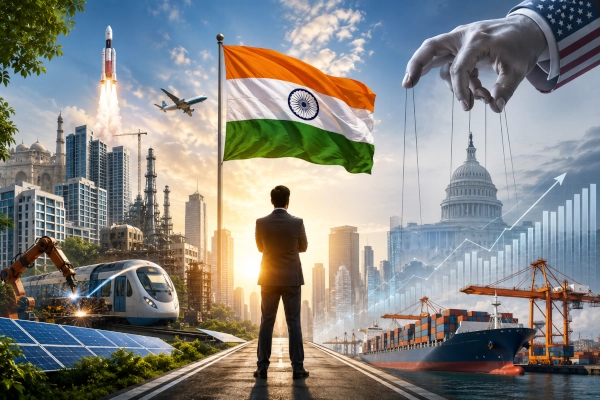
For much of the twentieth century, economic pressure exercised by the United States carried extraordinary weight in developing countries. Access to American aid, multilateral finance, Western technology, dollar markets and the American consumer could influence economic policy far beyond Washington’s borders. India itself once operated in an environment of food shortages, scarce foreign exchange, limited industrial capacity and dependence on external assistance for important development programmes.
That India no longer exists.
The modern Indian economy is approaching a scale at which neither American aid nor foreign philanthropic funding is remotely large enough to determine its direction. India’s growth is increasingly generated inside India itself through household consumption, infrastructure investment, manufacturing, services, entrepreneurship, digital commerce and an expanding technology ecosystem. The United States remains an exceptionally important economic partner, and American tariffs can undoubtedly hurt individual industries. What has disappeared, however, is the notion that Washington can determine whether the Indian economy grows simply by opening or closing an aid tap.
The distinction is important. American economic pressure is not irrelevant to India, but American economic control increasingly is.
The Arithmetic of Aid Has Become Almost Meaningless at the Macroeconomic Level
The scale comparison alone explains how dramatically the relationship has changed.
World Bank data puts India’s economy at approximately $3.96 trillion in 2025. U.S. government data, meanwhile, shows American foreign-assistance disbursements to India of about $182 million in FY2024. The latter represents less than one-hundredth of one per cent of India’s annual economic output.
This does not mean American-funded health, sanitation, disease-control, environmental or technical programmes have no value. Individual projects can produce important social benefits. But their macroeconomic significance should not be confused with their developmental usefulness. A country generating trillions of dollars of annual output is not economically sustained by assistance measured in hundreds of millions.
The comparison becomes even more striking when aid is placed beside India’s commercial economy. India exported a record $863.1 billion of goods and services in FY2025-26, consisting of approximately $441.8 billion in merchandise exports and $421.3 billion in services exports. India’s annual export earnings alone are therefore thousands of times larger than recent U.S. official assistance flows.
Similarly, gross foreign direct investment into India reached $81 billion in FY2024-25 according to the Economic Survey. Investment, technology partnerships, commercial borrowing, exports, remittances and domestic savings now matter vastly more to the Indian economy than traditional foreign aid.
This is the fundamental transformation. India has moved from an aid-era economic relationship with the developed world towards a market-to-market relationship.
India’s Largest Economic Engine Is the Indian Consumer
The greatest protection India possesses against external economic pressure is not a diplomatic alliance or a financial instrument. It is the size of its own domestic market.
The Economic Survey 2025-26 estimated that Private Final Consumption Expenditure accounted for 61.5 per cent of GDP, describing domestic demand as the principal anchor of growth. Household consumption was supported by easing inflation, improving real purchasing power and relatively broad-based rural and urban demand.
India’s latest provisional national accounts subsequently estimated real GDP growth of 7.7 per cent in FY2025-26, with real GDP reaching ₹323.12 lakh crore under the newly rebased national-accounts series.
This matters enormously when considering sanctions or tariffs.
An export-dependent economy in which overseas sales represent the principal source of demand can be badly destabilised if one major customer suddenly closes its market. India is different because hundreds of millions of domestic consumers continue buying food, telecommunications, automobiles, financial services, housing, travel, electronics, healthcare, entertainment and increasingly sophisticated digital services regardless of whether a particular export market becomes less favourable.
India is not immune to external shocks, but its enormous internal demand provides an economic shock absorber.
Indian Purchasing Power Is More Important Than Headline Dollar Income Suggests
India is often judged solely by nominal per-capita income converted into U.S. dollars. That measurement is important for international comparisons, but it does not fully capture the amount of economic activity that can be purchased domestically.
The IMF’s 2026 estimates place Indian GDP per capita at roughly $2,810 in nominal dollar terms but about $12,800 when measured at purchasing-power parity. That large difference reflects the fact that many goods and services cost substantially less inside India than equivalent products in advanced Western economies.
For an Indian company, this produces an enormous commercial advantage. A business does not necessarily require customers earning American salaries if its engineers, logistics networks, software developers, shops, factories and consumers also operate within an Indian cost structure.
The result is an increasingly self-reinforcing domestic marketplace in which businesses can reach significant scale before they ever enter the United States.
This was considerably harder during earlier stages of India’s development, when domestic purchasing power was lower and the formal consumer market was much smaller.
UPI Shows What a Billion-Person Domestic Market Looks Like When It Becomes Digitally Connected
One of the clearest demonstrations of India’s internal economic transformation is the extraordinary scale of digital payments.
By June 2026, approximately 55.49 crore users had been onboarded onto UPI. During FY2025-26, UPI processed about 24,162 crore transactions worth ₹314.23 lakh crore.
The importance of UPI extends beyond payments. It lowers the friction of conducting business.
A vegetable vendor, taxi driver, independent consultant, small manufacturer, online retailer and technology startup can participate in the same instantaneous payments network. Businesses can collect money without constructing expensive proprietary payment infrastructure, while customers can transact across banks using a common platform.
India consequently possesses something economically powerful that cannot easily be sanctioned away: an enormous domestic transaction network connecting consumers and enterprises.
Alongside UPI, Jan Dhan accounts, Aadhaar-based authentication, expanding broadband coverage, DigiLocker and other elements of India’s digital public infrastructure have progressively reduced the cost of participating in the formal economy. By July 2026, the government reported 58.63 crore Pradhan Mantri Jan Dhan Yojana accounts, while 5G networks had already reached virtually all Indian districts.
This is infrastructure just as surely as a highway or railway is infrastructure.
The Indian Graduate Is Increasingly Being Offered an Alternative to Waiting for a Job
Another structural change is taking place among India’s younger population.
Historically, education in India was often associated with a relatively narrow employment aspiration: obtain a degree, enter government service, join an established corporation or migrate overseas.
Those routes remain important, but entrepreneurship has become a much more credible alternative.
As of March 31, 2026, India had more than 2.23 lakh DPIIT-recognised startups, which the government estimated had generated more than 23.36 lakh direct jobs. More than 55,200 startups were recognised during FY2025-26 alone, the highest number recorded in a single year since the launch of Startup India.
The phenomenon is also spreading beyond Bengaluru, Hyderabad, Mumbai and Delhi. Startup India reported at the beginning of 2026 that approximately 53 per cent of recognised startups were located in Tier-II and Tier-III cities, demonstrating that entrepreneurship is becoming geographically broader.
Policy has increasingly attempted to accommodate this change. Startup recognition rules were expanded in 2026, raising the turnover ceiling for general startups from ₹100 crore to ₹200 crore, while DeepTech startups can qualify under still broader thresholds and longer recognition periods.
The significance is psychological as well as economic. A young engineer in Pune, Kochi, Bengaluru, Ahmedabad, Coimbatore or Bhubaneswar increasingly sees possibilities in drones, robotics, artificial intelligence, defence electronics, clean energy, electric mobility, fintech, biotechnology and software products that did not exist at comparable scale a generation ago.
Credit Is Reaching Far Below the Venture-Capital Economy
India’s entrepreneurial story is not limited to venture-backed technology startups.
As of June 26, 2026, the Pradhan Mantri Mudra Yojana had sanctioned approximately 59.14 crore loans worth ₹41.71 lakh crore, providing collateral-free institutional finance for micro and small businesses.
The scheme now offers financing of up to ₹20 lakh across manufacturing, trading and service activities.
A neighbourhood enterprise employing four people will never become a Silicon Valley unicorn, but millions of such businesses collectively create employment, purchasing power and local demand.
This is one reason the economic significance of India’s demographic scale should not be judged only by the number of globally famous companies it produces. India’s growth model increasingly contains several entrepreneurial layers simultaneously: venture-funded technology companies, formal MSMEs, professional services, digital self-employment and micro-enterprises financed through expanding formal credit channels.
Artificial Intelligence, Deep Technology and Manufacturing Are Creating New Aspirations
India’s younger workforce is also entering an economy in which national policy increasingly treats technology as strategic economic infrastructure.
The IndiaAI Mission, approved with an outlay of ₹10,371 crore, is intended to expand computing infrastructure, indigenous AI models, datasets, skills and startup capabilities. By July 2026, the programme included responsible-AI projects, AI Centres of Excellence and India Data & AI Labs intended to broaden access to advanced technological capabilities.
India also has the demographic scale to exploit these opportunities. Government estimates presented during the 2026 India AI Impact Summit noted that more than 65 per cent of India’s population is below 35 years of age.
Demography alone, however, guarantees nothing. Education quality, employability, research capability and job creation must keep improving. The World Bank has specifically argued that India needs stronger private-sector-led growth to generate employment at the scale required by young people entering the workforce.
The important difference from earlier decades is that India’s policy challenge is increasingly how to productively employ its own human and financial resources, rather than how to obtain basic development assistance from abroad.
The United States Still Matters — Enormously
It would be economically inaccurate to jump from these developments to the claim that American tariffs are meaningless.
They are not.
The United States remains one of India’s most valuable export markets. U.S. Census Bureau figures show that America imported approximately $103.8 billion of Indian goods during calendar year 2025.
The February 2026 U.S.-India trade framework set an 18 per cent reciprocal U.S. tariff rate on a number of Indian-origin products, while providing or envisaging more favourable treatment for several important categories as part of broader bilateral negotiations.
Washington subsequently imposed another Section 301 measure in July 2026. India was placed in the lower 10 per cent additional-duty tier, with the Indian government estimating that roughly 45 per cent of exports to the United States remain outside that additional measure, while approximately 55 per cent are covered by it.
These policies matter to companies selling garments, jewellery, marine products, leather, engineering products and other goods into the American market.
An Indian parliamentary committee warned in August 2026 that U.S. tariff measures were creating real difficulties for labour-intensive export industries and called for faster trade negotiations and additional assistance for affected exporters.
The correct economic conclusion is therefore not that tariffs are irrelevant.
It is that their impact has become increasingly sectoral rather than existential.
Even Severe Tariffs Do Not Automatically Stop Indian Growth
An earlier IMF analysis illustrates the point clearly.
When the IMF completed its 2025 Article IV review, it modelled a baseline in which the then-prevailing 50 per cent U.S. tariffs persisted for an extended period. Even under that assumption, the Fund projected India growing by 6.6 per cent in FY2025-26 and 6.2 per cent in FY2026-27, while explicitly noting that India’s relatively lower dependence on global trade and its large domestic market provided resilience against external shocks.
The tariff regime has changed since that forecast, so those numbers should not be interpreted as a description of today’s precise U.S. tariff structure. They are nevertheless useful because they demonstrate the scale of India’s internal economic momentum.
The IMF’s latest July 2026 projection still expects Indian real GDP growth of about 6.4 per cent in 2026.
The World Bank similarly projects India remaining among the world’s fastest-growing major economies, while pointing to substantial foreign-exchange reserves, predominantly rupee-denominated public debt, a healthier banking system and trade diversification as buffers against external shocks.
This is very different from an economy whose growth rate can be determined by the withdrawal of a few hundred million dollars in foreign assistance.
Services Have Changed the Balance of Economic Power
India’s services economy provides another layer of protection.
In FY2025-26, services exports reached approximately $421.3 billion, almost matching merchandise exports.
Software development, engineering, financial services, consulting, global capability centres, research, design and increasingly artificial intelligence allow India to sell intellectual and professional output rather than only physical products crossing customs borders.
Traditional tariffs are much easier to impose on a container of garments or machine components than on the complex web of software development, engineering services and multinational corporate functions that span borders digitally.
This does not make services immune to American regulation. Visa rules, taxation, technology controls, data regulation and restrictions on outsourcing can all affect Indian businesses.
But it substantially complicates attempts to use a single tariff instrument to pressure the entire Indian economy.
Trade Diversification Makes Single-Country Pressure Less Powerful
India is also deliberately widening its commercial relationships.
Total exports reached the record $863.1 billion in FY2025-26, while the government has been expanding trade arrangements and commercial access with partners including the UAE, Australia, the United Kingdom and the European Union.
The United States cannot simply be replaced; its consumer market is too large and too wealthy for that claim to be credible.
But diversification changes bargaining power.
If Indian exporters can increasingly sell into Europe, the Gulf, Africa, Southeast Asia, Australia and other markets while simultaneously serving a growing domestic economy, losing preferential conditions in one market becomes painful rather than catastrophic.
Likewise, American companies have incentives to maintain access to India. The February 2026 U.S.-India trade framework itself was explicitly constructed around reciprocal market access and more resilient supply chains, demonstrating that the relationship is commercial in both directions rather than donor-recipient in character.
Sanctions Are More Serious Than Aid Withdrawal, but They Are Not Omnipotent
Financial sanctions deserve more respect than ordinary trade tariffs.
The international financial system remains heavily influenced by the dollar, American banks, American technology and U.S.-linked capital markets. Restrictions involving advanced semiconductors, aerospace components, financial clearing or other strategic technologies could impose meaningful costs on Indian companies.
India also remains dependent upon imports in important areas, especially energy and some advanced technologies. These vulnerabilities cannot be dismissed through rhetoric.
Yet India’s external position is considerably stronger than it was during earlier periods of its development. The World Bank points to foreign-exchange buffers, largely rupee-denominated sovereign debt, a healthier financial sector and increasing trade diversification as important sources of resilience.
This means sanctions would increasingly operate by raising costs, delaying technology acquisition or damaging particular companies rather than automatically producing a national economic crisis.
That difference is strategically enormous.
The Real Limits on Indian Growth Are Increasingly Domestic
The most consequential threats to India’s economic ambitions today are arguably not American aid decisions.
They are India’s own unresolved structural problems.
India must generate enough productive employment for millions of young people. It needs better schooling and university outcomes, faster judicial and contract enforcement, deeper manufacturing capability, improved urban governance, greater female workforce participation, reliable energy, stronger research institutions and continued improvements in logistics and infrastructure.
The IMF argues that further reforms supporting innovation could raise Indian productivity growth substantially, while the World Bank similarly stresses the need to unlock private investment and employment creation.
These are problems New Delhi, Indian states, businesses and Indian society must solve themselves.
Washington cannot solve them for India.
More importantly, Washington cannot prevent India from solving them either.
From Aid Recipient to Market Whose Access Others Want
This is perhaps the most profound transformation.
The older relationship between developing India and wealthy Western economies was partly built around access to capital, aid and technology that India itself lacked.
The contemporary relationship is increasingly built around something India possesses: scale.
India offers more than 1.4 billion consumers, a large pool of technical talent, a rapidly expanding digital economy, enormous infrastructure requirements and one of the world’s largest potential markets for energy, aircraft, electronics, financial services, automobiles, defence systems and advanced technologies. World Bank data places India’s population at approximately 1.46 billion in 2025, while the IMF projects continued robust economic expansion.
The negotiation is therefore fundamentally different.
American companies want Indian customers.
Indian companies want American customers.
India wants American technology and capital.
American businesses increasingly want Indian engineers, manufacturing capacity and market access.
That is interdependence, not charity.
Indian Thought Has Always Linked Prosperity with Independence and Strategy
Chanakya expressed the underlying principle of economic resilience centuries ago when he wrote, “को हि भारः समर्थानां किं दूरं व्यवसायिनाम् । को विदेशः सुविद्यानां कः परः प्रियवादिनाम् ॥” — “What burden is too great for the capable? What distance is too far for the enterprising? What land is foreign to the well-educated, and who remains a stranger to one who speaks well?” The verse is particularly relevant to modern India because economic independence does not mean withdrawing from the world; it means possessing sufficient capability to engage with the world without becoming dependent upon any single external power. India’s expanding industrial base represents the samarthya, or capability, of which Chanakya speaks; its startups, exporters and entrepreneurs embody the vyavasāya, or enterprise, that refuses to regard distance or the loss of one market as an insurmountable obstacle; and its enormous pool of engineers, scientists, doctors, programmers and other skilled professionals gives particular meaning to “को विदेशः सुविद्यानाम्” — “What country is foreign to the well-educated?” Knowledge and technical capability can reach markets far beyond political boundaries, allowing Indian companies and professionals to diversify whenever one economic relationship becomes restrictive.
Chanakya reinforces the same idea in another verse: “उद्योगे नास्ति दारिद्र्यं जपतो नास्ति पातकम् । मौनेन कलहो नास्ति नास्ति जागरिते भयम् ॥”, whose most relevant teachings here are “उद्योगे नास्ति दारिद्र्यम्” — “For the industrious, there is no poverty,” and “नास्ति जागरिते भयम्” — “For the vigilant, there is no fear.” Applied to the Indian economy, udyoga is more than employment; it represents productive enterprise, manufacturing, innovation, entrepreneurship and the willingness to create wealth rather than wait for it to arrive through aid or charity. India’s growing startup ecosystem, expanding manufacturing capacity, digital economy, infrastructure investment and millions of small enterprises reflect precisely this transition. The second teaching, that vigilance removes fear, is equally relevant to economic statecraft. Strategic autonomy is sustained by constantly identifying vulnerabilities in energy, technology, finance, defence manufacturing and critical supply chains and then building alternatives before dependence becomes coercive leverage. In this sense, Chanakya’s wisdom strengthens the central argument of modern India’s economic rise: a capable nation does not become invulnerable to external pressure, but capability, enterprise, education and vigilance ensure that no single foreign power can easily determine its economic destiny.
The Fallacy of American Economic Control
The belief that tariffs or foreign assistance can still be used to broadly direct Indian economic policy rests on an outdated picture of India.
The Indian economy is no longer driven by foreign donations. It is driven by Indian households spending money, Indian companies investing, Indian entrepreneurs building businesses, Indian banks extending credit, Indian workers producing services, Indian infrastructure being constructed and Indian technology platforms connecting hundreds of millions of people.
A country with more than 2.23 lakh recognised startups, over 23 lakh startup-generated direct jobs, ₹314 lakh crore moving annually through UPI and hundreds of billions of dollars in annual exports possesses sources of economic momentum that no single foreign government created and no single foreign government can simply withdraw.
American tariffs can reduce orders in Tiruppur. They can squeeze diamond exporters in Surat. They can pressure seafood exporters and affect margins for engineering companies. Financial or technological sanctions could create even more serious difficulties.
These effects should never be trivialised because real workers and businesses bear the cost.
But there is an enormous difference between hurting parts of an economy and controlling the direction of an economy.
Modern India has increasingly crossed that threshold.
India Does Not Need Economic Isolation; It Needs Economic Confidence
None of this means India should turn away from the United States.
Quite the opposite.
The United States remains a natural economic partner for India in technology, defence, energy, higher education, finance, pharmaceuticals, semiconductors, artificial intelligence and advanced manufacturing. A stable U.S.-India commercial relationship benefits both countries.
Economic self-confidence should not be confused with economic isolation.
India’s objective should be to trade extensively with America while ensuring that India does not depend so heavily on America that access to the U.S. market becomes a mechanism for strategic coercion.
The same principle applies to China, Russia, Europe and every other major economic partner.
True strategic autonomy does not mean having no dependencies. No sophisticated modern economy achieves that.
It means having enough markets, enough domestic demand, enough technological capability and enough alternatives that no single external power possesses a veto over national economic choices.
That is the more important story behind India’s rise.
Foreign assistance can still help individual programmes. American investment can still accelerate Indian growth. American consumers remain immensely valuable to Indian exporters, and U.S. technology remains important to Indian industry.
But these are increasingly relationships India enters because they are economically beneficial, not relationships without which the Indian economy cannot function.
The age in which charity could be confused with economic leverage is passing.
The next phase of India’s development will ultimately be decided much closer to home: by the purchasing power of Indian families, the ambitions of its young people, the quality of its entrepreneurs, the productivity of its workers, the depth of its technology base and the effectiveness of the policies that allow all of them to prosper.
America can influence India’s economic environment. It can impose costs and create opportunities. What it increasingly cannot do is decide whether India grows.
You may also like
-
India and Russia Hold Seventh Strategic Security Dialogue on Pakistan and Afghanistan
-
Indian Coast Guard and Korea Coast Guard Strengthen Maritime Cooperation at 14th High-Level Meeting in Incheon
-
PM Modi Inaugurates ₹3,350 Crore Development Projects in Ladakh
-
AXISCADES Expands Global Technology Footprint with US Acquisition Plan and Swiss Company Takeover
-
Skyroot Aerospace Secures Two Satellite Launch Contracts from US Space Company Reflect Orbital
