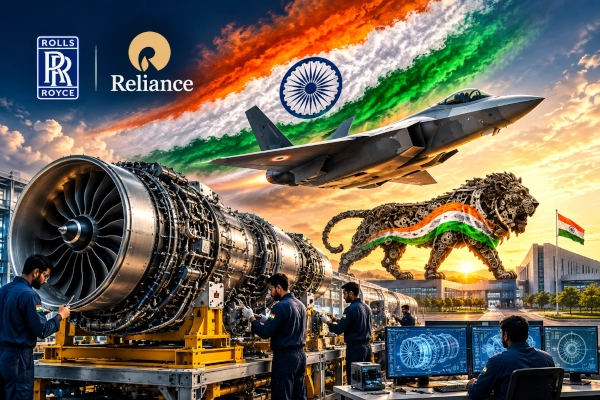
India’s ambition to develop a sovereign fighter aircraft engine has received a significant boost through a proposed partnership between British aerospace and propulsion technology company Rolls-Royce and Reliance Industries Limited. The two companies are exploring the joint design, development, manufacturing and delivery of an indigenous combat aircraft engine for India’s Advanced Medium Combat Aircraft (AMCA) programme, with a strong emphasis on establishing advanced propulsion capabilities within the country.
The initiative gained formal recognition on August 14, 2026, when Rolls-Royce and Reliance Industries announced their strategic intention to collaborate on an indigenous combat engine. The proposed partnership includes establishing an Aerospace Gas Turbine Complex in India, envisioned as a centre of excellence covering the complete engine lifecycle, from conceptual design and development to manufacturing, testing, production and long-term maintenance support.
According to media reports online, Rolls-Royce has proposed developing an engine capable of producing more than 120 kilonewtons (kN) of thrust, suitable for future variants of India’s fifth-generation stealth fighter. Company representatives have also indicated their willingness to pursue extensive localisation, with Indian participation extending into engineering design, manufacturing and intellectual property development.
The proposal represents an important opportunity to address one of India’s most demanding aerospace technology requirements: developing a powerful, reliable and technologically advanced indigenous fighter engine. While India has achieved substantial progress in aircraft design, manufacturing, avionics and military aviation systems, developing high-performance jet engines remains a major national technological objective.
The Rolls-Royce–Reliance initiative seeks to combine internationally established propulsion expertise with Indian industrial capabilities, creating the foundation for a domestic combat engine ecosystem capable of supporting advanced military aircraft and future aerospace programmes.
Rolls-Royce and Reliance Announce Strategic Partnership for AMCA Engine
Rolls-Royce and Reliance Industries officially announced their intention to collaborate on India’s indigenous combat aircraft engine programme on August 14, 2026. The announcement identified the Advanced Medium Combat Aircraft as the principal intended application and outlined a partnership focused on developing sovereign propulsion capabilities within India.
The companies propose combining Rolls-Royce’s expertise in advanced aerospace propulsion with Reliance Industries’ manufacturing capabilities, engineering resources and experience in executing large industrial projects. The collaboration aims to establish an Indian ecosystem capable of undertaking sophisticated engine development activities rather than relying exclusively on importing finished propulsion systems.
According to the joint announcement, the partnership will explore capabilities spanning engine design, development, manufacturing, delivery and long-term technical support. These activities represent the principal stages required to establish a sustainable domestic aerospace propulsion industry.
Anant Ambani, Executive Director of Reliance Industries, emphasised the importance of sovereign capabilities in critical technologies. He stated that the proposed collaboration seeks to combine Rolls-Royce’s propulsion expertise with Reliance’s industrial scale and execution capabilities to develop an indigenous aero-engine ecosystem.
Rolls-Royce Chief Executive Tufan Erginbilgiç also highlighted the opportunity to combine the company’s longstanding experience in advanced engineering with India’s growing industrial capabilities. The partnership is intended to build upon Rolls-Royce’s established operations and existing relationships within the Indian aerospace industry.
The initiative reflects an emerging industrial approach in which advanced technology development and large-scale manufacturing are brought together through partnerships involving international specialists and Indian companies.
Proposed 120 kN-Plus Engine Could Power Future AMCA Variants
The proposed combat engine is intended to address the propulsion requirements of future variants of India’s Advanced Medium Combat Aircraft, a fifth-generation stealth fighter being developed under the leadership of the Aeronautical Development Agency.
According to media reports online, Rolls-Royce has submitted a proposal for jointly developing a new-generation fighter engine capable of generating more than 120 kN of thrust. The proposed engine would belong to a higher thrust category than the engines currently associated with India’s existing indigenous fighter aircraft programmes.
A 120 kN-class engine produces approximately 27,000 pounds-force of thrust, placing it within the performance category associated with advanced military turbofan propulsion systems. In a twin-engine fighter aircraft, two such engines would provide a combined nominal rated thrust of around 240 kN, although actual aircraft performance depends on installed thrust, flight conditions, aerodynamic characteristics and aircraft configuration.
The AMCA is being developed as a twin-engine multirole stealth fighter incorporating advanced avionics, low-observable design characteristics and an internal weapons carriage capability. Its intended operational roles include air superiority, precision strike and other demanding combat missions.
Advanced engines are particularly important for stealth aircraft because propulsion performance must be balanced with fuel efficiency, thermal management, aircraft structure and radar-signature requirements. The engine must also provide the electrical power and cooling capacity needed to support modern onboard sensors, electronic warfare equipment and computing systems.
A domestically developed 120 kN-class engine could therefore contribute to India’s long-term objective of developing increasingly capable fighter aircraft while strengthening control over critical propulsion technologies.
Rolls-Royce Proposes an Aerospace Gas Turbine Complex in India
A central component of the proposed Rolls-Royce–Reliance partnership is the creation of an Aerospace Gas Turbine Complex within India. The proposed facility would serve as a centre of excellence for advanced propulsion technology, bringing together engineering, manufacturing, testing and lifecycle support capabilities.
According to the companies’ official announcement, the complex is intended to establish end-to-end Indian capabilities across the engine development process. This includes conceptual engineering, detailed design, component development, manufacturing, testing, production and through-life technical support.
A modern fighter engine requires an extensive industrial infrastructure extending far beyond the assembly of individual components. Its development involves specialised research facilities, advanced manufacturing equipment, high-temperature materials, precision machining, aerodynamic testing and sophisticated engine evaluation systems.
The proposed complex would bring these activities within an integrated industrial framework, allowing engineering and manufacturing teams to work across different stages of propulsion development. Such integration is important because engine performance depends on the precise interaction of numerous mechanical, aerodynamic and thermal systems.
The partnership also envisages wider opportunities across defence aviation, civil aerospace and other advanced propulsion applications. Technologies developed for high-performance military engines can contribute to specialised industrial capabilities relevant to other gas turbine programmes.
Establishing a dedicated propulsion development ecosystem would represent a significant step towards expanding India’s domestic aerospace manufacturing capabilities beyond aircraft structures and assembly into advanced engine engineering.
Full Engine Localisation Emerges as an Important Industrial Objective
One of the most significant aspects of the Rolls-Royce proposal is its emphasis on developing comprehensive indigenous capabilities rather than limiting Indian participation to final engine assembly.
According to media reports online, company representatives have indicated that the proposed programme could support extensive localisation, potentially encompassing the entire engine manufacturing process. The discussions have also highlighted the importance of developing Indian capabilities in design, engineering and long-term technological ownership.
The official August 2026 announcement supports this broader direction by explicitly identifying the development of sovereign, end-to-end Indian capabilities as an objective of the proposed Aerospace Gas Turbine Complex.
Achieving such a capability would require Indian industries to manufacture a wide range of specialised engine components, including compressor assemblies, turbine components, combustion systems, casings, shafts and associated control equipment.
Modern fighter engines also depend on advanced materials capable of operating under extreme temperatures and mechanical stresses. Manufacturing these components requires highly specialised metallurgy, precision engineering and sophisticated quality-control processes.
The development of domestic capability across these areas could strengthen India’s aerospace supply chain and create opportunities for specialised engineering companies to participate in advanced propulsion manufacturing.
The reported ambition of complete localisation represents a long-term industrial objective of the proposal. Its achievement would depend upon the detailed technology-development arrangements, manufacturing capabilities and industrial responsibilities established through any subsequent programme agreement.
Indian Ownership of Engine Technology Could Strengthen Strategic Autonomy
The proposed development of a sovereign fighter engine places particular importance on India’s ability to acquire and sustain advanced propulsion capabilities independently.
Manufacturing an engine domestically under licence does not necessarily provide the same technological control as participating in its design and development. The latter approach involves engineering knowledge, technical documentation, testing capabilities and the expertise required to modify and improve an engine throughout its operational life.
According to media reports online, Rolls-Royce has discussed a development model that could provide India with substantial ownership and control over the resulting engine technology. Such an arrangement would be particularly significant for a complex military propulsion system intended to remain in service for several decades.
An indigenous engine development capability would allow Indian engineering organisations to participate in future improvements involving thrust, fuel efficiency, materials, durability and operational performance.
It could also support the development of additional engine variants suited to evolving aircraft requirements, reducing dependence on foreign manufacturers for every major propulsion modification.
The strategic value of this approach extends beyond the AMCA programme. Once established, advanced engine design and development capabilities can contribute to future fighter aircraft, unmanned aviation platforms and other specialised aerospace applications.
The joint announcement by Rolls-Royce and Reliance places the creation of a sovereign Indian propulsion ecosystem at the centre of the proposed partnership, reflecting the importance of long-term technological capability alongside immediate aircraft requirements.
Engine Core Development Targeted for 2030 Under Reported Proposal
According to media reports online published in June 2026, Rolls-Royce outlined an indicative development schedule for its proposed 120 kN-plus fighter engine.
The proposal envisages demonstrating an engine core around 2030, followed by initial flight testing around 2034 and the commencement of production around 2036. These milestones were presented as part of the company’s proposed development roadmap and were dependent upon an agreement being concluded within the indicated period.
The engine core represents the central section of a gas turbine engine, comprising the compressor, combustion system and high-pressure turbine. Its development is critical because it establishes many of the fundamental performance characteristics of the complete propulsion system.
Engine core testing allows engineers to evaluate combustion efficiency, turbine performance, thermal behaviour, mechanical reliability and other critical operating characteristics before progressing towards the complete engine.
Following successful core evaluation, the development process normally involves integrating additional engine components, conducting extensive ground tests and establishing compliance with applicable technical requirements.
Flight testing introduces further challenges because the engine must demonstrate reliable performance across the aircraft’s operating envelope. Engineers must examine acceleration characteristics, fuel consumption, temperature limits, vibration, reliability and compatibility with aircraft systems.
The proposed development schedule reflects the long-term engineering effort required to create an advanced fighter engine. The August 2026 Rolls-Royce–Reliance announcement establishes the industrial intention to pursue such a programme, while the reported technical milestones provide an indication of the development approach being proposed.
Rolls-Royce’s Existing Engineering Centres in India Provide a Strong Foundation
Rolls-Royce already maintains a substantial engineering presence in India, providing an established technical foundation for the proposed propulsion partnership.
According to the company’s official information, its engineering centre in Bengaluru supports aerospace projects and contributes to the development of new technologies, engineering tools and global design processes. The facility works with Rolls-Royce engineering teams across its international operations, allowing Indian engineers to participate in advanced aerospace development activities.
The company’s engineering centre in Pune supports research, development and product engineering activities associated with marine and power systems. Its work includes computer-aided design, electrical engineering and advanced data analysis, demonstrating the breadth of technical capabilities Rolls-Royce has developed within India.
These facilities have enabled Indian engineers to contribute to sophisticated global engineering programmes while gaining experience with the design methods, technical standards and development processes associated with advanced propulsion technologies.
The proposed AMCA engine programme could build upon this established presence by expanding the scope of Indian participation into dedicated fighter engine development. Combining existing engineering resources with new manufacturing and testing facilities would support the creation of a more comprehensive domestic propulsion ecosystem.
Such an approach would also strengthen opportunities for collaboration among Indian aerospace companies, research institutions, engineering specialists and component manufacturers.
Six Decades of Rolls-Royce and HAL Collaboration in Aero-Engine Manufacturing
Rolls-Royce has maintained a longstanding relationship with Hindustan Aeronautics Limited (HAL), dating back more than six decades. The companies have worked together on the manufacturing, maintenance and support of military aircraft engines used by the Indian Armed Forces.
One of the most prominent examples is the Rolls-Royce Adour engine, which powers India’s Jaguar combat aircraft. HAL has manufactured and supported variants of the Adour engine in India, building valuable industrial experience in military propulsion manufacturing and maintenance.
The relationship also extends to aerospace component production through International Aerospace Manufacturing Private Limited (IAMPL), a joint venture between Rolls-Royce and HAL.
According to Rolls-Royce, the venture manufactures specialised compressor shrouds and cones for gas turbine engines, supporting new engine production and aftermarket requirements. These components form part of sophisticated propulsion systems that demand high manufacturing accuracy, specialised materials and rigorous quality control.
Rolls-Royce has also developed supply chain relationships with Indian manufacturers, including Bharat Forge, Godrej & Boyce and Tata Advanced Systems. These partnerships support the production of precision-machined components, fabricated assemblies and other specialised aerospace products.
This established industrial network provides an important foundation for expanding India’s participation in advanced engine manufacturing. The proposed partnership with Reliance Industries would introduce another major industrial participant into the country’s propulsion technology ecosystem.
Reliance Industries Brings Large-Scale Manufacturing and Engineering Capabilities
Reliance Industries’ proposed participation represents an important expansion of private sector involvement in India’s advanced military aerospace sector.
The company has developed substantial industrial capabilities across energy, petrochemicals, advanced materials, telecommunications, digital infrastructure and large-scale manufacturing. These activities require sophisticated engineering, industrial project management and the operation of complex technological facilities.
Developing an advanced fighter engine presents a different engineering challenge, but many supporting industrial capabilities are relevant to establishing large research, manufacturing and testing facilities.
In the August 2026 announcement, Reliance Industries Executive Director Anant Ambani emphasised the importance of developing domestic technological capabilities that support India’s strategic autonomy.
He described the proposed partnership as an opportunity to combine Rolls-Royce’s propulsion engineering expertise with Reliance’s manufacturing scale, technology resources and industrial execution capabilities.
The collaboration is intended to establish enduring domestic capabilities that can support India’s aerospace industry over the long term.
The company’s participation also reflects the increasing role of India’s private sector in sophisticated defence manufacturing programmes. Large industrial enterprises can contribute capital-intensive infrastructure, manufacturing management and supply chain development alongside specialised aerospace organisations.
By bringing together expertise from different industrial sectors, the proposed initiative aims to strengthen India’s ability to undertake advanced propulsion programmes through domestic industrial participation.
Developing Advanced Turbine Blades and High-Temperature Materials
One of the greatest technological challenges in manufacturing modern fighter engines involves developing components capable of operating under extreme temperatures and mechanical stresses.
The turbine section of a jet engine extracts energy from high-temperature gases generated during combustion. Turbine blades must withstand intense heat, centrifugal forces, vibration and prolonged mechanical loading while maintaining their structural integrity.
Advanced military engines use specialised nickel-based superalloys, sophisticated cooling arrangements and protective coatings to enable reliable operation under these conditions.
Some high-performance turbine blades employ single-crystal manufacturing techniques, which eliminate conventional grain boundaries and improve resistance to deformation under elevated temperatures.
Developing these components requires specialised foundry processes, materials research, precision casting and advanced inspection technologies.
A domestic fighter engine programme would also create requirements for highly accurate compressor blades, rotating discs, shafts, seals, combustion components and other specialised assemblies.
These components must meet demanding manufacturing tolerances because small variations can affect engine performance, reliability and service life.
The development of indigenous manufacturing capabilities in such technologies could benefit India’s wider aerospace and advanced engineering industries. Expertise acquired in materials processing, precision manufacturing and component testing can contribute to other high-performance industrial applications.
The proposed propulsion complex offers a framework for bringing these specialised capabilities together as part of India’s long-term aerospace technology development.
Digital Engineering and Advanced Testing Will Shape Engine Development
Modern fighter engine programmes increasingly rely on sophisticated digital engineering tools to support design, development and testing.
Computer-based modelling allows engineers to examine airflow through compressors and turbines, assess combustion performance and study thermal and mechanical stresses before manufacturing physical components.
Computational fluid dynamics helps designers evaluate aerodynamic behaviour within the engine, while advanced structural analysis supports the development of components capable of withstanding demanding operating conditions.
These technologies allow engineering teams to assess different design configurations and improve performance through repeated simulation and evaluation.
Digital manufacturing methods also support the production of specialised components with complex geometries. Additive manufacturing, advanced machining and automated inspection systems have become increasingly important in modern aerospace engineering.
Nevertheless, physical testing remains essential. Engine developers must conduct extensive evaluations to establish performance, reliability, durability and compliance with applicable military aviation requirements.
The proposed Aerospace Gas Turbine Complex is intended to cover both development and testing capabilities, creating opportunities for Indian engineers to participate in the complete technical evaluation process.
Establishing such infrastructure would strengthen India’s ability to undertake increasingly complex propulsion programmes while reducing reliance on overseas facilities for specialised engineering activities.
AMCA Programme Opens New Opportunities for Indian Aerospace Industry
The proposed Rolls-Royce–Reliance engine initiative comes as India advances the development of its indigenous Advanced Medium Combat Aircraft.
On May 27, 2025, Defence Minister Rajnath Singh approved the AMCA Programme Execution Model, establishing a new framework for involving Indian industry in the development of the fifth-generation fighter.
According to the Ministry of Defence, the Aeronautical Development Agency will execute the programme through industry partnerships, allowing qualified Indian companies to participate through a competitive selection process.
The framework provides opportunities for both public and private sector enterprises. Companies may participate independently, through joint ventures or as members of industrial consortia.
This approach aims to harness the technological expertise, manufacturing capacity and engineering resources available across India’s aerospace industry.
The AMCA programme requires capabilities spanning stealth aircraft structures, avionics, flight control systems, advanced materials, weapons integration and propulsion.
A domestic engine development programme would complement these activities by addressing one of the most technologically complex elements of a modern combat aircraft.
The emerging industrial model reflects India’s increasing emphasis on developing advanced military platforms through cooperation among research agencies, established public sector organisations and private manufacturing companies.
Why a 120 kN Engine Matters for India’s Fifth-Generation Fighter
High-performance propulsion is a critical requirement for modern combat aircraft because an engine influences almost every aspect of flight performance.
Thrust affects acceleration, climb performance and the aircraft’s ability to maintain energy during demanding manoeuvres. Fuel efficiency influences operational range and endurance, while engine dimensions and weight affect aircraft configuration and aerodynamic design.
For fifth-generation stealth fighters, propulsion systems must also operate within airframes designed to minimise radar detectability. Engine integration therefore involves balancing performance requirements with specialised inlet designs, exhaust arrangements and thermal management considerations.
A 120 kN-class engine would provide a substantial thrust capability for future AMCA configurations. In a twin-engine aircraft, the combined propulsion system would support the high-performance requirements associated with advanced combat aviation.
However, thrust alone does not determine engine suitability. Engineers must also consider fuel consumption, engine weight, durability, thermal characteristics, maintainability and compatibility with the aircraft’s mission systems.
Developing these characteristics together requires extensive aerodynamic research, materials engineering and repeated testing.
The Rolls-Royce proposal seeks to address these challenges through an integrated development programme involving Indian engineering and manufacturing capabilities.
Such a programme would contribute to the broader objective of developing propulsion technologies tailored to India’s future military aviation requirements.
Indigenous Engine Development Can Reduce Long-Term Dependence on Imports
India has developed considerable capabilities in aircraft design and manufacturing, but advanced jet propulsion remains an area requiring sustained technological development.
Military aircraft engines are among the most sophisticated engineering systems manufactured anywhere in the world. Their development involves technologies that countries often protect because of their strategic importance and demanding industrial requirements.
A country capable of designing and manufacturing its own fighter engines gains greater control over maintenance, upgrades, component availability and future development programmes.
Indigenous propulsion capabilities can also support long-term fleet management by allowing domestic organisations to participate directly in engineering modifications and reliability improvements.
For India, this objective is particularly important because modern combat aircraft remain operational for several decades and require continuous technical support throughout their service lives.
The Rolls-Royce–Reliance proposal is intended to establish domestic capabilities across the propulsion lifecycle, including development, manufacturing and through-life support.
Such an ecosystem could strengthen India’s ability to maintain and improve advanced aircraft engines while expanding opportunities for indigenous research and manufacturing.
The resulting expertise would also contribute to the country’s wider defence industrial development, particularly in areas involving advanced materials, precision engineering and specialised testing.
Opportunities for Indian MSMEs and Aerospace Component Manufacturers
Developing a fighter engine requires the participation of a large network of specialised suppliers capable of manufacturing components to demanding aerospace standards.
Large engine manufacturers depend upon companies producing precision-machined components, castings, forgings, sensors, electronic systems, seals, bearings and specialised materials.
India already possesses an expanding aerospace supply chain that includes public sector enterprises, private manufacturers and micro, small and medium enterprises.
Rolls-Royce has worked with Indian companies for several decades and continues to expand its domestic sourcing activities.
In 2025, the company announced its intention to at least double supply chain sourcing from India over the following five years. The initiative reflects its growing interest in increasing Indian participation in international aerospace and propulsion manufacturing.
A dedicated indigenous fighter engine programme could create additional opportunities for suppliers capable of meeting the required technical standards.
Participation in such programmes often encourages manufacturers to invest in new machinery, testing equipment, quality systems and workforce training.
These improvements can strengthen the competitiveness of Indian aerospace companies and support their participation in international supply chains.
The proposed Aerospace Gas Turbine Complex could therefore contribute to industrial development beyond the principal engine manufacturers by encouraging the growth of specialised component production capabilities.
Indigenous Propulsion Research Could Support Future Aircraft Programmes
The technological capabilities required to develop an advanced fighter engine have applications extending beyond a single aircraft programme.
Research in high-temperature materials, compressors, combustion systems, turbine design and advanced manufacturing can support the development of different categories of aerospace propulsion.
India is pursuing several military aviation programmes involving fighters, helicopters, unmanned aircraft and other specialised platforms.
Although these aircraft require different propulsion configurations, the underlying engineering knowledge developed through advanced gas turbine research can contribute to broader national capabilities.
An indigenous fighter engine programme would also create opportunities for Indian research institutions and universities to participate in specialised areas of propulsion technology.
Advanced materials research, aerodynamic modelling, thermal engineering, combustion science and digital simulation are disciplines that benefit from close cooperation between industry and academic organisations.
The proposed partnership could support the growth of a technical workforce with expertise in these demanding fields.
Establishing such capabilities would strengthen India’s long-term aerospace research ecosystem and improve its ability to undertake increasingly advanced aircraft development programmes.
Atmanirbhar Bharat Moves Towards Sovereign Aerospace Propulsion
The Rolls-Royce–Reliance initiative aligns with the Government of India’s Atmanirbhar Bharat objective of strengthening domestic technological and manufacturing capabilities in strategically important sectors.
India has already expanded indigenous defence production across aircraft, helicopters, warships, missiles, artillery systems and military electronics.
Advanced fighter engine development represents another important technological frontier because it requires mastery of specialised materials, manufacturing processes and complex engineering systems.
The proposed partnership seeks to combine the experience of an established international propulsion manufacturer with the industrial capabilities of a major Indian enterprise.
Its focus on design, manufacturing, testing and long-term technical support reflects a comprehensive approach to technological development.
The initiative also complements the government’s AMCA Programme Execution Model, which encourages greater participation by Indian industry in advanced combat aircraft development.
Together, these developments demonstrate the increasing importance of partnerships that support domestic engineering and research capabilities alongside manufacturing.
The creation of an indigenous propulsion ecosystem would strengthen India’s position in advanced aerospace technologies and support the development of future military aviation platforms.
Rolls-Royce and Reliance Aim to Build a Long-Term Indian Propulsion Ecosystem
The proposed collaboration between Rolls-Royce and Reliance Industries represents an important development in India’s efforts to establish sovereign combat aircraft engine capabilities.
The companies’ August 2026 announcement outlines an ambitious industrial framework covering the complete propulsion lifecycle, while the reported 120 kN-plus engine proposal provides a potential technical direction for future AMCA variants.
The planned Aerospace Gas Turbine Complex forms the centrepiece of this approach, bringing together the infrastructure and expertise required for advanced engine design, development, manufacturing and testing.
India’s existing aerospace research organisations, engineering centres and component manufacturers provide a substantial foundation for developing these capabilities further.
The participation of Reliance Industries introduces additional industrial resources, while Rolls-Royce contributes its longstanding experience in advanced propulsion engineering and international aerospace manufacturing.
As India advances the AMCA programme and strengthens its indigenous aerospace industry, the development of domestic fighter engine capabilities represents an important national technological objective.
The Rolls-Royce–Reliance initiative offers a pathway towards expanding India’s participation in advanced propulsion development, creating opportunities for Indian engineers, manufacturers and research institutions to contribute to a sophisticated aerospace technology ecosystem.
Its central ambition extends beyond producing an engine for a single fighter aircraft. The proposed partnership seeks to establish the engineering knowledge, manufacturing infrastructure and technological capabilities required to support India’s long-term independence in military aerospace propulsion.
By combining indigenous industrial capacity with international engineering expertise, India is advancing towards a future in which the design, development, production and long-term support of advanced fighter engines can become an integral part of its domestic aerospace capabilities.
References
1. Rolls-Royce — Official Joint Announcement with Reliance Industries Limited
Date: August 14, 2026
Title: Reliance Industries and Rolls-Royce Announce Strategic Intent to Partner and Develop India’s Indigenous Combat Engine for the Advanced Medium Combat Aircraft (AMCA) Programme
Details: Proposed collaboration covering engine design, development, manufacturing and delivery, and plans to explore an Aerospace Gas Turbine Complex in India.
https://www.rolls-royce.com/media/press-releases/2026/14-08-2026-reliance-industries-and-rolls-royce-announce-strategic-intent-to-partner-and-develop-indias-indigenous-combat-engine-for-the-amca-programme.aspx
2. Press Information Bureau, Ministry of Defence
Date: May 27, 2025
Title: Aatmanirbhar Bharat: Raksha Mantri Approves Advanced Medium Combat Aircraft Programme Execution Model Through Industry Partnership
Details: Government approval for the AMCA execution framework involving Indian public and private sector companies.
https://www.pib.gov.in/PressReleasePage.aspx?PRID=2131528
3. Rolls-Royce — Official India Engineering Information
Title: Engineering — Partners in Progress
Details: Aerospace engineering activities in Bengaluru and research and development operations in Pune.
https://www.rolls-royce.com/country-sites/india/partners-in-progress/engineering.aspx
4. Rolls-Royce — Official Manufacturing and Supply Chain Information
Title: Manufacturing & Supply Chain — Partners in Progress
Details: Rolls-Royce’s longstanding cooperation with HAL, International Aerospace Manufacturing Private Limited and Indian aerospace component manufacturers.
https://www.rolls-royce.com/country-sites/india/partners-in-progress/manufacturing-and-supply-chain.aspx
5. Rolls-Royce — Official Corporate Announcement
Date: 2025
Title: Rolls-Royce Intends to Double Its Sourcing in India by 2030, in Line with the Make in India Vision
Details: Expansion of Indian aerospace component sourcing and development of domestic manufacturing capabilities.
https://www.rolls-royce.com/country-sites/india/discover/2025/rr-intends-to-double-its-sourcing-in-india-by-2030-in-line-with-the-make-in-india-vision.aspx
6. Rolls-Royce — Official India Aerospace Information
Title: Powering the People Who Protect Our Skies
Details: Adour engine manufacturing, Indian engineering capabilities and cooperation with HAL.
https://www.rolls-royce.com/country-sites/india/discover/2019/03-powering-the-people-who-protect-our-skies.aspx
7. Media Reports Online — Statement by Rolls-Royce Executive
Date: June 23, 2026
Subject: Rolls-Royce’s Proposed 120 kN-Plus Combat Engine for India’s AMCA
Details: Proposed engine core demonstration by 2030, flight testing by 2034 and production from 2036, subject to programme approval.
8. Media Reports Online
Date: October 15, 2026
Subject: Rolls-Royce Signals Scope for Full Local Manufacturing of AMCA Engine
Details: Reported company position on extensive Indian manufacturing localisation, domestic engineering participation and sovereign propulsion capabilities.
You may also like
-
India and Russia Hold Seventh Strategic Security Dialogue on Pakistan and Afghanistan
-
Indian Coast Guard and Korea Coast Guard Strengthen Maritime Cooperation at 14th High-Level Meeting in Incheon
-
Ministry of Defence Signs ₹4,106 Crore Contracts for GSAT-7C Satellite and Varunastra Torpedoes
-
AVNL, Indian Army and Russian Delegation Explore Modernisation of Armoured Vehicles
-
JSR Dynamics Develops Indigenous Miniature Ground-Launched Decoy for Electronic Warfare Applications
