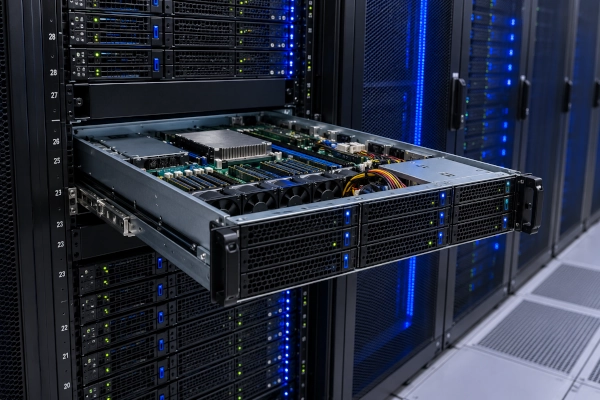
India’s push for technological self-reliance has entered an important new area with Zoho Corporation’s launch of Nathu La, an enterprise-grade server platform designed in India for cloud computing, artificial intelligence, high-performance computing and data-storage workloads.
Unveiled on June 10, 2026, Nathu La represents Zoho’s first major entry into computer hardware. The Chennai-headquartered technology company developed the platform through a specialised engineering team based in Nagpur, extending its operations beyond business software, cloud services and artificial intelligence into the physical infrastructure that runs them.
The server is intended initially for use within Zoho’s own data centres. By controlling the hardware, firmware, operating environment, applications and AI models, the company hopes to reduce infrastructure expenses, improve energy efficiency and strengthen control over customer data.
Nathu La is therefore not merely a new server model. It is part of Zoho’s larger effort to build and operate an integrated technology stack in which critical intellectual property is owned in India.
Why India Needs Indigenous Server Technology
Servers form the foundation of the digital economy. They operate cloud platforms, banking systems, government databases, websites, communication services, enterprise applications and artificial-intelligence systems.
India has emerged as a global software and IT-services power, but much of the physical server infrastructure supporting these services has traditionally been designed and supplied by overseas companies.
This creates several forms of dependence. Indian organisations may have to pay licensing and intellectual-property fees to foreign technology providers while also relying on external companies for firmware updates, security support, replacement components and product continuity.
Global supply-chain disruptions can delay hardware deliveries, while sudden increases in the price of processors, memory, networking equipment and server platforms can raise the cost of running data centres.
The expansion of generative AI has made this issue more urgent. AI applications require large quantities of computing power, and every response generated by an AI model creates an inference cost. Even relatively small increases in hardware, electricity and cooling expenses can become significant when millions of AI requests are processed every day.
Zoho developed Nathu La partly to gain greater control over these costs and dependencies. The company says that owning the server platform allows it to optimise hardware specifically for its applications rather than purchasing general-purpose systems carrying features and software it may not require.
Developed by a Small Team in Nagpur
Development of Nathu La began in 2020, when Zoho established a small hardware research team at its Nagpur centre.
Nagpur is not traditionally considered one of India’s major electronics-design centres. The city had a smaller pool of experienced server engineers than established technology hubs such as Bengaluru, Hyderabad or Chennai.
Zoho therefore recruited young engineering graduates and trained them in hardware design, embedded systems, firmware development and electronic-system manufacturing.
ThMinister of State for Defence Sanjay Seth highlighted the contribution of MSMEs, start-ups and private companies in developing indigenous defence equipment, components and technologies. These enterprises increasingly support major defence manufacturers and public-sector undertakings by supplying precision components, electronics, materials, software, subsystems and maintenance services.e company supported this process through SETU — Student Engagement for Transformative Upskilling, a programme that works with engineering students from colleges in central India. More than 300 students have reportedly undergone training through the initiative, with some subsequently joining Zoho’s engineering teams.
The project illustrates an important aspect of decentralised technology development. Instead of concentrating advanced engineering exclusively in India’s largest cities, Zoho built specialised capabilities through talent drawn from smaller towns and regional colleges.
After approximately five years of research and development, the Nagpur team produced the motherboard, chassis, firmware, power-delivery systems, management modules and other major elements of the Nathu La platform.
What Zoho Designed in India
Nathu La is built around a server architecture developed by Zoho’s hardware engineers.
The company designed important system components including:
- The server motherboard
- Modular chassis architecture
- Firmware and systems-management software
- Customised power-delivery subsystems
- Network interface cards
- Microcontroller-based systems
- Data Centre Secure Control Modules
- Thermal-management arrangements
- Hardware-management and security features
The server platform is assembled through Indian electronics manufacturing services partners, creating a domestic chain extending from architecture and component design to system integration and production.
Zoho has filed five patents relating to areas such as thermal management and cost-optimised server architecture.
The company based the platform’s design philosophy on principles associated with the Open Compute Project, emphasising modularity, efficient cooling, easier maintenance and the ability to configure hardware for different workloads.
Modularity allows individual subsystems to be replaced or upgraded without redesigning the entire server. It can also simplify repairs and reduce downtime inside large data centres.
Powered by Intel Xeon 6 Processors
Nathu La uses Intel Xeon 6 processors, developed with technical enablement and support from Intel.
These processors are intended for enterprise data centres and can support virtual machines, databases, storage systems, cloud applications and computationally intensive workloads.
Zoho has configured Nathu La for four principal areas:
- Virtualisation
- High-performance computing
- Artificial-intelligence inference
- Data-storage applications
Virtualisation allows a physical server to operate several independent virtual machines. High-performance computing supports scientific, engineering and large-scale data-processing applications.
AI inference refers to the stage at which a trained artificial-intelligence model processes new information and produces an answer, prediction, image or other output.
Storage applications include document repositories, databases, backups and large distributed systems that must provide reliable access to enormous volumes of information.
India-Designed Does Not Mean Entirely Indian Silicon
Nathu La is best described as an India-designed server platform, rather than a system in which every electronic component was manufactured or invented in India.
Its processors come from Intel, while memory and some other semiconductor components continue to be sourced through global suppliers.
The indigenous achievement lies mainly in the server architecture, motherboard, power systems, chassis, firmware, secure control modules, networking elements, thermal engineering and overall integration.
Zoho owns the intellectual property associated with its platform design, but it does not yet manufacture the central processor used by the server.
This distinction is important. Developing an enterprise server involves considerably more than placing an imported processor inside a locally assembled cabinet. The motherboard must distribute power, connect memory and storage, manage networking, maintain security and ensure that the processor operates reliably under demanding data-centre conditions.
Nevertheless, complete technological sovereignty would ultimately require India to develop stronger capabilities in advanced processors, memory chips, accelerators and semiconductor fabrication. Zoho executives have acknowledged that the platform currently remains dependent on global suppliers for processors and memory.
Nathu La should therefore be viewed as a major step in India’s journey towards hardware self-reliance rather than the final completion of that journey.
Lower Electricity Consumption
Zoho claims that Nathu La can provide equivalent performance while consuming between 12% and 18% less electricity than the server systems against which it was compared.
Electricity is one of the largest operating expenses for a data centre. Power is required not only to run processors, memory, storage and networking equipment but also to cool the heat generated by these systems.
Even a modest improvement in energy efficiency can produce substantial savings when hundreds or thousands of servers operate continuously.
Zoho attributes the efficiency gains to several factors, including reduced software overhead, improved mechanical design for heat dissipation and configurations tailored to specific workloads.
Instead of using the same general configuration for every application, Nathu La can be adapted to the requirements of transaction processing, document storage, video communication or AI inference.
This approach can prevent organisations from paying for computing capacity, components and software that their workloads do not need.
Total Cost of Ownership Could Fall by 20–30%
Zoho estimates that the Nathu La platform can reduce total cost of ownership by approximately 20% to 30%.
Total cost of ownership includes more than the initial purchase price of a server. It also covers electricity, cooling, maintenance, repairs, management software, spare parts, data-centre space and replacement over the full operating life of the equipment.
A cheaper server can still be expensive to operate if it consumes excessive power, requires frequent maintenance or depends on costly proprietary licences.
Zoho’s strategy is to reduce both capital expenditure and recurring operating expenses through an architecture designed around its own data-centre requirements.
These savings could help the company control the price of its cloud software and AI services as computing costs increase globally.
Reducing the Cost of AI Inference
Artificial-intelligence infrastructure has become one of the most expensive parts of the technology industry.
Training a large AI model requires enormous computing resources, but inference can also become costly when a model serves millions of users.
Nathu La is designed to support smaller and appropriately sized AI models, as well as host processors that coordinate specialised AI accelerators.
Zoho’s broader AI strategy focuses on contextual models developed for particular business requirements rather than using the largest available model for every task.
By combining right-sized AI models with servers optimised for its workloads, Zoho hopes to reduce the cost of generating AI responses.
The server platform is also intended to work with Zoho’s wider technology stack, which includes its applications, cloud infrastructure, databases and AI systems.
Hardware-Rooted Security
Nathu La has been designed with security controls beginning at the hardware level.
Modern servers contain firmware and management systems that operate below the application and operating-system layers. A vulnerability in these components can provide attackers with persistent and difficult-to-detect access.
Ownership of the underlying server intellectual property gives Zoho greater control over security audits, firmware updates, vulnerability management and long-term support.
The company says the platform does not depend on a foreign server vendor for firmware continuity, security audits or licensing decisions relating to Zoho-designed systems.
This does not eliminate every external dependency, particularly because the server still uses globally sourced processors and other semiconductor components. It does, however, reduce dependence at the system-platform level.
For organisations handling sensitive customer, business or government information, such control can contribute to stronger data governance and supply-chain transparency.
Initial Deployment Inside Zoho Data Centres
Zoho is not initially positioning Nathu La as a mass-market server available for immediate purchase by other companies.
The platform has been developed primarily for captive deployment within Zoho’s data centres, where the company can test it under real operating conditions.
At the time of the launch, Zoho executives said that a few hundred Nathu La systems had entered deployment. The company had close to 1,000 units in production and pre-production and was targeting approximately 2,000 systems by the end of 2026.
Zoho operates a global infrastructure containing more than 10,000 servers across over 16 data centres.
The early Nathu La installations are being used for workloads including transaction processing, customer relationship management, email services, video collaboration and document storage.
Operating the platform internally allows Zoho to identify defects, measure energy use, study reliability and improve the design before considering wider commercial availability.
Why the Name Nathu La?
The server takes its name from Nathu La, the strategically important Himalayan mountain pass in Sikkim.
The historic route once formed part of the trade network connecting India and Tibet. Zoho selected the name partly in keeping with the technology industry’s practice of naming processor and server platforms after geographical locations.
The name also carries symbolic meaning. Just as the mountain pass historically connected regions and facilitated movement, the server platform is intended to serve as a gateway connecting India’s software capabilities with deeper domestic control over computing hardware.
Strategic Importance for India
Nathu La demonstrates that Indian companies can move beyond software services and undertake complex server engineering.
The project develops capabilities in:
- Enterprise motherboard design
- Data-centre hardware architecture
- Thermal engineering
- Firmware development
- Secure hardware management
- Network-interface design
- Power electronics
- Electronics manufacturing
- Server validation and maintenance
These capabilities can support the broader development of Indian cloud infrastructure, supercomputers, AI systems and data centres.
A strong domestic server ecosystem would also create opportunities for component manufacturers, electronics assemblers, embedded-software engineers, cybersecurity specialists and research institutions.
The project is aligned with the objectives of Make in India, Atmanirbhar Bharat and the National Supercomputing Mission, although it remains a privately developed Zoho platform rather than a government-created server programme.
A Beginning Rather Than the Final Goal
Nathu La does not remove India’s dependence on imported processors, memory chips or advanced semiconductor manufacturing.
However, technological self-reliance is rarely achieved through a single product. It develops layer by layer.
India already has considerable strength in applications, software engineering and cloud services. Server architecture represents another layer of the computing stack that Indian engineers must understand and control.
By designing the motherboard, firmware, management modules, chassis, power systems and thermal architecture domestically, Zoho has shown that Indian companies can undertake advanced hardware development rather than remaining solely users or assemblers of foreign designs.
Future versions could incorporate more Indian-designed components, locally developed accelerators and, eventually, domestic processors as the country’s semiconductor ecosystem matures.
Nathu La is therefore significant not because every component is already Indian, but because the knowledge, engineering capability and system-level intellectual property are being built within the country.
Conclusion
Zoho’s Nathu La server marks an important transition in India’s technology industry—from strength primarily in software towards deeper participation in the infrastructure that powers the digital economy.
Designed by a Nagpur-based engineering team, the platform combines locally developed motherboard architecture, firmware, secure control modules, networking, power delivery and thermal-management systems with Intel Xeon 6 processors.
Zoho claims that the platform can lower electricity consumption by 12% to 18% and reduce total cost of ownership by 20% to 30% while supporting cloud applications, storage, high-performance computing and AI inference.
Its immediate impact will be measured inside Zoho’s own data centres. Its wider importance lies in the engineering knowledge it creates for India.
Nathu La shows that technological sovereignty is not achieved merely by hosting data locally or replacing foreign software. It also requires control over hardware design, firmware, security, manufacturing and the complete infrastructure stack.
In that journey, Nathu La represents a meaningful Indian beginning.
References
Zoho Corporation
“Zoho Corporation Unveils Nathu La, a Designed-in-House Server, in a Move Towards Technological Sovereignty and Inference Cost Reduction.”
Press release dated June 10, 2026.
The Indian Express
“Zoho Debuts Made-in-India Server ‘Nathu La’ to Enable AI Inference, Reduce Data Centre Costs.”
Published June 2026.
Moneycontrol
“Zoho Enters Hardware with India-Designed Server Nathu La, Eyes Lower AI and Data Centre Costs.”
Published June 10, 2026.
The Times of India
“Zoho Forays into IT Hardware with an Indigenously Designed Server Platform.”
Published June 10, 2026.
You may also like
-
India’s Economic Warfare Challenge: Strategic Autonomy, Energy Security and the Rise of a Global Power
-
India-US Trade Deal Stalemate: Why Washington’s Tariff Pressure Has Failed to Secure an Agreement
-
US Double Standards in Foreign Policy: 16 Recent Cases Involving India, Russia, China and Global Trade
-
India’s Arctic Energy Ambitions: Russian Oil, LNG and a New Sea Route to Indian Ports
-
India and Russia Explore Joint Icebreaker Construction as Maritime Industrial Cooperation Expands
