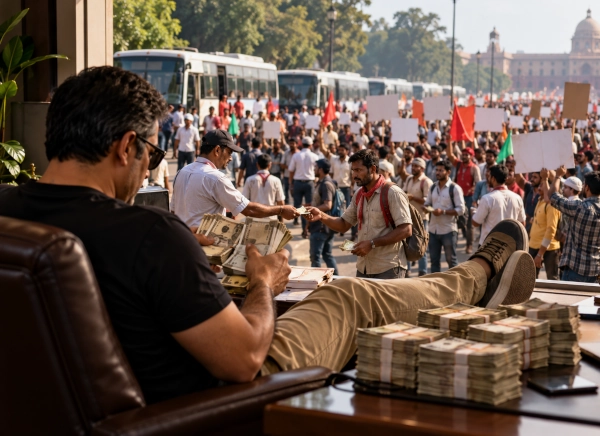
Public protests have played a defining role in the political and social development of democratic nations. From India’s freedom struggle to movements demanding better working conditions, environmental protection, educational reforms and government accountability, collective demonstrations have allowed citizens to express grievances and seek institutional change. Peaceful assembly remains an important democratic right, protected by India’s Constitution and recognised in democratic societies around the world.
However, the growing sophistication of political communication has created opportunities for a different kind of mobilisation. Organisations with financial resources can arrange demonstrations, recruit participants, commission publicity campaigns and coordinate digital messaging to create the appearance of widespread public support. When the financial interests behind these activities are deliberately concealed, public demonstrations can become instruments of manufactured political influence.
This practice is commonly associated with paid protests, manufactured grassroots campaigns and astroturfing. Unlike genuine civic mobilisation, deceptive astroturfing attempts to make an organised campaign appear spontaneous and independent, concealing the individuals, companies, political interests or foreign organisations responsible for its financing and direction.
The business model can extend beyond payments to demonstrators. Transportation companies, recruitment intermediaries, event organisers, communications consultants, advertising agencies and digital campaign operators may all provide services to organisations seeking public visibility. These services are not inherently improper. The concern arises when their involvement is concealed to misrepresent public sentiment or when financing violates applicable laws.
The international record confirms that covertly sponsored political mobilisation is a genuine phenomenon. Investigations by the United States Department of Justice have documented operations involving Russian-linked organisations that recruited participants, financed demonstrations, directed political activity and coordinated publicity while concealing foreign involvement.
India faces its own questions concerning political financing, public demonstrations, economic disruptions and foreign contributions. Yet credible examination requires distinguishing documented wrongdoing from allegations, lawful organisational support from paid impersonation, and genuine dissent from covert political interference.
The issue is therefore not whether protests should exist. It is whether citizens, policymakers and the media can identify who is financing a campaign, who is directing its activities and whether its public presentation reflects genuine participation.
Paid Protests and the Commercialisation of Public Demonstrations
A paid protest can be understood as a demonstration in which individuals receive money or material incentives to participate, particularly when attendance is organised to create an exaggerated or misleading impression of public support.
The distinction between paid participation and legitimate organisational assistance is important. Political organisations, trade unions, farmers’ associations and civil society groups frequently provide transportation, meals, accommodation and logistical facilities to people attending demonstrations. Such assistance may enable individuals with genuine grievances to participate in public activity that would otherwise be financially difficult.
Problems arise when participants are recruited primarily for compensation and presented as independent supporters of a cause without disclosure of the arrangement. In these circumstances, observers may believe they are witnessing spontaneous public mobilisation when the gathering has actually been commissioned and financed by an interested organisation.
Manufactured participation can serve political, commercial or strategic objectives. An organisation may seek to demonstrate apparent support for a policy, generate opposition to an investment project, influence a regulatory decision or create pressure on public institutions. The value of the demonstration lies not necessarily in the number of people persuaded by the underlying cause but in the visibility and influence generated by the gathering.
The term astroturfing is particularly relevant because it describes campaigns that imitate grassroots activity while concealing the interests responsible for organising them. Astroturfing can occur through physical demonstrations, petitions, public relations campaigns, online communities and coordinated social media accounts.
Not every professionally organised protest is an astroturf campaign. The defining issue is deliberate deception concerning sponsorship, independence or the authenticity of the support being presented.
The Financial Structure Behind Manufactured Protest Campaigns
Organising a large demonstration can involve considerable expenditure. Participants may need transportation from several locations, accommodation, meals, communication facilities and arrangements for assembling at a designated venue. Organisers may also commission publicity materials, professional photography, video production and digital advertising.
These expenses create an operational structure resembling other organised public events. The difference lies in the purpose of the expenditure and the manner in which financial relationships are disclosed.
In a legitimate demonstration, a recognised organisation may openly mobilise its members, collect contributions and provide logistical assistance. The funding supports participation by people who share an identifiable interest or grievance.
In a deceptive mobilisation campaign, financial expenditure may be used to create the appearance of support that would not otherwise exist at the same scale. Recruitment may be delegated to intermediaries, while event management and publicity are coordinated by organisations whose role is not disclosed.
Such operations can generate revenue for service providers involved in recruitment, transport, logistics and communications. However, the existence of a paid service provider does not establish that the demonstrators themselves were hired or that the campaign was unlawful.
The financial questions become more serious when payments are hidden, accounts are deliberately misrepresented or the funding originates from prohibited sources. Investigators must therefore establish whether the financial arrangements were lawful, accurately disclosed and consistent with the purpose publicly attributed to the event.
A credible assessment requires documentary evidence rather than assumptions based on crowd size, travel arrangements or the professional appearance of a demonstration.
Why Crowds Have Become Valuable Political Assets
Public demonstrations have a distinctive advantage in political communication: they create visible evidence of collective activity.
A crowd gathered outside a government building, industrial facility or prominent public institution can convey urgency and political significance through a single photograph. Television broadcasts and social media platforms can distribute that image to audiences far beyond the event’s location.
The visual impact becomes particularly influential when the demonstration occurs during a major political decision, legislative debate or public controversy. Images of collective participation may persuade observers that a particular issue has generated substantial public concern.
For genuine movements, this visibility is an important democratic resource. It allows people who might otherwise struggle to attract attention to communicate their grievances through collective action.
For organisations engaged in deceptive mobilisation, the same visual power creates an opportunity to manufacture an impression of public opinion.
The distinction matters because the number of people attending an event does not establish how widely its message is supported. A demonstration may attract thousands of committed participants while still representing a minority view. Conversely, an issue may command widespread public support even when relatively few people attend a particular gathering.
Crowd photographs also cannot reveal whether participants received compensation, who financed transportation or whether the organisers are acting independently.
The political value of a crowd therefore depends partly upon how audiences interpret what they see. When financial sponsorship is concealed, the appearance of grassroots support can become more influential than the underlying evidence of public sentiment.
Media Optics: How Demonstrations Become National Narratives
Media coverage can transform a local demonstration into a national political event. A relatively small gathering may attract extensive attention when it occurs at a symbolically important location or coincides with a contentious policy announcement.
Television reporting often relies on compelling images, direct statements from participants and visible signs of confrontation or disruption. Digital platforms further increase the reach of such material by allowing short videos and photographs to circulate rapidly.
The relationship between protests and media coverage is entirely legitimate when journalists accurately describe the event and its context. Problems arise when publicity campaigns seek to manipulate the appearance of participation or conceal important information about the organisers.
A professionally managed campaign may produce videos, supply images to newsrooms, circulate prepared statements and coordinate social media distribution. These activities can amplify an event and increase the likelihood that it enters wider public discussion.
Selective footage can also distort perceptions. Repeated images of a crowded location may create an impression of continuing mass participation even when the footage covers a limited period. Similarly, online material can circulate without revealing the location, date or circumstances of the original gathering.
These techniques are not unique to protest movements. Political campaigns, commercial organisations and advocacy groups all employ professional communication strategies.
The central issue is transparency. Media audiences should be able to distinguish independently organised public participation from publicity commissioned by an interested sponsor.
Responsible journalism has an important role in establishing that distinction by examining organisers, funding disclosures and the factual context surrounding major demonstrations.
Astroturfing: When Organised Campaigns Pretend to Be Grassroots Movements
Astroturfing is the deliberate creation of a misleading appearance that a campaign originates independently among ordinary citizens.
The practice can involve several forms of political and commercial communication. Organisations may sponsor public advocacy without disclosing their role, create apparently independent interest groups or promote messages through coordinated online identities.
In the context of public demonstrations, astroturfing may involve financial inducements, undisclosed organisational control or exaggerated claims about the independence of participants.
The purpose is to influence how audiences interpret the campaign. A statement issued openly by a corporation, political organisation or foreign government may be received differently from the same message appearing to originate from an independent community movement.
By concealing sponsorship, an astroturf campaign attempts to benefit from the credibility associated with ordinary citizens expressing their views voluntarily.
Such activity can become particularly consequential during debates over public policy, industrial projects or international relations because decision-makers may consider apparent public support when evaluating competing proposals.
Yet identifying astroturfing requires more than observing coordinated slogans or professionally designed materials. Genuine organisations also coordinate their messages, and participants may independently adopt similar expressions of support.
Evidence of concealed sponsorship, deceptive identities or misrepresented organisational relationships is necessary before describing a particular campaign as manufactured.
Foreign Sponsorship and the Political Objectives Behind Covert Mobilisation
Foreign financing raises additional concerns when an overseas organisation or government seeks to influence domestic political activity without revealing its involvement.
International organisations routinely engage in legitimate research, advocacy, development cooperation and public diplomacy. Such activities may involve grants, technical assistance, partnerships and public campaigns conducted within the laws of the countries concerned.
Covert interference is different because the sponsor conceals its role while attempting to direct political activity within another country.
Foreign-backed influence operations may pursue different objectives. Some attempt to promote a particular policy position, while others seek to discredit institutions, shape international perceptions or intensify existing political disagreements.
A sponsoring organisation may find domestic intermediaries particularly useful because local groups possess familiarity with political conditions, public grievances and community networks. Their participation can also make an externally directed campaign appear to originate within the affected society.
Foreign influence campaigns may combine physical demonstrations with digital communication, allowing images of public gatherings to circulate through international media and social platforms.
The existence of foreign funding alone does not establish covert interference. The relevant evidence must show the nature of the financial relationship, the activities financed, the sponsor’s role in directing those activities and any violation of applicable law.
Documented international investigations provide important examples of how these relationships can operate.
Russian Internet Research Agency: A Documented Case of Manufactured Political Activity
A major investigation into covert political influence emerged in the United States following the 2016 presidential election.
On February 16, 2018, the United States Department of Justice announced an indictment against 13 Russian individuals and three Russian companies concerning alleged interference in American political processes.
The indictment described an operation associated with the Internet Research Agency, a Russian organisation accused of conducting coordinated political influence campaigns through fictitious identities, social media groups and public events.
According to federal prosecutors, the organisation employed personnel responsible for creating apparently American online identities and managing social media activity. Its operations included specialised functions involving information technology, communications, graphic design and financial administration.
The indictment alleged that individuals associated with the operation developed online groups addressing sensitive American political and social issues. These groups attracted audiences who generally believed they were interacting with other American users.
The operation also organised political events and used contacts within the United States to assist with demonstrations and associated activities. Participants and local collaborators were not necessarily aware of the foreign origins of the campaign.
One particularly revealing allegation concerned the organisation of opposing demonstrations following the 2016 presidential election. The reported activities illustrated how an influence operation could seek to intensify political divisions rather than consistently support one side of a debate.
The indictment established the formal allegations brought by American prosecutors, but it should not be treated as a conviction of every named defendant. Its importance lies in the detailed account of a structured influence operation involving concealed foreign identities, organised activity and coordinated online amplification.
The case demonstrates that apparently domestic political mobilisation can be targeted by external actors seeking influence through deceptive organisational methods.
The 2024 US Convictions: Foreign Direction of Domestic Demonstrations
A separate American case provides more direct judicial evidence of foreign-directed political activity involving domestic organisations.
On September 12, 2024, the United States Department of Justice announced that a federal jury had convicted four American citizens of conspiracy to act as agents of a foreign government.
The case concerned activities involving Aleksandr Ionov, a Russian national associated with the Anti-Globalization Movement of Russia, and American political organisations that participated in activities directed by individuals linked to Russia.
According to evidence presented at trial, Ionov maintained relationships with domestic organisations and directed certain political activities in the United States. The prosecution established that foreign direction extended beyond online messaging into public demonstrations.
The Justice Department reported that Ionov directed demonstrations at the headquarters of a social media company in California. He also financed travel expenses for members of a participating American organisation to attend one of the events.
The evidence demonstrated a relationship in which a foreign-linked organiser provided direction and financial assistance for political activity conducted by domestic participants.
The case also illustrated the value of demonstrations to covert influence campaigns. Public events create photographs, video footage and opportunities for publicity that can circulate through media outlets after the gathering has ended.
The jury convictions concerned the specific individuals and conduct established during the proceedings. They do not demonstrate that all protest movements with international connections operate under foreign direction.
Nevertheless, the case confirms that financial support, organisational relationships and public demonstrations can form part of a covert foreign influence operation.
Why Some Influence Operations Promote Opposing Political Positions
One of the most significant features of certain covert influence campaigns is their willingness to promote competing political narratives.
A foreign sponsor seeking to influence public debate may not necessarily pursue one consistent ideological position. Its objective may instead be to intensify disagreements, weaken confidence in institutions or increase the visibility of contentious political issues.
The 2018 American indictment described activities that included organising or encouraging demonstrations associated with opposing political positions.
This approach demonstrates that a covert influence operation can seek to benefit from conflict itself rather than from the success of a single political movement.
In a highly polarised environment, competing demonstrations can generate repeated media coverage, provoke confrontations and encourage escalating exchanges between political groups.
Digital amplification can extend this effect by circulating emotionally charged material among audiences already divided over the underlying issue.
However, ordinary political disagreement must not be confused with deliberate manipulation. Democratic societies naturally contain competing interests, and groups may organise protests independently because they genuinely hold opposing views.
The presence of simultaneous demonstrations, contradictory political messaging or intense public debate does not establish foreign interference.
The distinction depends upon evidence connecting activities to concealed sponsorship, coordination or direction.
India’s Protest Economy: Legitimate Mobilisation and Questions of Funding
India has one of the world’s largest and most diverse traditions of public mobilisation. Political parties, farmers’ organisations, labour unions, student associations, environmental groups and community organisations regularly conduct demonstrations concerning public policy and social issues.
The scale of India’s population and geographical diversity means that major demonstrations can require extensive logistical planning. Participants may travel from distant districts or states, sometimes remaining at protest locations for several days. Food preparation, temporary accommodation, medical assistance and transportation can therefore become important components of a movement’s organisation.
These arrangements may involve substantial expenditure without indicating that participants have been hired or that their grievances are insincere. A farmers’ association providing transport to its members, for example, is not necessarily manufacturing support. The participants may be directly affected by the policy being challenged.
Nevertheless, major mobilisation campaigns raise legitimate questions concerning financial transparency. Organisers may collect donations, receive contributions from affiliated organisations or commission commercial services. Understanding these relationships can help the public assess the independence and accountability of a movement.
Financial scrutiny should examine the source and use of money rather than presume wrongdoing from the presence of organised facilities. The distinction is particularly important in India, where allegations of paid participation or foreign sponsorship frequently arise during contentious political debates.
A credible investigation must establish the actual financial transactions and organisational relationships involved. Without such evidence, describing an entire protest as paid or foreign-directed risks misrepresenting the actions of people exercising legitimate constitutional rights.
How India’s Foreign Contribution Regulation Framework Addresses Political Funding
India regulates foreign financial contributions through the Foreign Contribution (Regulation) Act, 2010, commonly known as the FCRA, together with subsequent amendments and applicable rules.
The legislation establishes a regulatory framework governing who may receive foreign contributions, the purposes for which such funds may be used and the reporting requirements applicable to authorised recipients.
Section 3 restricts the acceptance of foreign contributions by specified categories of persons and organisations. These include political parties, candidates for election and certain other recipients identified in the legislation.
The Act also addresses organisations classified as being of a political nature, with Section 5 providing a statutory mechanism for determining that status.
These provisions reflect India’s approach to regulating specified forms of foreign financial influence over domestic political activity.
However, the legislation does not prohibit every international financial relationship. Registered organisations may receive foreign contributions for permitted activities, subject to compliance with statutory requirements.
The legal treatment of a transaction depends upon the identity of the recipient, the definition of foreign contribution, the purpose of the funding and the applicable restrictions.
For journalists investigating alleged foreign-sponsored protests, FCRA records can provide a starting point for examining disclosed financial relationships. They cannot, by themselves, establish that a particular demonstration was unlawfully funded.
Foreign Grants, Advocacy and Political Interference Are Different Activities
Public debate sometimes treats foreign financial assistance, international advocacy and covert political interference as interchangeable concepts. In law and practice, they are distinct.
International cooperation may involve educational programmes, public health projects, environmental research and other activities undertaken by authorised organisations. Some initiatives also involve public advocacy concerning issues within their stated objectives.
The receipt of a lawful foreign grant does not establish that a recipient is operating under foreign political direction.
Covert interference requires a more specific factual relationship. An external sponsor may conceal its role while directing activities intended to influence domestic political processes, or funds may be transferred in violation of applicable restrictions.
An organisation may also receive foreign funding for one lawful purpose while independently participating in unrelated civic activities. Establishing that a particular demonstration was foreign-financed requires evidence connecting the relevant funds to that event.
This distinction is especially important when examining advocacy concerning major infrastructure, energy, industrial or environmental projects. International attention to an issue does not establish that local opposition is externally manufactured.
Genuine community concerns may exist alongside foreign commentary, organisational assistance or wider political debate.
The responsibility of investigators is to identify the actual relationships and transactions involved rather than infer foreign control from the international visibility of a movement.
Economic Disruption: When Demonstrations Affect Commerce and Industry
Protests can affect economic activity when they interrupt transportation networks, restrict access to commercial establishments or interfere with the movement of goods and workers.
The extent of disruption depends upon the location, duration and methods used during the demonstration. A short gathering in a designated public area may produce limited economic effects, while prolonged obstruction of an important transport corridor can interfere with commercial operations across a much wider region.
Businesses located near affected roads may experience reduced customer access and delays in deliveries. Employees may face longer journeys, while transportation operators may incur additional fuel and operating expenses.
Industrial production can also be affected when workers, raw materials or finished products cannot move reliably between facilities. Manufacturing depends upon coordinated supply chains, and interruptions at one stage can affect subsequent production and distribution.
For export-oriented businesses, transportation delays can interfere with shipping schedules, increase logistical expenses and complicate contractual commitments.
However, such consequences do not establish that the underlying protest was manufactured or unlawfully financed. Genuine demonstrations can cause economic disruption, while deceptive influence campaigns may occur without significant physical obstruction.
Economic impact and funding legitimacy must therefore be assessed separately.
Could Deliberate Economic Disruption Become an Objective of Covert Influence?
Economic activity depends partly upon predictable transportation, functioning infrastructure and confidence in the continuity of commercial operations.
An organisation seeking to create disruption could regard prolonged demonstrations, uncertainty surrounding industrial projects or interruptions to key infrastructure as potentially useful to its objectives.
In theory, covertly sponsored mobilisation could therefore be directed towards creating political pressure or operational uncertainty in economically important locations.
However, such a conclusion cannot be drawn merely because a protest affects an industrial facility, transport route or investment project. The existence of disruption does not establish that economic damage was intended, financed or coordinated by an external organisation.
Community opposition to an industrial project may arise from genuine concerns involving land acquisition, environmental protection, public health or employment. Those concerns require examination on their merits.
To establish deliberate economic destabilisation, investigators would need evidence of the sponsor’s objectives, the organiser’s instructions and the relationship between financing and the disruptive activity.
Without that evidence, economic consequences remain consequences rather than proof of a covert strategy.
The distinction protects public debate from unsupported allegations while allowing genuine threats to economic security to be investigated.
Digital Amplification: Turning a Local Protest into a National Story
Social media has significantly changed how demonstrations reach public audiences.
A gathering that once depended primarily upon local newspapers or television coverage can now become visible nationally through livestreams, short videos and rapidly shared photographs.
This has created important opportunities for genuine civic movements. Participants can document events, communicate directly with supporters and bring attention to issues that may otherwise receive limited coverage.
The same technological capabilities can also be exploited by deceptive influence operations.
Coordinated networks of accounts may repeatedly distribute selected material, promote identical messages or create misleading impressions concerning the number of independent people discussing an issue.
The 2018 Internet Research Agency indictment described the use of fictitious online identities and thematic social media groups to reach American audiences. The alleged operation combined digital messaging with efforts to organise offline political activities.
This relationship between online influence and physical mobilisation is significant because each can reinforce the visibility of the other.
A demonstration produces images that can circulate online, while online mobilisation can direct additional attention towards the physical event.
Nevertheless, high engagement or repeated messaging is not conclusive evidence of coordinated deception. Genuine supporters frequently share similar material because they identify with the same cause.
Determining whether a campaign is manipulative requires evidence of deceptive coordination, concealed sponsorship or fabricated identities.
India’s Constitutional Right to Protest and the Limits of Public Disruption
The Constitution of India protects freedom of speech and expression under Article 19(1)(a) and the right to assemble peaceably and without arms under Article 19(1)(b).
These rights form an important part of democratic participation, allowing citizens to express disagreement with government decisions and advocate changes to public policy.
The rights are subject to constitutionally permitted restrictions, including those relating to public order and other specified considerations.
The Supreme Court examined the relationship between protest rights and the use of public spaces in its October 7, 2020, judgment in Amit Sahni v. Commissioner of Police and Others.
The case arose from the prolonged occupation of a public road during the Shaheen Bagh protests in New Delhi.
The Court recognised the importance of peaceful dissent while holding that public ways cannot be occupied indefinitely in a manner that prevents their ordinary use.
The judgment illustrates an important distinction between the legitimacy of expressing a grievance and the lawfulness of particular methods used during a demonstration.
A movement may raise genuine concerns while engaging in activities that create unacceptable interference with public movement. Conversely, an inconvenient demonstration is not automatically unlawful or secretly financed.
The proper assessment requires examining constitutional protections, applicable restrictions and the specific circumstances of the event.
Paid Protests Can Generate Publicity but Cannot Guarantee Electoral Support
Paid demonstrations may create the appearance of widespread political support, but manufactured crowds do not necessarily translate into electoral votes. Individuals attending protests primarily for financial compensation may have little commitment to the cause being promoted. Their participation can end with the event, without influencing their political preferences or voting decisions.
Such campaigns can generate substantial media coverage, social media attention and temporary political visibility. However, media optics should not be mistaken for genuine public sentiment. Voters make electoral decisions based on various factors, and a highly publicised demonstration does not automatically reflect the preferences of the wider electorate.
This creates a potential financial contradiction for political organisers and foreign sponsors. Recruitment agents, event managers, publicity consultants and other intermediaries may profit from organising demonstrations even when the campaigns produce little measurable electoral benefit. Money spent manufacturing political visibility can therefore generate commercial returns for organisers without delivering the desired political outcomes.
Ultimately, paid protests may purchase crowds and publicity, but they cannot guarantee political loyalty or votes. The business of organising demonstrations can remain financially attractive to intermediaries even when its effectiveness in influencing elections remains unproven.
Lessons for India from Documented International Influence Operations
The international cases examined in this article demonstrate that political demonstrations can become instruments of concealed foreign influence.
The 2018 Internet Research Agency indictment described a structured operation involving fictitious identities, coordinated communications and attempts to organise political activities within another country.
The September 2024 American jury convictions established that individuals had conspired to act as agents of a foreign government through relationships involving domestic political organisations and foreign direction.
These cases illustrate the importance of examining financial relationships alongside public communications.
They also demonstrate that covert influence does not necessarily depend upon organising enormous demonstrations. A relatively limited public event can become significant when supported by coordinated media attention and digital distribution.
For India, these findings provide a basis for understanding the risks associated with concealed sponsorship without assuming that particular domestic protests are foreign-directed.
The most effective institutional response involves reliable financial oversight, lawful investigations, independent journalism and accurate public information.
Protecting economic activity and public order is also important, particularly when demonstrations involve prolonged obstruction of critical infrastructure.
However, responses must preserve the distinction between unlawful conduct and the constitutional right to peaceful dissent.
The lessons from international investigations concern the methods used by confirmed or alleged influence operations, not the automatic classification of unrelated civic movements.
The Business of Paid Protests and the Future of Public Accountability
The commercial and political dimensions of organised demonstrations deserve greater attention as public mobilisation becomes increasingly connected with professional communications, digital platforms and international information networks.
Money can finance transportation, event management, publicity and participation. These activities may support legitimate democratic expression, but they can also be exploited to manufacture an exaggerated appearance of public support.
Documented international investigations confirm that foreign-linked actors have used domestic organisations, financial assistance and public demonstrations to pursue concealed political objectives.
These cases demonstrate why identifying the source of funds and the identity of the ultimate sponsor can be important to understanding major advocacy campaigns.
For India, the Foreign Contribution (Regulation) Act provides a framework for regulating specified foreign financial relationships, while constitutional protections safeguard peaceful political participation.
The challenge is to ensure that legitimate public mobilisation remains protected while deceptive sponsorship, unlawful financing and covert foreign direction can be identified through credible evidence.
Economic disruption, media amplification and political controversy require careful examination, but none of these factors independently establishes that a protest was manufactured.
The distinction between authentic civic engagement and concealed influence is therefore central to responsible governance, journalism and public understanding.
A strong democratic society must protect the freedom to protest while ensuring that money cannot be used covertly to misrepresent public opinion.
Greater financial transparency, independent scrutiny and consistent application of the law can strengthen public trust in genuine movements while reducing opportunities for organised deception.
India’s democratic institutions, economic interests and citizens all benefit when public debates are shaped by authentic participation, transparent sponsorship and verifiable information.
References
1. United States Department of Justice
Date: February 16, 2018
Title: Grand Jury Indicts Thirteen Russian Individuals and Three Russian Companies for Scheme to Interfere in the United States Political System
Official announcement concerning alleged Russian influence operations, fictitious online identities, organised political activities and concealed foreign sponsorship.
https://www.justice.gov/archives/opa/pr/grand-jury-indicts-thirteen-russian-individuals-and-three-russian-companies-scheme-interfere
2. United States Department of Justice — Special Counsel’s Office
Date: February 16, 2018
Document: United States v. Internet Research Agency LLC, et al. — Indictment
Primary court filing describing alleged coordinated political influence activities, online impersonation, advertisements and public demonstrations.
https://www.justice.gov/archives/sco/file/1035477/dl
3. United States Department of Justice
Date: September 12, 2024
Title: U.S. Citizens Convicted of Conspiring to Act as Illegal Agents of the Russian Government
Official announcement of jury convictions involving foreign-directed political activity and financial support for demonstrations.
https://www.justice.gov/archives/opa/pr/us-citizens-convicted-conspiring-act-illegal-agents-russian-government
4. United States Department of Justice
Date: July 29, 2022
Title: Russian National Charged with Conspiring to Have U.S. Citizens Act as Illegal Agents of the Russian Government
Official account of allegations involving Aleksandr Ionov, financial support, political organisations and coordinated demonstrations.
https://www.justice.gov/archives/opa/pr/russian-national-charged-conspiring-have-us-citizens-act-illegal-agents-russian-government
5. United States Department of Justice
Date: April 18, 2023
Title: U.S. Citizens and Russian Intelligence Officers Charged with Conspiring to Use U.S. Citizens as Illegal Agents of the Russian Government
Details of the federal prosecution concerning alleged covert foreign influence over domestic political organisations.
https://www.justice.gov/usao-mdfl/pr/us-citizens-and-russian-intelligence-officers-charged-conspiring-use-us-citizens
6. Ministry of Home Affairs, Government of India
Legislation: Foreign Contribution (Regulation) Act, 2010
Official framework governing foreign contributions, restrictions on specified recipients and regulatory compliance.
https://www.indiacode.nic.in
7. Ministry of Home Affairs — Foreign Contribution Regulation Division
Document: Frequently Asked Questions on the Foreign Contribution (Regulation) Act, 2010
Government guidance explaining the definition of foreign contributions and the regulatory obligations applicable to recipients.
https://www.mha.gov.in/sites/default/files/ForeigD-ForeigD-FCRA_FAQs_1.pdf
8. Supreme Court of India
Date: October 7, 2020
Case: Amit Sahni v. Commissioner of Police and Others
Supreme Court judgment examining peaceful protest, public roads and the relationship between constitutional rights and public movement.
https://api.sci.gov.in/supremecourt/2020/2418/2418_2020_36_1501_24294_Judgement_07-Oct-2020.pdf
9. Election Commission of India
Official information concerning political funding, expenditure reporting and electoral transparency.
https://www.eci.gov.in
10. Ministry of Home Affairs — FCRA Online Services
Official portal providing information concerning foreign contribution registration, compliance and regulatory administration.
https://fcraonline.nic.in
You may also like
-
Maharashtra’s Inter-Caste Marriage Incentive Scheme Helps Young Couple Build a Future Based on Equality
-
IMD Launches Advanced Cyclone Warning and Marine Weather Decision Support System
-
PM Dhan-Dhaanya Krishi Yojana Completes One Year: Gaya, Nagaur and Umaria Emerge as Best-Performing Districts
-
India Post and Blue Dart Join Forces to Expand Parcel Delivery Across Urban and Rural India
-
Starlink-Ukraine, Myanmar and Drug Smuggling: Why India Must Regulate Satellite Internet for National Security
