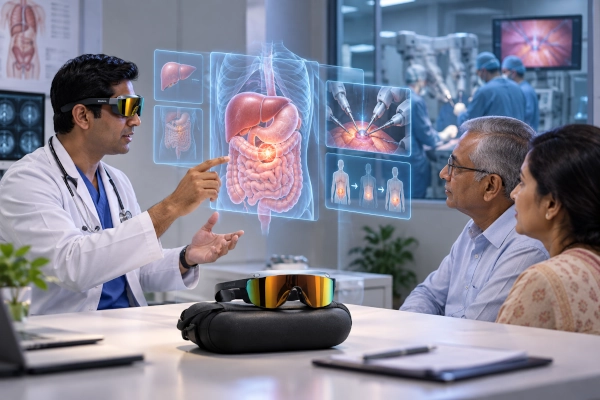
Bengaluru-based startup Luxid Tech has launched its VueAR Glass for the Indian hospital technology market, introducing a lightweight augmented-reality platform designed to help doctors explain complex medical procedures to patients while also supporting information-intensive nursing and clinical workflows.
The healthcare-focused launch was announced on August 22, 2026, as Luxid moves its augmented-reality technology beyond conventional entertainment and productivity applications into hospitals. The company is targeting areas where three-dimensional visualisation and hands-free access to digital information could improve communication between healthcare professionals and patients.
One of the first applications being developed around VueAR Glass is pre-surgery counselling. Doctors and hospital teams frequently need to explain complicated procedures, anatomy, treatment stages and expected recovery to patients and their families. These conversations can become particularly difficult when patients are unfamiliar with medical terminology or when advanced procedures such as robotic surgery are involved.
Luxid’s approach allows hospitals to create customised three-dimensional visual modules for individual procedures. Patients wearing the glasses can view anatomical structures and different stages of a planned treatment from multiple perspectives, giving them a more visual understanding of what will happen during surgery.
Such visualisation could complement conventional counselling methods based on diagrams, printed material, computer screens or verbal explanations. Instead of asking patients to interpret two-dimensional medical imagery, augmented reality can present anatomy and procedural information in a more immersive form.
The technology is therefore aimed less at replacing doctors and more at giving clinicians an additional communication tool. Clearer visual explanations could help patients and families better understand a procedure before consent and potentially make discussions around complex interventions more intuitive.
Luxid is also positioning VueAR Glass for nursing and hospital workflow applications, particularly in intensive-care environments where staff continuously monitor multiple streams of patient information.
Hospitals and technology partners can use the company’s VueAR Software Development Kit, or SDK, to build customised information displays suited to particular departments, procedures or operational requirements. These could potentially allow relevant information to be displayed within a clinician’s field of view while they continue interacting with the patient or working within the clinical environment.
The platform’s software architecture gives hospitals the ability to develop specialised applications rather than relying on a single fixed healthcare interface. This could allow different organisations to create modules for counselling, training, monitoring, clinical information display or other workflows depending on how their digital systems are configured.
The VueAR Glass weighs approximately 78 grams, considerably lighter than many conventional virtual-reality headsets. Reducing weight is particularly important in healthcare environments, where devices may need to be worn repeatedly or for extended periods by patients and medical professionals.
The glasses use micro-OLED displays and provide a binocular field of view of around 53 degrees. Luxid lists a resolution of 1920×1080 for each display, support for stereoscopic 3D and 360-degree content, and peak brightness of up to 1,600 nits. The company also provides motion sensing through an accelerometer, gyroscope and compass.
Instead of functioning as a completely standalone computer, VueAR Glass can connect to external devices such as smartphones and computers. The system supports DisplayPort connectivity over USB Type-C and is designed to work with multiple operating systems and computing environments.
Luxid’s broader software ecosystem includes applications for Android, iOS, macOS and other platforms, allowing connected devices to handle the underlying computing while the glasses function as the user’s visual interface. The company says processing can remain on the connected device rather than sending information to external cloud services, an approach that could be particularly relevant when handling sensitive information.
That local-processing architecture could have particular relevance for healthcare because hospitals deal with confidential patient records and other sensitive data. Keeping processing within hospital-controlled devices or infrastructure can make it easier to design systems around institutional privacy and security policies.
Another important aspect of the technology is its ability to display large private virtual screens. Luxid markets VueAR as capable of creating a virtual display equivalent to roughly 180 inches, allowing substantial amounts of visual information to be presented without installing a physical screen of equivalent size.
Within a hospital setting, the more important feature is the ability to create customised three-dimensional content. Medical anatomy, implants, surgical pathways or treatment sequences can potentially be displayed in a spatial format that is easier for non-specialists to interpret.
For medical professionals, AR could eventually support a broader range of workflows as hospital information systems become increasingly digital. Nurses and doctors already work with bedside monitors, electronic medical records, imaging systems and mobile devices. Augmented-reality interfaces offer another way of presenting information while allowing users to remain visually engaged with their surroundings.
The distinction between augmented reality and conventional virtual reality is important in this context. Virtual-reality headsets typically immerse the user in a largely enclosed digital environment, while AR systems are designed to overlay or present digital content while preserving awareness of the physical environment.
This makes lightweight AR devices potentially better suited to hospitals, factories and other professional environments where users need to continue seeing and interacting with the world around them.
Luxid’s entry into healthcare also demonstrates how India’s wearable-technology ecosystem is beginning to move beyond consumer-focused smart glasses.
Globally, augmented reality has been explored for surgical training, medical education, remote assistance and procedure planning. Indian startups are now beginning to adapt similar technologies to local healthcare workflows, where affordability, portability and compatibility with existing hospital systems will be important for adoption.
The VueAR platform’s SDK could be particularly significant because individual hospitals may have very different requirements. A tertiary-care centre performing complex surgery may prioritise three-dimensional patient counselling, while an ICU may place greater emphasis on clinical information display and workflow support.
Allowing software developers and hospital technology teams to build customised modules could therefore make the same hardware useful across multiple departments.
The technology may also have applications in medical education and professional training. Three-dimensional models can help students understand anatomy and procedures without depending entirely on static textbooks or conventional two-dimensional displays. Hospitals could similarly use immersive visualisation for staff training and simulation.
Luxid already markets VueAR Glass more broadly as a portable augmented-reality display for productivity, media and professional use. The healthcare initiative represents an effort to transform that underlying hardware into a specialised platform through hospital-specific software and content.
The company’s Bengaluru base also places it within one of India’s largest technology and health-innovation ecosystems, where software firms, hospitals, medical-device companies and startups are increasingly collaborating on digital healthcare products.
As hospitals adopt artificial intelligence, connected devices, electronic health records and digital imaging at greater scale, the challenge is increasingly shifting from simply collecting information to presenting it efficiently to doctors, nurses and patients.
Augmented reality could provide one approach by placing selected information directly within the user’s visual environment rather than requiring constant movement between separate monitors and devices.
For patients, the immediate opportunity may be simpler but equally practical: helping them understand what doctors are trying to explain.
A three-dimensional representation of anatomy or a planned surgical procedure can potentially make an unfamiliar medical process easier to visualise, particularly when compared with technical scans or verbal descriptions alone.
For healthcare workers, future applications could involve more contextual access to information while keeping their hands free for clinical tasks.
Luxid’s healthcare launch therefore represents more than the introduction of another wearable display. It reflects an effort by an Indian startup to adapt augmented reality into a practical clinical communication and hospital workflow tool.
By combining lightweight AR hardware, three-dimensional medical visualisation and an open development platform for customised hospital applications, Luxid Tech is attempting to build a new interface between digital healthcare systems and the doctors, nurses and patients who use them.
You may also like
-
SCI and India’s Push for a Larger Indigenous Maritime Fleet
-
Takshak Heavyweight Torpedo: How India’s Indigenous Submarine Weapon Compares With the World’s Leading Torpedoes
-
Embraer Builds Dual Aerospace Strategy in India Through C-390 Military and E175 Regional Aircraft Programmes
-
NextLeap Tests Indigenous Jet Engine for Long-Range Stryker Kamikaze UAV
-
Côte d’Ivoire Military Delegation Visits HAL, Shows Interest in India’s Indigenous Aerospace Platforms
