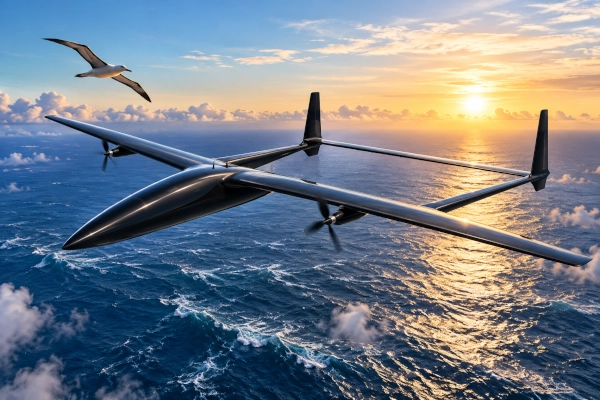
Bengaluru-based aerospace startup Alteon is developing an autonomous aircraft that could eventually remain airborne for months by harvesting energy from winds above the ocean, drawing inspiration from the remarkable flight technique used by albatrosses to cover vast distances with minimal effort.
The company recently achieved an important milestone during testing over the Bay of Bengal, where its experimental fixed-wing aircraft autonomously completed repeated high-speed manoeuvres less than one metre above the ocean surface. The demonstration represents a major step toward Alteon’s broader objective of achieving sustained flight through a technique known as dynamic soaring.
Dynamic soaring allows an aircraft to extract energy from differences in wind speed at different heights. Winds immediately above the sea generally move more slowly because of friction with the ocean surface, while air higher above the water can travel significantly faster. By repeatedly climbing into faster-moving air, turning, descending into slower air and repeating the cycle, an aircraft can gain kinetic energy from the atmosphere and reduce its dependence on conventional propulsion.
Albatrosses have evolved to exploit this phenomenon with extraordinary efficiency. These ocean-going birds can travel hundreds of kilometres while barely flapping their wings, repeatedly using wind gradients above the sea to maintain speed. Alteon is seeking to reproduce the same principle using an autonomous aircraft controlled by advanced sensing, navigation and flight-control systems.
The startup’s current experimental aircraft has a wingspan of approximately three metres. During the recent offshore demonstration, it autonomously completed seven O-shaped flight cycles, travelling at speeds exceeding roughly 100 kilometres per hour while passing within one metre of the water.
Such low-altitude autonomous flight represents a demanding engineering challenge. The aircraft must continuously calculate its position relative to a moving ocean surface while responding to waves, turbulence, changing winds and other environmental conditions. Performing repeated high-speed manoeuvres close to the water provides an important validation of Alteon’s control and navigation architecture.
The company is now working toward energy-neutral dynamic soaring, where the aircraft would use the energy available in the wind field to compensate for aerodynamic losses during flight. Achieving this would establish the key aerodynamic foundation needed for dramatically extending the endurance of future aircraft.
Alteon’s longer-term concept goes further by combining dynamic soaring with onboard energy generation. The company plans to explore propellers capable of functioning as airborne turbines during appropriate phases of flight, allowing energy extracted from the wind to be converted into electricity.
That electricity could recharge onboard batteries used to power avionics, sensors, communications equipment and other systems. The aircraft would therefore combine aerodynamic energy harvesting with electrical energy generation, creating the possibility of maintaining useful onboard systems during extremely long missions.
If successfully developed at scale, such an architecture could allow unmanned aircraft to remain over the ocean for periods measured in weeks or months rather than hours.
Alteon ultimately envisions autonomous aircraft capable of remaining airborne for exceptionally long periods without conventional refuelling. The company’s ambition is to create platforms whose endurance is determined largely by environmental conditions and maintenance requirements rather than simply by the quantity of fuel or battery capacity carried at take-off.
One of the most promising applications is persistent maritime surveillance.
Governments currently rely on satellites, maritime patrol aircraft, ships, coastal radar networks and unmanned aircraft to monitor large ocean areas. Each platform performs a different role, but maintaining continuous surveillance over vast maritime zones remains expensive and technically challenging.
A highly persistent autonomous aircraft could complement these systems by remaining over designated maritime areas for extended periods while carrying electro-optical, infrared, communications or other surveillance payloads.
Potential missions could include monitoring shipping routes, identifying suspicious vessels, tracking illegal fishing, supporting anti-smuggling operations and improving broader maritime domain awareness.
For a country such as India, with an extensive coastline, major commercial sea lanes and a large Exclusive Economic Zone, persistent low-cost aerial surveillance could have considerable strategic and economic value.
The technology could also support several civilian applications. Long-endurance aircraft operating above oceans could collect meteorological information, monitor marine ecosystems, detect pollution, study weather systems and provide communications coverage to remote maritime regions.
The central attraction of dynamic soaring is its potential to address one of aviation’s fundamental limitations: aircraft normally have to carry most of the energy required for their mission.
Conventional aircraft rely on fuel, while electric aircraft depend on batteries whose energy density remains significantly lower than aviation fuels. Solar-powered aircraft can achieve very long endurance but require large photovoltaic surfaces and depend on available sunlight.
Dynamic soaring introduces a different approach by using the atmosphere itself as an energy source.
The underlying aerodynamic principle is well understood, but modern autonomous systems are creating new possibilities for applying it more precisely. Advances in sensors, onboard computing, flight-control software and artificial intelligence now allow unmanned aircraft to react rapidly to changing wind conditions and continuously optimise their trajectories.
This intersection of aerodynamics, robotics and autonomous control is central to Alteon’s approach.
The Bengaluru startup has adopted an intensive flight-testing strategy to accelerate development. Alteon has a team of around 20 people operating from a 10,000-square-foot facility, and founder Samay Sanghvi has said the company conducted more than 200 test flights within a 30-day period while producing four to five experimental aircraft every week for testing.
Such rapid hardware iteration allows engineers to test new aerodynamic configurations, control algorithms and structural changes in actual flight rather than relying entirely on computer simulations.
Sanghvi began experimenting with aircraft after completing school in 2023 and formally established Alteon in 2025. His early work involved designing, building and repeatedly flying radio-controlled aircraft before progressing toward the autonomous prototypes now forming the basis of the company’s dynamic-soaring programme.
Alteon has also attracted early investor support for the technology. The startup raised $2.5 million in pre-seed funding, led by investor Lachy Groom with participation from Together Fund. The funding is being used to expand engineering, flight testing and development of the autonomous energy-harvesting aircraft.
The programme represents an unusual direction within India’s expanding unmanned-aerial-systems ecosystem. Much of the domestic drone industry is focused on improving conventional aircraft through better batteries, engines, sensors or payloads. Alteon is instead exploring whether aircraft endurance itself can be fundamentally re-engineered by extracting useful energy from natural wind gradients.
Its Bay of Bengal demonstration provides an important foundation for that effort. Repeated autonomous flight at more than 100 km/h within one metre of the ocean shows that the startup has developed the precision control necessary to operate in the demanding environment where dynamic soaring must eventually take place.
The next stages of development could progressively combine this low-altitude autonomy with increasingly efficient energy extraction from ocean winds, onboard power generation and longer-duration flight.
If these technologies mature together, they could lead to a new category of autonomous aircraft capable of maintaining persistent presence over large maritime areas while consuming far less stored energy than conventional unmanned systems.
Alteon’s work also reflects a broader change taking place across India’s deep-tech ecosystem. Startups are increasingly moving beyond conventional software and incremental product development into fundamental engineering challenges involving aerospace, robotics, propulsion, semiconductors and advanced materials.
The company’s effort to reproduce one of nature’s most efficient flight strategies using autonomous aircraft illustrates this shift particularly well.
From a three-metre experimental aircraft skimming the Bay of Bengal to the longer-term vision of aircraft remaining above the ocean for months, Alteon is attempting to transform naturally occurring wind energy into a practical new source of endurance for autonomous aviation.
You may also like
-
EON Space Labs and Dhruva Space Advance Indian Space Hardware on Transporter-18 Mission
-
SatLeo Labs’ TAPAS-1 Reaches Orbit, Advancing India’s Private Thermal-Imaging Capability
-
TakeMe2Space’s MOI-1A Reaches Space on Falcon 9 Transporter-18 Mission
-
Bank of Baroda Enters Pension Fund Management After PFRDA Appointment
-
SCI and India’s Push for a Larger Indigenous Maritime Fleet
